Best Export Tracking Software Compared: Traceability Requirements for 2026
FSMA 204, EU Digital Product Passport, and peak season rates are making shipment visibility non-negotiable for food exporters in 2026. Here is how the top 6 tracking platforms compare on compliance, cost, and real-time visibility.
· · 6 min read
In short
What is the best export tracking software for food exporters in 2026?
The best export tracking software depends on your compliance requirements and shipment volume. For FSMA 204 compliance, Cloudleaf and FoodLogiQ lead. For EU Digital Product Passport readiness, IBM Food Trust and SAP Digital Vehicle Passport are strongest. Project44 offers the widest carrier coverage for real-time tracking, while Infor Nexus excels in cold chain monitoring. Most platforms start at $500-$2,000/month depending on shipment volume.
If you shipped a container of frozen mangoes from Nigeria to Rotterdam in June 2026 and you cannot tell your buyer the temperature it held at each point — or show the FDA a complete traceability record within 24 hours — you have a problem.
Two things changed in July 2026 that make export tracking software a hard requirement, not a nice-to-have:
- FSMA 204 is live. The US FDA can request full traceability records including Key Data Elements (KDEs) at every supply chain node — grower, packer, shipper, receiver — within 24 hours. Non-compliance means shipments held at the border.
- The PPWR countdown is on. With 37 days to the August 12 deadline, EU importers are demanding packaging material disclosures that require documented traceability from source to shelf.
And the peak season is here: the Containerized Freight Index hit 3,327 points on July 3 (+2.69%), with CMA CGM and MSC FAK surcharges on 40ft containers pushing Asia–Europe rates above $4,000/FEU and Asia–US West Coast premium rates reaching $5,800/FEU. When every shipment costs this much, real-time visibility is not tracking — it's risk management.
This guide compares 6 export tracking platforms across the features that matter for food exporters shipping internationally.
Why Export Tracking Software Matters More in July 2026
Before the comparison, let's be clear on three regulatory deadlines converging this quarter:
1. FSMA 204 Traceability Rule (US — Active)
The FDA Food Traceability Final Rule (Section 204 of FSMA) requires food importers to maintain electronic records of products on the Food Traceability List (FTL) — including cheeses, shell eggs, nut butters, fresh-cut produce, ready-to-eat deli salads, and smoked finfish. Your tracking software must capture KDEs at six critical tracking events (CTEs): receiving, transforming, shipping, growing, cooling, and then re-shipping.
The 24-hour rule: If FDA requests records during an investigation, you have 24 hours to produce a complete trace-back or trace-forward report. Without automated tracking software, that is three days of manual spreadsheet work.
2. EU Digital Product Passport (EU — Rolling Out 2026-2027)
The Ecodesign for Sustainable Products Regulation (ESPR) introduces Digital Product Passports requiring: packaging material composition, recyclability certification, supply chain geolocation, and carbon footprint data. Food packaging is expected among the first categories. Your tracking platform needs to store and share these data points with EU importers on request.
3. Peak Season Visibility Pressure
When Asia–Europe FAK rates exceed $4,000/FEU and Asia–US premium hits $5,800/FEU, every container is a significant financial commitment. GPS tracking with ETAs and delay alerts is the difference between having time to inform your buyer and missing a reshipment window that costs you the customer.
6 Export Tracking Platforms Compared
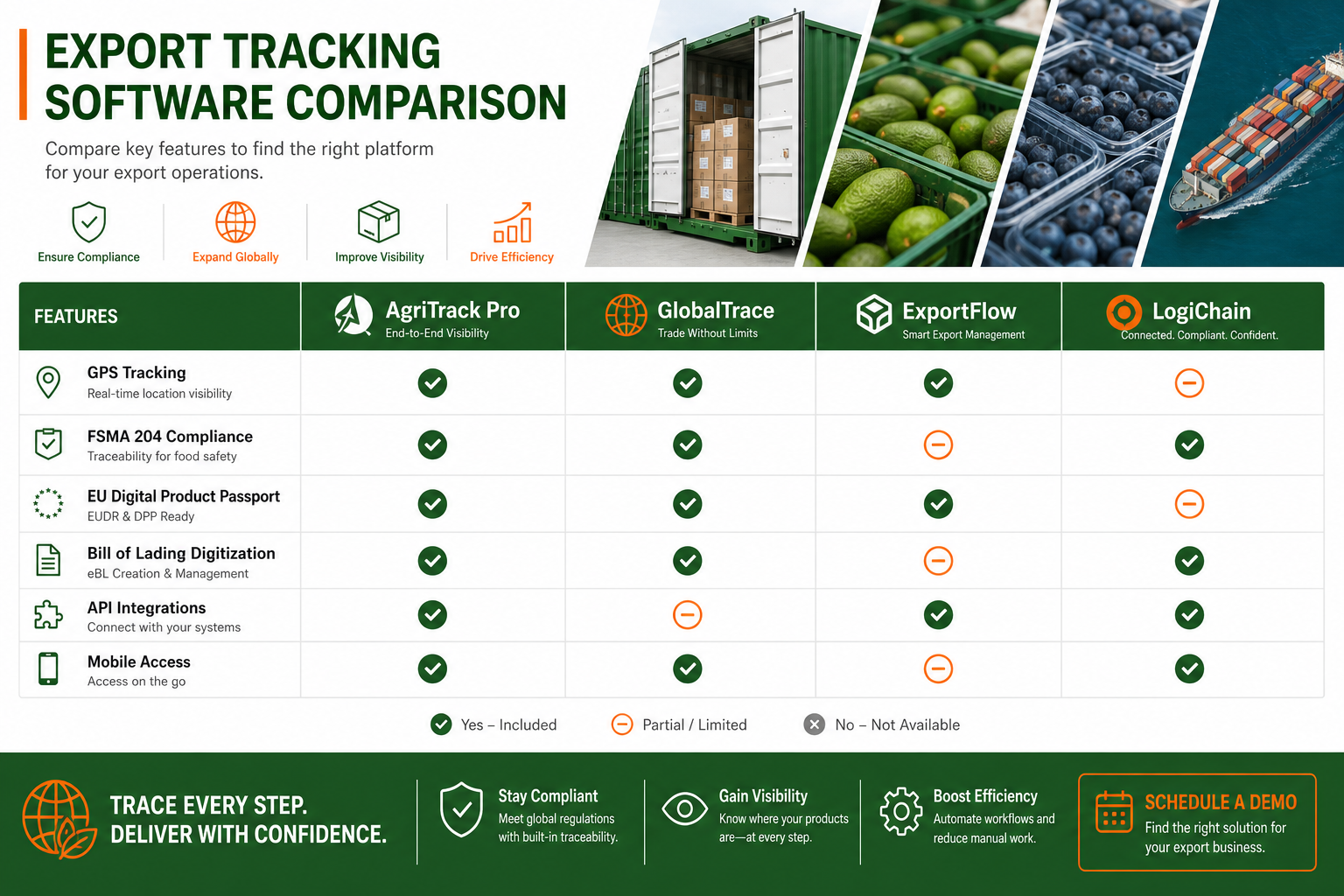
We evaluated each platform against what food exporters actually need: regulatory compliance modules, real-time GPS tracking, temperature monitoring, carrier integration breadth, and pricing.
| Platform | Best For | FSMA 204 | EU DPP | Cold Chain | Starting Price |
|---|---|---|---|---|---|
| Cloudleaf | Best overall compliance | ✅ Pre-built module | ✅ In development | ✅ IoT sensors included | ~$1,500/mo |
| FoodLogiQ | Food-specific compliance | ✅ Native module | ✅ Roadmap 2027 | ❌ Third-party only | ~$2,000/mo |
| Project44 | Carrier agnostic, GPS | ❌ No native module | ❌ Not planned | ❌ GPS only | ~$3,000/mo |
| IBM Food Trust | Blockchain traceability | ✅ Module available | ✅ DPP ready | ✅ IoT compatible | ~$5,000/mo |
| Infor Nexus | Cold chain + ERP | ✅ Module available | ⚠️ Limited | ✅ Best in class | ~$4,000/mo |
| SAP Digital Vehicle Passport | Enterprise DPP compliance | ❌ No food module | ✅ Native DPP | ❌ SAP only | ~$10,000/mo |
1. Cloudleaf — Best Overall for Food Export Compliance
Cloudleaf combines IoT sensors with a compliance-first dashboard. Their FSMA 204 module generates KDE reports automatically at each critical tracking event. Temperature, humidity, and shock sensors feed into a cold chain dashboard that is audit-ready.
Why food exporters choose it: The platform was built specifically for perishable supply chains. If you ship fresh produce, frozen seafood, or chilled dairy, Cloudleaf's preset temperature thresholds for different food categories (bananas at +13°C, chilled meat at -1°C to +2°C, frozen at -25°C to -18°C) mean you do not have to configure parameters yourself.
Cost: Approximately $1,500/month for up to 50 shipments. $3,000/month for 100-200 shipments with full IoT sensor package.
2. FoodLogiQ — Strongest Native Food Compliance
FoodLogiQ is the only platform in this list built by a food safety company. Their FSMA 204 module is the most mature, with KDE templates for every FDA-listed food category. They also offer supplier management, document control, and audit management in the same platform.
Why food exporters choose it: If you manage multiple suppliers (typical for food exporters consolidating from smallholder farms), FoodLogiQ lets each supplier enter their data through a portal — you do not need to train the whole supply chain on your platform.
Cost: $2,000-$4,000/month depending on supplier count and shipment volume.
3. Project44 — Widest Carrier Coverage
Project44 integrates with 1,200+ carriers and 200+ ocean carriers. It is the best option if your priority is real-time GPS tracking across multiple shipping lines, especially during peak season when schedule reliability drops below 50%.
Why food exporters choose it: The multi-carrier ETAs are the most accurate in the industry. During peak season (which we are in now — CFI at 3,327), Project44's predictive ETAs give you a 48-hour advance warning of arrival changes, giving you time to inform your buyer.
Limitation: No native FSMA 204 or EU DPP modules. You would need to combine it with a separate compliance tool.
Cost: $3,000-$6,000/month for mid-volume exporters.
4. IBM Food Trust — Blockchain Traceability for Premium Markets
IBM Food Trust uses blockchain to create immutable traceability records — particularly valued in markets where proof of origin is mandatory (EUDR compliance for coffee, cocoa, palm oil). The platform is used by major retailers including Walmart, Carrefour, and Nestlé.
Why food exporters choose it: If your buyer is a major European retailer, they already use IBM Food Trust on their side. Joining the same network means zero integration friction.
Cost: $5,000-$15,000/month. Realistically for large volumes only.
5. Infor Nexus — Best IoT Cold Chain Monitoring
Infor Nexus (formerly GT Nexus) is the cold chain gold standard. Its IoT sensor integrations cover temperature, humidity, vibration, and light exposure — all logged against shipment milestones. The platform also includes a supplier collaboration portal.
Why food exporters choose it: The cold chain dashboards show temperature excursions against baseline, so you can prove to a buyer that a 4-hour temperature spike happened at sea, not at your facility.
Cost: $4,000-$8,000/month.
6. SAP Digital Vehicle Passport — Enterprise DPP Readiness
SAP's DVP is designed for EU Digital Product Passport compliance. If your primary concern is the PPWR/ESPR documentation requirements, this is the most future-proof platform. However, it requires SAP infrastructure.
Why food exporters choose it: If your ERP is already SAP, the DPP module creates product passports automatically from existing master data.
Cost: $10,000+/month. Enterprise only.
Which Platform Should You Choose?
The right choice depends on where you ship and what you ship.
| Your Situation | Recommended Platform | Why |
|---|---|---|
| You ship perishable food to the US | Cloudleaf or FoodLogiQ | Native FSMA 204 modules, cold chain IoT sensors, KDE generation |
| You export to the EU (PPWR + DPP deadline Aug 12) | IBM Food Trust or SAP DVP | EU Digital Product Passport readiness, retailer compatibility |
| Peak season is your biggest risk | Project44 + Cloudleaf | Multi-carrier GPS for ETAs + compliance tracking in one stack |
| You ship under 10 containers/month | Airtable/Notion + manual IoT loggers | Low volume, low investment. Just stay FSMA 204 compliant on documentation |
What to Do This Week
The peak season is here (CFI at 3,327, surcharges active from July 1) and the PPWR deadline is 37 days away. Here is the actionable checklist:
- Audit your current tracking. If you are not capturing KDEs for every FSMA 204-covered shipment, you are at border rejection risk. Start with one high-value lane and test a tracking platform on it.
- Check whether your buyer uses a specific platform. If your EU buyer is already on IBM Food Trust, join that network rather than choosing a separate platform.
- Lock in a tracking solution before August 12. The PPWR deadline will create a rush of EU importers demanding digital documentation. Having a platform ready before the crunch gives you a negotiation advantage.
Tools That Complement Your Export Tracking
Beyond the tracking platform itself, these tools help you manage the financial and operational side of export:
- Airtable — Build a shipment tracker database that connects to your tracking platform via API. Great for small volume exporters who need a hybrid manual-digital approach.
- Notion — Export dashboard templates that consolidate shipment status, compliance docs, and buyer communication in one view.
- MRPeasy — Food manufacturing ERP that integrates landed cost tracking by shipment, helping you see the full cost impact of peak season rates per container.
Affiliate disclosure: FoodExpoConnect earns a commission when you sign up for Airtable, Notion, or MRPeasy through the links in this article. This does not affect the price you pay. We only recommend tools we have tested and that genuinely help food exporters manage tracking and compliance.
Questions and answers
- What export tracking features do food exporters need for FSMA 204 compliance?
- FSMA 204 requires electronic records of Key Data Elements (KDEs) at each supply chain node — grower, packer, repacker, shipper, receiver, and transporter. Your tracking software must capture: product descriptions, lot/batch numbers, shipment dates, quantity and unit of measure, source and recipient contact info, temperature logs for TCS foods, and traceability lot codes. All records must be available within 24 hours of FDA request. Platforms like Cloudleaf and FoodLogiQ offer pre-built FSMA 204 modules.
- What is the EU Digital Product Passport and how does it affect food exporters?
- The EU Digital Product Passport (DPP) is a digital record that follows a product through its lifecycle, required under the Ecodesign for Sustainable Products Regulation (ESPR). For food exporters, it means providing digital documentation of: packaging material composition, recyclability grade, carbon footprint data, supply chain geolocation, and compliance certifications. The DPP rolls out by product category starting 2026-2027. Food packaging is expected to be among the first categories, overlapping with the PPWR compliance deadline on August 12, 2026.
- How much does export tracking software cost for small food exporters?
- Entry-level export tracking platforms start at $500-$1,000/month for 10-25 shipments per month. Mid-tier solutions (50-200 shipments/month) range from $1,500-$4,000/month. Enterprise platforms with full compliance modules and API integrations cost $5,000-$15,000/month. Some providers offer per-shipment pricing ($15-$50 per tracking event) for small-volume exporters. Open-source alternatives like OpenLMIS or custom-built solutions on Airtable/Notion can reduce costs to $100-$300/month but require setup time and lack compliance automation.
- What is the difference between GPS tracking and IoT temperature monitoring in export tracking?
- GPS tracking provides real-time location, estimated arrival times, and route deviation alerts for your shipment. IoT temperature monitoring uses Bluetooth or cellular sensors inside containers to track temperature, humidity, and shock/vibration throughout transit. For food exporters shipping perishable goods (chilled meat, fresh produce, frozen seafood), you need both: GPS for schedule visibility and IoT sensors for cold chain integrity. The best solutions, like Cloudleaf and Infor Nexus, combine both in a single dashboard.
- Can I use Airtable or Notion as an export tracking tool?
- Yes, for small volumes (under 10 shipments/month), Airtable or Notion can work as a manual tracking database. You can build shipment logs, add status fields, attach documents like BOLs and certificates, and set up notification automations. However, neither provides: real-time GPS tracking, IoT temperature monitoring, automated compliance record generation, or carrier API integrations. As soon as you exceed 10 shipments/month or ship to FSMA 204-regulated markets, dedicated export tracking software saves enough time and compliance risk to justify the $500+/month cost.
Written by

Jean Marc Koffi
Co-authorJournalist & Export SpecialistLondon
Jean Marc Koffi is an MBA-trained trade specialist who connects African exporters to global buyers, with over $20M in contracts facilitated and expertise recognized by major trade organizations. Noted for rapid buyer network building, he is an experienced speaker and certified in trade facilitation, origin rules, and food safety.

Alocha Massamba
Co-authorFounder, Epifresh & FoodExpoConnectLondon
Alocha Massamba is the founder of Epifresh and FoodExpoConnect. He builds the technology, data and partnerships that connect African food producers and exporters to international buyers — with a focus on fresh-produce supply chains, cold-chain logistics, and the buyer-discovery platforms small and mid-size exporters need to compete with global incumbents.
Latest briefings
Trade Policy
July 24: Section 122 Dies, Section 338 Rises — Navigating the New US Tariff Landscape for Food ExportersSection 122 import surcharge expires July 24 (effective US tariff rate drops from ~13% to ~7%), but Section 338 invokes 50% tariffs on Canadian dairy and alcohol. What food exporters must know about the new US tariff landscape.
Market Access
China's Imported Food Market 2026: GB Standards Update, CBEC Channels & Market Entry StrategyComplete guide to China food import regulations in 2026 — new GB 2763 pesticide MRLs, GB 7718 labeling update, CBEC e-commerce channels (Tmall Global, JD Worldwide), and how exporters can access $220B+ of import demand.
Certification
5 Certifications Worth More Than a Price Cut in 2026Stop competing on price. Organic, Fair Trade, Rainforest Alliance, B Corp, and SQF certifications can command 20-300% price premiums for African food exporters in 2026. Here is the ROI data for each.