Freight Forwarding for Food Exporters 2026: Rates, Routes & How AI Is Changing Pricing
Ocean freight rates are rising again in June 2026. Here is what food exporters need to know about locking rates, choosing routes, and using AI tools to cut landed costs.
· · 7 min read
In short
How can food exporters manage freight costs and capacity in 2026?
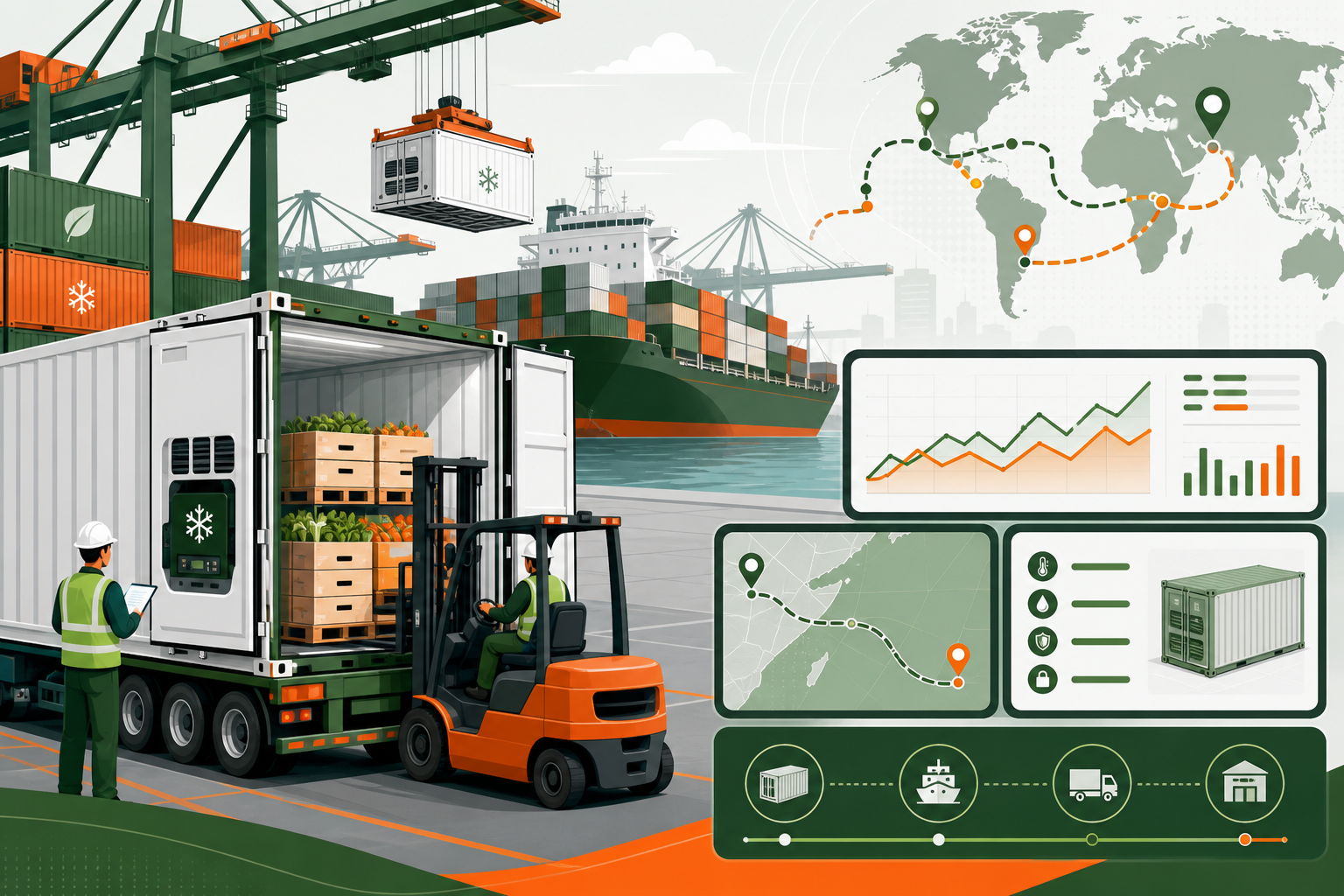
Food exporters should lock Q3 freight contracts now, diversify routes, book reefer space early, and use AI-powered freight platforms to compare rates and predict capacity.
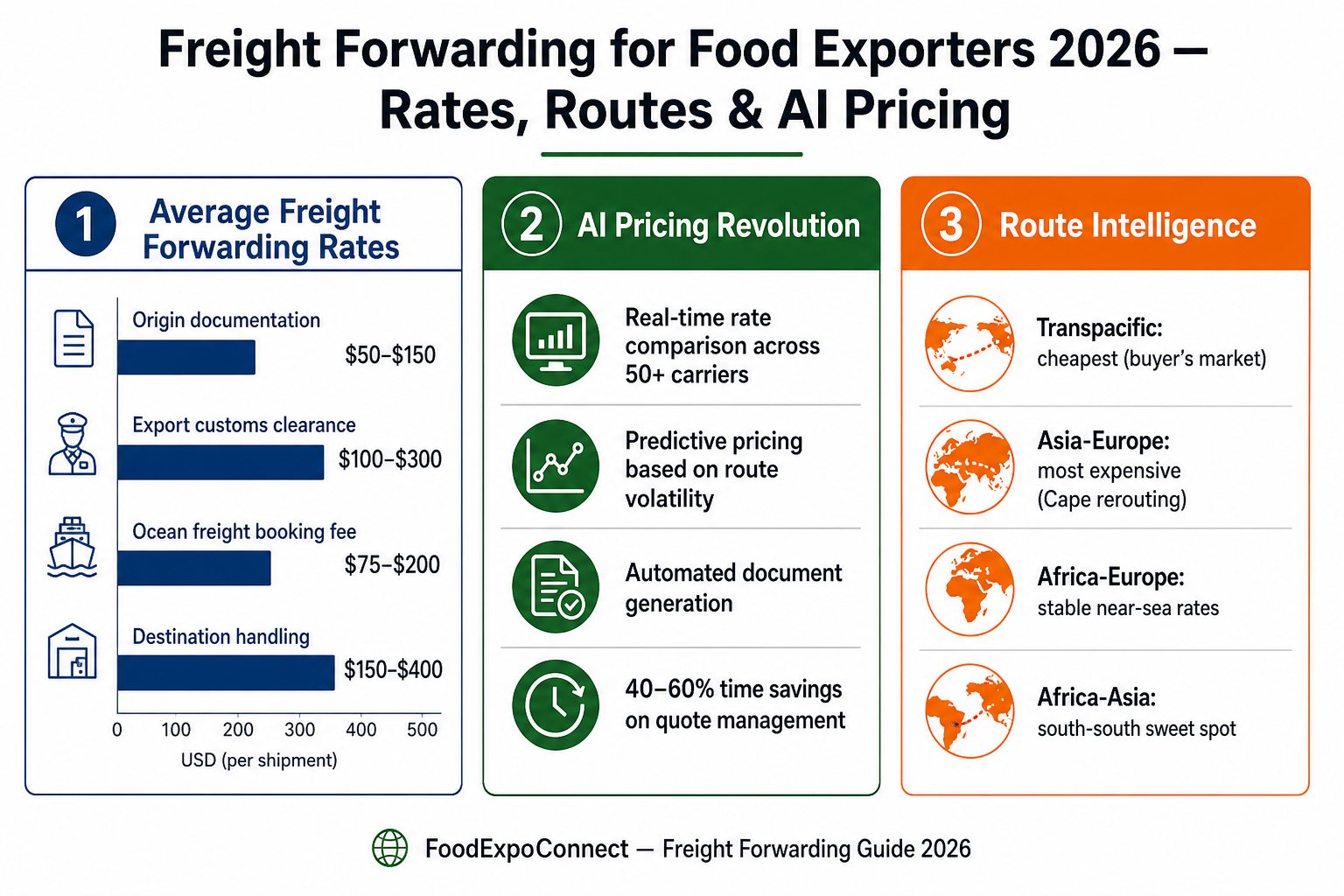
Introduction: The Freight Market Turned
For most of 2025 and early 2026, ocean freight rates were a bright spot for food exporters. Spot rates had fallen more than 70% from their 2022 peaks. Shippers who waited could often find cheap capacity.
That changed in June 2026.
Asia-US rates are up 20-31% in a matter of weeks. Asia-Europe rates are at or above year-ago levels. Schedule reliability remains below 65%, with late arrivals averaging more than five days. Importers are front-loading cargo ahead of the July 6 Section 301 tariff comment deadline and potential new duties.
For food exporters, this is not just a cost problem. It is a capacity problem. And capacity problems spoil product.
This guide explains the current freight environment, how to choose between spot and contract rates, which lanes matter most for food exports, and how AI is changing the way forwarders price and route shipments.
What you will learn:
- Current rate levels and trends by major lane
- Why reefer capacity is tightening faster than dry cargo
- Spot versus contract strategy in a rising market
- How AI freight tools are changing pricing
- Practical steps to lock in capacity before Q3
The June 2026 Freight Snapshot
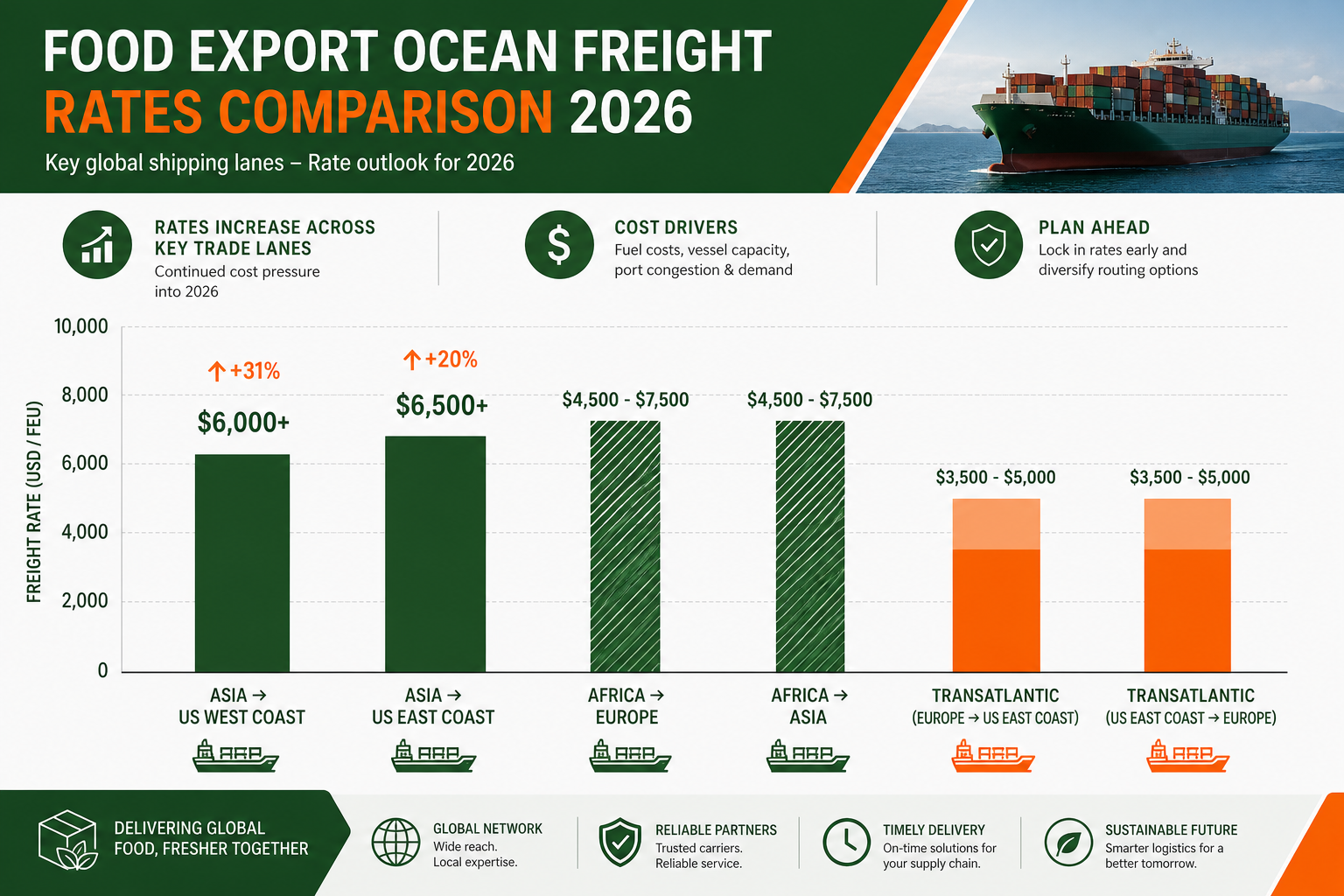
The freight market shifted quickly. Here is where things stand as of late June 2026.
| Lane | Rate trend | Benchmark spot rate (40ft) | What food exporters should know |
|---|---|---|---|
| Asia → US West Coast | +31% | ~$6,000+ FEU | Front-loading ahead of tariffs is driving volumes. Reefer premiums rising. |
| Asia → US East Coast | +20% | ~$6,500+ FEU | Suez routing adds time but East Coast demand is strong. |
| Asia → Europe | Rising | Above 2025 records | Capacity tightening; reliability still a problem. |
| Latin America → Europe | Firm | Varies by origin | Fruit and coffee seasons affect seasonal capacity. |
| Africa → Europe / Asia | Firm | $4,500-$7,500 FEU | Limited reefer capacity from East and West Africa ports. |
| Transatlantic | Stable | $3,500-$5,000 FEU | Less volatile but monitor carrier capacity reductions. |
These rates are spot market indicators. Contract rates for regular shippers are usually lower, but they require volume commitments and early negotiation.
Why Reefer Capacity Is the Real Constraint
Food exporters do not move dry boxes. They move refrigerated containers. And reefer capacity behaves differently than the overall market.
Reefer containers are a specialized fleet with expensive equipment and limited plugs per vessel. When general cargo demand surges, carriers still only have so many reefer slots. In June 2026, food exporters are competing with electronics, retail, and industrial importers who are front-loading ahead of potential tariffs.
The result: reefer bookings need to happen earlier, premiums are rising, and the risk of rolled cargo — a shipment bumped to a later vessel — is increasing.
For perishable food, rolled cargo is a disaster. A delay of even a few days can push product past shelf-life windows, trigger buyer rejection, or force expensive air freight rescue shipments.
Spot Rates vs. Long-Term Contracts: The 2026 Choice
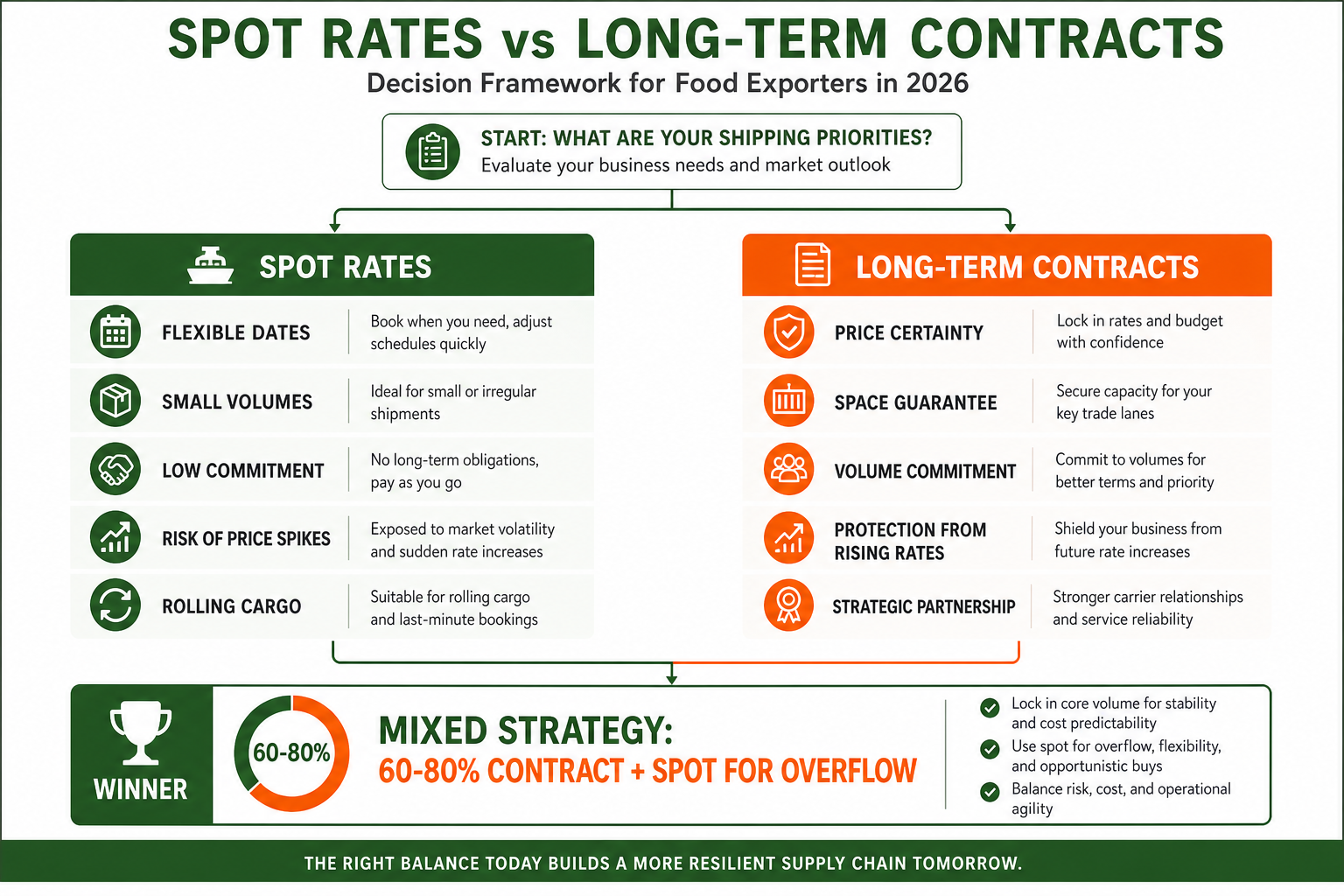
The choice between spot and contract depends on the market direction. In 2026, the market is rising. That changes the math.
Spot rates make sense when:
- Rates are falling or stable
- You have flexible shipping dates
- Your volumes are small or unpredictable
- You can absorb the risk of price spikes
Long-term contracts make sense when:
- Rates are rising
- You need space certainty
- You have predictable monthly volumes
- Product spoilage risk from rolled cargo is high
Most scaling food exporters should aim for a mixed strategy. Lock contracts for 60-80% of expected volume to secure baseline capacity, then use spot for overflow and unexpected orders.
The time to negotiate Q3 contracts is now. Waiting until July or August means accepting whatever spot rate is available — and possibly not getting space at all.
How AI Is Changing Freight Pricing
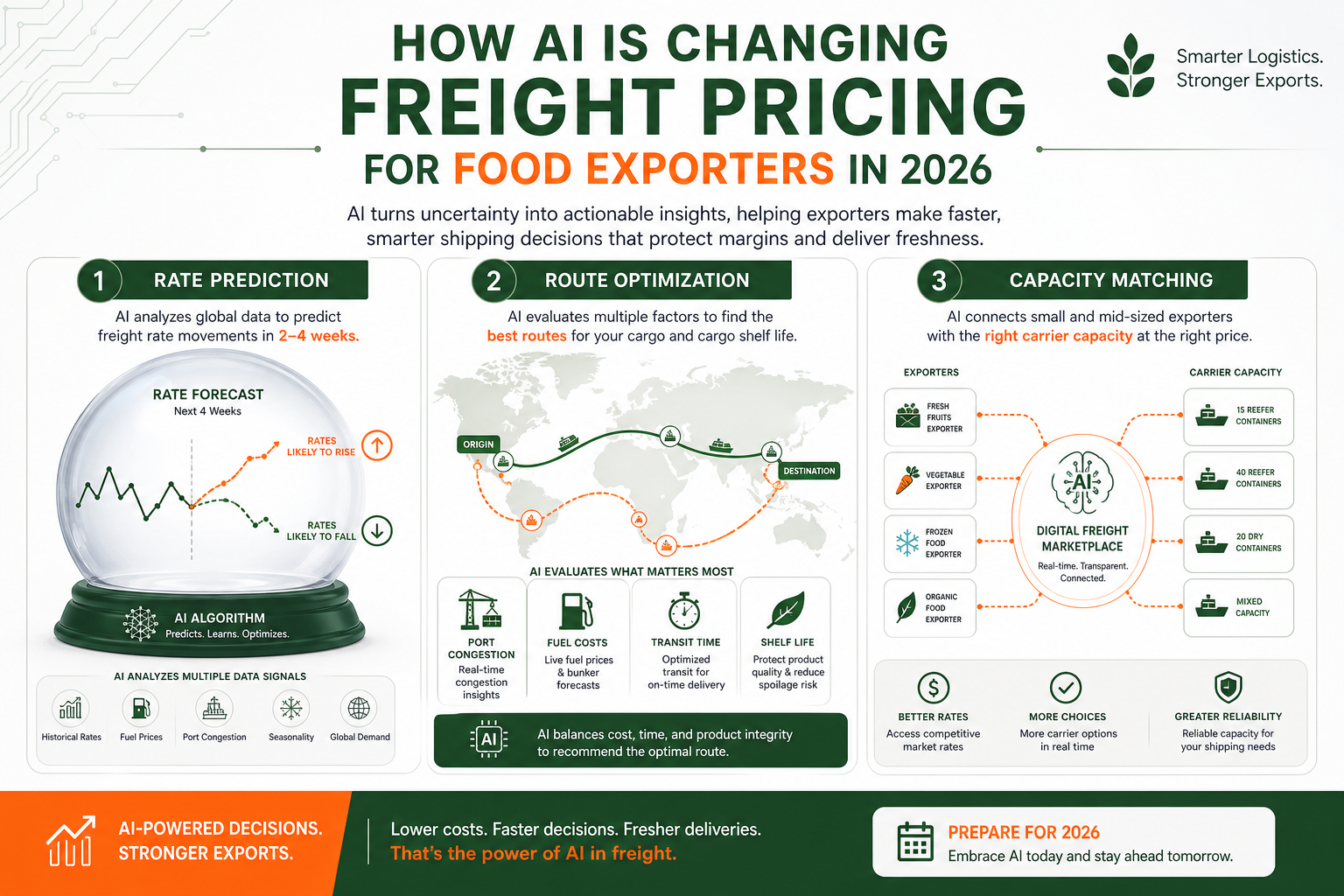
Freight forwarding is becoming a data business. AI is entering the industry in three ways.
1. Rate Prediction
Platforms analyze historical rate data, capacity signals, and disruption events to predict whether rates will rise or fall in the next two to four weeks. This helps shippers decide when to book.
2. Route Optimization
AI models evaluate port congestion, vessel schedules, fuel costs, and transit reliability to recommend routes. For food exporters, this can mean choosing between a faster but expensive lane and a slower but cheaper one based on shelf life.
3. Capacity Matching
Digital freight marketplaces use algorithms to match shippers with available carrier capacity. This is especially useful for smaller exporters who do not have the volume to negotiate directly with carriers.
The reality in 2026 is that AI tools are useful but not magic. They give exporters better information, but the fundamentals — booking early, building forwarder relationships, and understanding your own product's time sensitivity — still matter more than any algorithm.
Choosing a Freight Forwarder in 2026
Not all forwarders are equal for food exports. The right partner should offer:
- Reefer expertise: Experience with temperature-controlled cargo, pre-cooling, and cold chain handoffs
- Food documentation support: Help with phytosanitary certificates, health certificates, and customs paperwork
- Tracking and visibility: Real-time container tracking and temperature monitoring
- Route flexibility: Multiple carrier relationships so they can pivot when space is tight
- Credit terms: Ability to extend payment terms so you are not paying freight costs before you collect from buyers
Ask forwarders specific questions: How many reefer containers did you move on my lane last quarter? What is your rollover rate? Which carriers do you have allocations with? Do you offer cargo insurance and claim support?
A good forwarder is a strategic partner, not just a rate quote.
Practical Steps for Q3 2026
If you are shipping food in the next three months, here is a short action list.
This week:
- Review your Q3 shipping forecast with your forwarder
- Request contract quotes for your baseline volume
- Identify your highest-risk shipments — the ones that cannot be delayed
Next two weeks:
- Lock contracts for at least 60% of expected Q3 volume
- Set up rate tracking for your top lanes
- Confirm reefer equipment availability for peak weeks
Ongoing:
- Use a shared dashboard to track bookings, ETAs, and exceptions
- Build relationships with at least two forwarders to avoid single-source risk
- Schedule regular logistics reviews with your operations team
Airtable is a lightweight way to build a freight tracker that links shipments, forwarders, rates, and documents in one place. Get the Airtable freight tracker template → (affiliate link)
To stay ahead of schedule changes and negotiate with forwarders, book regular check-in calls across time zones. Calendly handles time-zone coordination automatically. Schedule logistics calls with Calendly → (affiliate link)
The Bottom Line
The June 2026 freight market is a warning. Rates that looked cheap for months are rising fast, and reefer capacity is tightening as non-food importers front-load cargo.
Food exporters who wait for the market to calm down will pay more and risk rolled cargo. The companies that navigate this well will be the ones that locked contracts early, diversified their forwarder relationships, and used data to time their bookings.
Freight is not just a cost line. For food exporters, it is a quality control function. The container that arrives on time and at the right temperature protects your product, your buyer relationship, and your margin.
Affiliate disclosure: FoodExpoConnect earns a commission when you sign up for Airtable or Calendly through the links in this article. This does not affect the price you pay. We only recommend tools we believe genuinely help food exporters manage logistics.
Questions and answers
- Are ocean freight rates rising for food exporters in 2026?
- Yes. After months of decline, June 2026 marked a reversal. Asia-US rates are up 20-31%, Asia-Europe rates are firm, and refrigerated container capacity is tightening as importers front-load shipments ahead of Section 301 tariffs.
- How much does a 40-foot reefer container cost in 2026?
- Benchmark rates vary by lane. Asia-US West Coast spot rates have moved past $6,000 per FEU for general cargo, with reefer premiums adding $1,500-$3,000 depending on the route, season, and carrier. Long-term contract rates are typically lower but require volume commitments.
- What is AI doing to freight pricing?
- AI is being used to predict rate movements, optimize container consolidation, match shippers with available capacity, and recommend booking timing. Freight marketplaces and forwarder platforms now use machine learning on historical rate, capacity, and disruption data.
- Should food exporters use spot rates or long-term contracts in 2026?
- In a rising-rate environment, long-term contracts offer price certainty and space protection. Spot rates can save money when the market is falling but expose exporters to price spikes and rolled cargo when capacity is tight. Most scaling exporters use a mix: contracts for baseline volume, spot for overflow.
- Why is reefer capacity tighter than dry container capacity?
- Reefer containers are a specialized fleet. When general cargo demand surges, carriers may prioritize dry boxes, and reefer plugs on vessels are limited. Perishable food exporters compete for fewer slots and must book earlier than dry cargo shippers.
Written by

Jean Marc Koffi
Co-authorJournalist & Export SpecialistLondon
Jean Marc Koffi is an MBA-trained trade specialist who connects African exporters to global buyers, with over $20M in contracts facilitated and expertise recognized by major trade organizations. Noted for rapid buyer network building, he is an experienced speaker and certified in trade facilitation, origin rules, and food safety.

Alocha Massamba
Co-authorFounder, Epifresh & FoodExpoConnectLondon
Alocha Massamba is the founder of Epifresh and FoodExpoConnect. He builds the technology, data and partnerships that connect African food producers and exporters to international buyers — with a focus on fresh-produce supply chains, cold-chain logistics, and the buyer-discovery platforms small and mid-size exporters need to compete with global incumbents.
Latest briefings
Trade Policy
July 24: Section 122 Dies, Section 338 Rises — Navigating the New US Tariff Landscape for Food ExportersSection 122 import surcharge expires July 24 (effective US tariff rate drops from ~13% to ~7%), but Section 338 invokes 50% tariffs on Canadian dairy and alcohol. What food exporters must know about the new US tariff landscape.
Market Access
China's Imported Food Market 2026: GB Standards Update, CBEC Channels & Market Entry StrategyComplete guide to China food import regulations in 2026 — new GB 2763 pesticide MRLs, GB 7718 labeling update, CBEC e-commerce channels (Tmall Global, JD Worldwide), and how exporters can access $220B+ of import demand.
Certification
5 Certifications Worth More Than a Price Cut in 2026Stop competing on price. Organic, Fair Trade, Rainforest Alliance, B Corp, and SQF certifications can command 20-300% price premiums for African food exporters in 2026. Here is the ROI data for each.