How Smallholder Cooperatives Can Access Export Markets: The Digital Bridge
Learn how African smallholder coffee cooperatives can use digital platforms, EUDR-compliant traceability tools, and AI-powered buyer matching to access EU export markets directly — without traders.
· 7 min read
In short
How can smallholder coffee cooperatives access EU export markets directly?
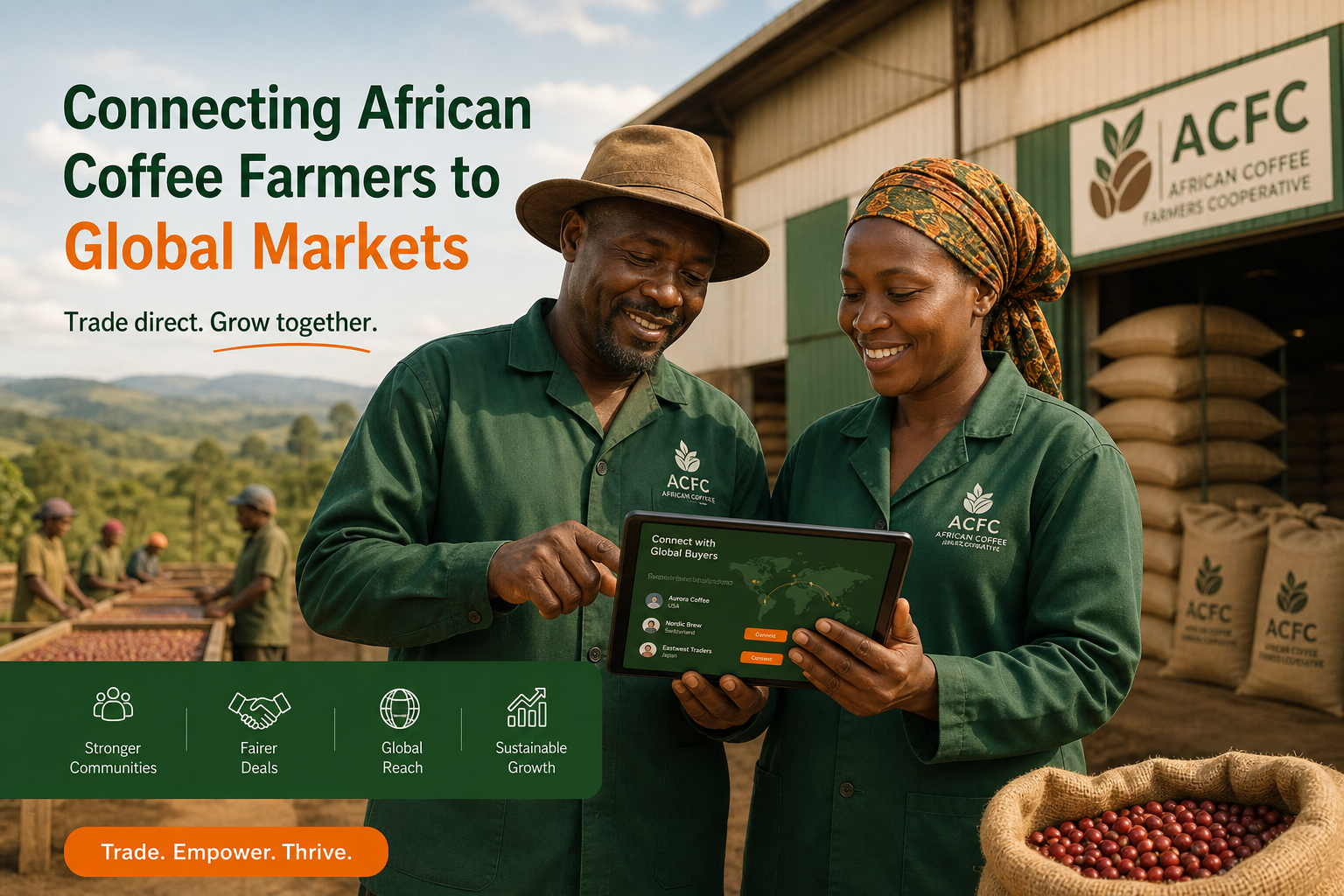
Smallholder coffee cooperatives can access EU export markets directly by using digital platforms that serve as a bridge: Alibaba.com (40M+ buyers, AI-powered matching), blockchain traceability tools (TE-FOOD, IBM Food Trust), cooperative management platforms for batch-level EUDR compliance, and direct buyer outreach via Apollo.io and trade show participation. The digital bridge eliminates dependency on intermediary traders, allowing cooperatives to capture the full €12-18/kg specialty coffee premium.
import NewsletterCTA from '@/components/blog/NewsletterCTA';
The Problem: Smallholders Are Stuck Between Low Prices and High Barriers
The average smallholder coffee farmer in Africa manages 0.5-2 hectares and produces 200-500 kg of green coffee per year. They sell to local collectors, who sell to traders, who sell to exporters, who sell to European importers, who sell to roasters.
Each layer takes a margin. By the time coffee reaches a European specialty roaster at €15/kg, the farmer has received $1.50-2.50/lb — roughly 25-40% of the FOB export price.
The digital bridge eliminates layers. It connects the cooperative directly to the roaster. This guide shows you exactly how to build that bridge.
The Digital Bridge: How It Works
| Layer | Traditional Model | Digital Bridge Model | Farmer Share |
|---|---|---|---|
| 1 | Farmer → Local collector (pays $1.20/lb) | Farmer → Cooperative (pays $2.00/lb) | +67% |
| 2 | Collector → Regional trader | Cooperative → Digital platform (Alibaba/Algrano) | — |
| 3 | Trader → Exporter (pays $2.80/lb) | Digital platform → EU Roaster (pays $4.80-6.00/lb) | Direct to cooperative |
| 4 | Exporter → European importer ($3.80/lb) | — (eliminated) | N/A |
| 5 | Importer → Roaster ($4.50/lb) | — (eliminated) | N/A |
| Consumer pays | €15-22/kg | €15-22/kg | |
Platform 1: Alibaba.com — The Direct-to-Buyer Channel
Alibaba.com is the most accessible digital marketplace for African cooperatives in 2026. With 40M+ registered buyers, 200+ countries, and its AI-powered sourcing tool Accio Work (230,000 businesses adopted in month one), it's the single largest B2B platform for food trade.
What's Changed in 2026
| Feature | 2025 | 2026 |
|---|---|---|
| AI buyer matching | Limited | Accio Work — AI-suggested products from market data |
| Food compliance support | None | Food export config guides (PPWR, FDA, shelf-life) |
| Trade Assurance | Cross-border | Expanded to local markets (Indonesia, Vietnam) |
| Supplier verification | Manual | AI-enabled — 2M profiles audited in Dec 2025 alone |
| EUDR compliance tools | None | Documentation templates for deforestation-free declarations |
Cost Breakdown for a Cooperative
| Item | Cost (Annual) |
|---|---|
| Gold Supplier membership | $2,500-5,000 |
| Product listing optimization | $500 (one-time) |
| AI keyword research (included) | $0 |
| Trade Assurance coverage | 0.5-1.5% per transaction |
| RFQ responses (50/month) | $0 |
| Total year 1 | ~$3,000-5,500 |
Case Study: Ethiopian Cooperative on Alibaba
Guji Coffee Farmers Cooperative Union (2,800 members, 400 tonnes/year):
- Created Alibaba Gold Supplier listing in January 2026
- Added AI-optimized product descriptions using Accio Work
- Received 47 RFQs in the first 90 days
- Closed 3 contracts worth €180,000 total
- Average price: $4.95/lb FOB (+35% vs Ethiopian auction average)
- Cost of Alibaba program: $3,200/yr
- ROI: 5,625% in 3 months
"Before Alibaba, we sold through the ECX auction and got $3.40/lb. Now we communicate directly with German roasters who value our single-origin story. The platform paid for itself in the first container." — Guji Cooperative Manager
Platform 2: Digital Traceability for EUDR Compliance
EUDR compliance is the biggest hurdle for smallholder cooperatives targeting the EU. But the May 2026 simplification package made it significantly easier — especially the voluntary grouping provision.
How Voluntary Grouping Works
| Step | What Happens | Who Does It |
|---|---|---|
| 1 | Cooperative registers in TRACES (EU system) | Cooperative manager |
| 2 | Each farmer plot mapped (polygon or point) | Cooperative + satellite tool |
| 3 | Cooperative files one consolidated DDS per batch | Cooperative manager |
| 4 | Certification scheme (Organic/RA) serves as pre-verified risk assessment | Certifying body |
| 5 | Batch-level declaration submitted to EU buyer | Cooperative → TRACES |
The key insight: each individual farmer does not need to file anything with the EU. The cooperative handles the consolidated declaration. This is the digital bridge working at the regulatory level.
Recommended Tools
| Tool | Cost | EUDR Function |
|---|---|---|
| Notion (Affiliate) | $10/user/mo | DDS template library, compliance dashboard, audit trail |
| Airtable (Affiliate) | $20/user/mo | Plot geolocation database, batch traceability, shipment tracking |
| TE-FOOD | $0.005-0.01/kg | Farm-to-roaster blockchain traceability |
| EU Copernicus (free) | €0 | Satellite imagery for deforestation verification |
| TRACES (EU system) | €0 | DDS submission, certification repository access |
Budget Traceability Stack (Under $500/year)
Small cooperatives don't need expensive software. This three-tool stack covers EUDR compliance:
- Google Earth + Airtable — Map farmer plots with polygon coordinates (free + $20/mo)
- Notion template — Pre-built EUDR DDS template with certification fields ($10/mo)
- WhatsApp + photo timestamp — Prove harvest timeline with GPS-tagged photos (free)
Real example: Dukunde Kawa Cooperative (Rwanda, 3,000 members) uses a combination of GPS-tagged farmer registration, Airtable batch tracking, and blockchain certification to prove deforestation-free status for every lot. Their EU buyers receive a QR code that shows the full traceability chain. Cost: $1,200/year. Result: €16/kg FOB — 3x the commodity price.
Platform 3: AI-Powered Buyer Matching
The biggest challenge for cooperatives isn't quality coffee — it's finding the right buyer. AI matching tools in 2026 are solving this.
Alibaba's Accio Work
Adopted by 230,000 businesses in its first month, Accio Work uses machine learning to:
- Match product descriptions to buyer purchase history
- Recommend optimal pricing per market (EU vs Middle East vs Asia)
- Flag RFQs that match the cooperative's certification profile
- Translate buyer inquiries in 17 languages
Apollo.io for Buyer Prospecting
Apollo.io (Affiliate) allows cooperatives to:
- Search 275M+ contacts by: role (Head of Sourcing, Coffee Buyer), industry (Specialty Coffee, Roasting), location (EU countries)
- Find verified email addresses for direct outreach
- Track engagement rates on cold emails
- Integrate with Pipedrive (Affiliate) CRM for pipeline management
Cost: $49-99/month for a small cooperative.
Trade Show Digital Matchmaking
SIAL Paris (October 19-23, 2026) now offers:
- Pre-event AI matching: upload your cooperative profile, get matched to 20+ relevant buyers
- Virtual booth preview: buyers browse your coffee before the event
- Meeting scheduler: Calendly (Affiliate) integration for booking face-to-face meetings
Part 4: Success Stories
Story 1: Rwanda's Dukunde Kawa — From $2.00/lb to €16/kg
Before (2019): 400 members, selling through local traders at $2.00/lb After (2026): 3,000 members, selling directly to European roasters at €16/kg FOB The digital bridge:
- Blockchain traceability via TE-FOOD (cost: €0.008/kg)
- Digital farmer registry with GPS coordinates for all 3,000 members
- Direct WhatsApp groups with 12 European roasters
- Participation in SIAL Paris digital matchmaking
- EUDR compliance managed through consolidated declarations
Result: Farmers receive $3.50-4.00/lb — 2x the Rwandan cooperative average.
Story 2: Ethiopia's Yirgacheffe Coffee Farmers Cooperative Union (YC FCU)
Scale: 50,000+ farmers, 78 member cooperatives Digital bridge: Alibaba.com Gold Supplier since 2025 Result: 30% of export volume now direct-to-roaster, eliminating 2 intermediary layers Average price: $4.50/lb vs $3.20/lb auction average
Part 5: Your 60-Day Digital Bridge Launch Plan
Days 1-14: Foundation
| Task | Tool | Cost | Owner |
|---|---|---|---|
| Register cooperative (if not registered) | Local authorities | $50-200 | Manager |
| Map all farmer plots with GPS | Google Earth + phone | Free | Field officer |
| Create digital farmer register | Airtable | $20/mo | Admin |
| Document existing certifications | Scanner + Google Drive | Free | Quality team |
Days 15-30: Platform Setup
| Task | Tool | Cost | Owner |
|---|---|---|---|
| Create Alibaba Gold Supplier listing | Alibaba.com | $2,500-5,000 | Export manager |
| Set up EUDR compliance dashboard | Notion | $10/mo | Compliance officer |
| Open business account for EUR receipts | Wise | Free (0.5% FX) | Finance |
| Prepare sample packs (12x 500g) | Local roastery | $750 | Quality team |
| Create buyer outreach list | Apollo.io | $49/mo | Sales |
Days 31-60: Buyer Acquisition
| Task | Tool | Cost | Owner |
|---|---|---|---|
| Send samples to 15 EU roasters | DHL/FedEx | $750 | Export manager |
| Set up Pipedrive pipeline | CRM | $15/mo | Sales |
| Follow up with WhatsApp Business | WhatsApp + phone | Free | Sales |
| Book SIAL Paris buyer meetings | Calendly | $8/mo | Export manager |
| Register for TRACES EUDR system | EU Portal | Free | Compliance officer |
Total First-Year Investment
| Category | Cost |
|---|---|
| Platform fees (Alibaba) | $2,500-5,000 |
| Software (Airtable + Notion + Pipedrive + Calendly) | ~$650/yr |
| Buyer data (Apollo.io) | ~$600/yr |
| Sample shipping (2 rounds) | $1,500 |
| Certification (Organic group, shared across members) | $3,000-8,000 |
| EU cross-border payments (Wise) | 0.5% per transaction |
| Total first year | ~$8,250-15,750 |
First-year additional revenue (40 tonnes, Organic + Fair Trade certification): €163,000-170,000
Effective ROI: 970-2,060%
The Bottom Line
The digital bridge is not theory. It's operating today — in Rwanda, Ethiopia, Kenya, and across East Africa. The tools are affordable, the EUDR compliance path is simplified (especially with voluntary grouping), and the buyer demand for directly-sourced African specialty coffee is at an all-time high.
The cooperatives that build this bridge in 2026 — before the December 30 EUDR deadline forces everyone to digitize — will have an 18-month head start on those that wait.
The farmer who can prove where their coffee was grown, show its certification, and connect directly with a European roaster through a digital platform, will earn 2-3x more than the farmer who sells to a local collector.
Questions and answers
- What digital platforms can smallholder cooperatives use to find EU coffee buyers?
- The most accessible platforms for smallholder cooperatives in 2026 are: (1) Alibaba.com — $1,500-5,000/year for Gold Supplier status, 40M+ registered buyers, AI-powered matching via Accio Work tool (230K businesses adopted in month one). (2) Coffee-specific B2B platforms like Algrano and Sucafina's digital channels. (3) Cooperative-to-roaster direct trade supported by digital sampling platforms like Cropster. (4) Trade show digital matchmaking — SIAL Paris and Gulfood now offer pre-event buyer-matching apps. (5) WhatsApp Business API for day-to-day buyer communication and sample shipment coordination.
- How does EUDR compliance work for a cooperative with 500 smallholder farmers?
- With voluntary grouping under the May 2026 EUDR simplification package, the cooperative files one consolidated Due Diligence Statement (DDS) covering all 500 farmers. Each farmer plot must be geolocated (polygon for >4ha, single point for smaller plots — most African smallholder plots are <2ha so single point GPS is sufficient). The cooperative aggregates geolocation data using a simple mapping tool (Google Earth or a smartphone app), uploads to the TRACES system, and submits one batch-level DDS per export shipment. Certification schemes like Organic or Rainforest Alliance serve as pre-verified risk assessments, further reducing the documentation burden. Estimated time to set up: 2-4 weeks with a field officer and smartphone.
- What is the cost of setting up a digital export operation for a cooperative?
- A realistic first-year budget: Alibaba Gold Supplier ($2,500), basic traceability software using Airtable/Notion ($500/yr), sample shipping to 15 EU roasters ($750), certification fees shared across members ($3,000-8,000 for Organic group certification), and cooperative management platform ($1,200/yr). Total first-year investment: approximately $8,000-13,000. Based on the financial model in our companion guide, a cooperative exporting 40 tonnes/year can expect €163,000 additional revenue with Organic + Fair Trade certification — ROI is 1,200-2,000% in year one.
- Can smallholders use mobile phones for EUDR compliance?
- Yes — mobile phones are the primary tool for EUDR compliance at the smallholder level. Free or low-cost apps allow farmers to: (1) GPS-tag their plot location using Google Maps or a dedicated app like Farmforce; (2) Photo-timestamp harvest dates with metadata; (3) Record lot numbers via QR code scanning; (4) Receive SMS confirmation that their coffee is included in the cooperative batch DDS. The EUDR simplification package design specifically accounted for the technology constraints of smallholders — the cooperative aggregates the data; individual farmers only need a basic smartphone. Programs like TechnoServe and Root Capital provide smartphone training to cooperatives across East Africa.
- What are real examples of cooperatives that successfully bridged digitally?
- Three notable examples: (1) Rwanda's Dukunde Kawa Cooperative (3,000 members) uses blockchain traceability to track coffee from 1,800m elevation farms to European roasters, achieving €16/kg FOB — 3x the commodity price. (2) Ethiopia's Yirgacheffe Coffee Farmers Cooperative Union (YC FCU) connects 50,000+ farmers to EU buyers through Alibaba.com, reducing intermediary layers. (3) Kenya's Gikanda Farmers Cooperative Society uses digital auction integration to sell AA-grade lots directly to UK and German roasters at $5.50-6.00/lb, bypassing Nairobi Coffee Exchange commission fees.
Written by

Jean Marc Koffi
Co-authorJournalist & Export SpecialistLondon
Jean Marc Koffi is an MBA-trained trade specialist who connects African exporters to global buyers, with over $20M in contracts facilitated and expertise recognized by major trade organizations. Noted for rapid buyer network building, he is an experienced speaker and certified in trade facilitation, origin rules, and food safety.

Alocha Massamba
Co-authorFounder, Epifresh & FoodExpoConnectLondon
Alocha Massamba is the founder of Epifresh and FoodExpoConnect. He builds the technology, data and partnerships that connect African food producers and exporters to international buyers — with a focus on fresh-produce supply chains, cold-chain logistics, and the buyer-discovery platforms small and mid-size exporters need to compete with global incumbents.
Latest briefings
Trade Policy
July 24: Section 122 Dies, Section 338 Rises — Navigating the New US Tariff Landscape for Food ExportersSection 122 import surcharge expires July 24 (effective US tariff rate drops from ~13% to ~7%), but Section 338 invokes 50% tariffs on Canadian dairy and alcohol. What food exporters must know about the new US tariff landscape.
Market Access
China's Imported Food Market 2026: GB Standards Update, CBEC Channels & Market Entry StrategyComplete guide to China food import regulations in 2026 — new GB 2763 pesticide MRLs, GB 7718 labeling update, CBEC e-commerce channels (Tmall Global, JD Worldwide), and how exporters can access $220B+ of import demand.
Certification
5 Certifications Worth More Than a Price Cut in 2026Stop competing on price. Organic, Fair Trade, Rainforest Alliance, B Corp, and SQF certifications can command 20-300% price premiums for African food exporters in 2026. Here is the ROI data for each.