Scaling Food Export: From 1 Container to 50/Month — Systems That Scale
Most food exporters plateau because their systems break before their ambition does. Here's how to build operations, finance, and logistics systems that scale from one container to fifty per month.
· 14 min read
In short
How do I scale my food export business from one container to fifty per month?
Scale food export operations by implementing staged systems: CRM and SOPs at 3-5 containers, ERP and cold chain monitoring at 6-15 containers, QA automation and trade finance at 16-30 containers, and regional warehousing plus demand forecasting at 31-50+ containers.
Introduction: The Scaling Trap
There is a moment in every growing food export business when the founder realizes the business has outgrown its own systems.
It usually sounds like this: "We just landed three new buyers in one month, and now I'm not sure which container has which lot, whether the cold chain held, or if we have enough stock to fulfill the orders we already promised."
The jump from one container per month to fifty is not just a volume challenge. It is a systems challenge. The habits that work at small scale — WhatsApp messages to the freight forwarder, Excel inventory trackers, owner-managed quality checks, informal payment terms — become the bottlenecks that break the business.
This guide maps the five operational stages of food export growth and the systems you need at each stage. It is based on patterns we see across hundreds of exporters: African coffee cooperatives, Southeast Asian spice traders, Latin American fruit exporters, and European specialty food brands. The companies that scale successfully do not just sell more. They build operations that can absorb more volume without falling apart.
What you will learn:
- The five stages of export scale and what changes at each threshold
- Exact systems to implement for operations, finance, quality, and logistics
- A comparison of manual versus scaled operations across key functions
- Recommended tools for ERP, CRM, scheduling, and payment workflows
- The most common scaling mistakes and how to avoid them
- A 90-day roadmap to move from stage two to stage four
The Five Stages of Food Export Scale
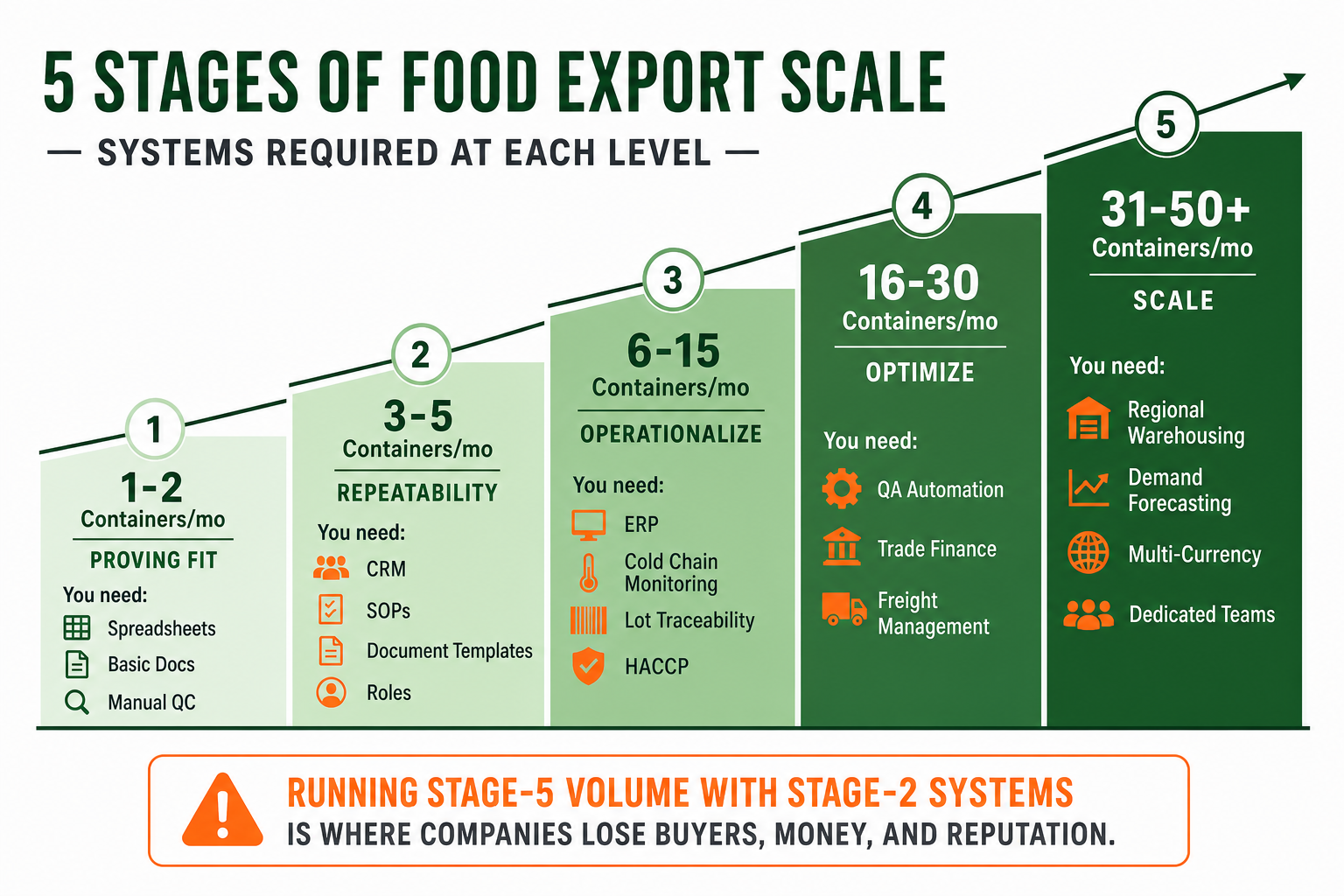
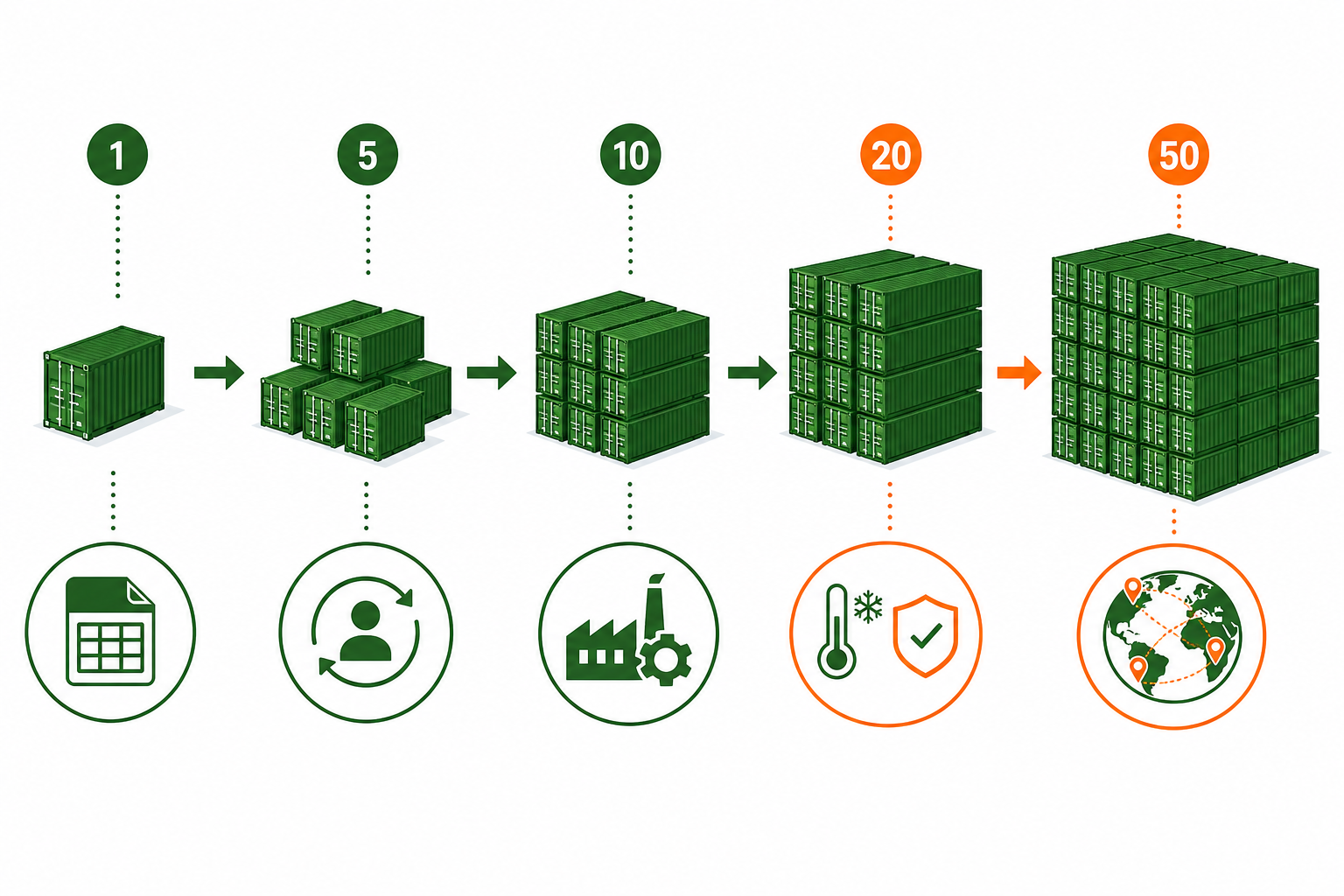
Scaling is rarely linear. Most exporters move through predictable stages, each with a different ceiling and a different set of required systems. Trying to run stage-five volume with stage-two systems is where companies lose buyers, money, and reputation.
Stage 1: Proving Product-Market Fit (1–2 Containers/Month)
At this stage, the business is testing whether foreign buyers will pay for its product repeatedly. The founder is usually involved in every order: sourcing, packing, documentation, shipping, and follow-up.
What matters most:
- Product quality consistency
- Basic export documentation
- One or two reliable freight forwarders
- Simple cost tracking
Systems:
- Spreadsheet or basic accounting for costs
- Email and WhatsApp for buyer communication
- Manual packing lists and invoices
- Notebook or simple checklist for quality checks
This stage is about learning. You do not need an ERP yet. You need clean data on what each shipment actually costs, how long it takes, and whether the buyer reorders. Many exporters stay here for one to two years, testing products and markets before committing to scale.
Stage 2: Building Repeatability (3–5 Containers/Month)
Once orders become predictable, the business needs repeatable processes. The founder can no longer personally inspect every pallet or chase every buyer.
What matters most:
- Standard operating procedures
- Buyer relationship management
- Order intake and confirmation workflow
- Basic inventory visibility
Systems:
- CRM to track buyer conversations and deal stages
- Document templates for invoices, packing lists, and certificates
- A simple inventory tracker
- Defined roles for operations, sales, and logistics
A CRM becomes critical here. Without it, follow-ups fall through the cracks, payment terms get forgotten, and promising buyers go cold. The companies that stall at this stage usually do so because the founder still tries to manage every relationship personally. Try Pipedrive free for buyer deal tracking → (affiliate link)
Stage 3: Operationalizing the Business (6–15 Containers/Month)
This is where most exporters hit their first real ceiling. Six containers per month usually means multiple SKUs, multiple buyers, multiple suppliers, and overlapping production and shipping schedules.
What matters most:
- Production planning tied to orders
- Lot traceability and recall readiness
- Cold chain monitoring
- Freight consolidation and route planning
Systems:
- ERP for inventory, production, and procurement
- Cold chain temperature loggers
- Supplier performance tracking
- Quality management system or digitized HACCP records
This is also the stage where an ERP pays for itself. MRPeasy, built for small and mid-sized food manufacturers, connects inventory, production planning, and procurement in one place. It is far cheaper and faster to deploy than enterprise ERPs, and it handles lot traceability out of the box. Start a free MRPeasy trial → (affiliate link)
Stage 4: Professionalizing for Volume (16–30 Containers/Month)
At sixteen containers per month, the business is no longer a large small business. It is a small mid-market exporter. The risks shift from operational chaos to financial exposure, quality consistency across batches, and buyer concentration.
What matters most:
- Cash flow management and trade finance
- Multi-origin sourcing strategy
- Quality control automation and lab partnerships
- Freight rate contracts and space allocation
Systems:
- Integrated ERP with finance module
- Supplier scorecards and audits
- Pre-shipment inspection workflows
- Credit insurance or invoice factoring
- Demand planning tools
At this stage, the founder typically moves from operations to strategy, hiring a general manager or operations director who owns day-to-day execution. The businesses that fail here often do so because the founder cannot let go of operational control.
Stage 5: Scaling to Market Leadership (31–50+ Containers/Month)
At this level, the exporter is competing on reliability, cost efficiency, and speed. Margins compress, so operational excellence becomes the moat.
What matters most:
- Regional warehousing or bonded storage
- Multi-modal logistics optimization
- Advanced demand forecasting
- Integrated buyer portals and EDI
- Trade finance at scale
Systems:
- WMS or 3PL integration
- AI-assisted demand forecasting
- Automated compliance documentation
- Enterprise-grade ERP or best-of-breed integrations
- Dedicated account management structure
Only a small percentage of food exporters reach this stage. Those that do treat their supply chain as a competitive weapon, not a cost center.
Manual Operations vs. Scaled Operations: What Changes
The table below compares how key functions change as you move from a founder-led manual operation to a systems-driven exporter.
| Function | Manual (1–5 containers/month) | Scaled (15–50+ containers/month) |
|---|---|---|
| Order intake | Email, WhatsApp, phone calls | CRM-linked order portal or ERP sales order workflow |
| Inventory tracking | Spreadsheets updated weekly | ERP with real-time stock, lot numbers, and expiry dates |
| Production planning | Owner decides based on memory | MRP runs tied to sales orders and lead times |
| Quality control | Visual checks and paper records | Supplier audits, COA review, lab testing, digital batch records |
| Cold chain | Carrier provides manual temperature log | IoT sensors with real-time alerts and digital handoffs |
| Freight booking | Ad-hoc spot quotes per shipment | Annual contracts, space allocation, and route optimization |
| Documentation | Manual invoice, packing list, certificate creation | Auto-generated export docs tied to lot and buyer data |
| Buyer communication | Reactive, founder-led | Scheduled follow-ups, account managers, and buyer portals |
| Payments and finance | Bank transfers, simple terms | Multi-currency accounts, credit insurance, PO financing |
| Compliance | Files kept in folders or email | Document management with version control and audit trails |
The pattern is clear: at scale, every function that was once informal becomes systematized. The goal is not to remove human judgment. It is to free human judgment for the decisions that matter while automating the repeatable work.
The Systems That Actually Matter
ERP: The Central Nervous System
An ERP is the single most important scaling investment for a food exporter. It connects what you have, what you need, what you promised, and what you shipped.
For food exporters specifically, the ERP must handle:
- Lot and batch traceability
- Shelf-life and expiry management
- Recipe and formulation control
- Supplier and procurement planning
- Production scheduling
- Cost of goods sold by SKU and order
Without this, you cannot answer basic questions at scale: Which lot went to which buyer? What did that shipment actually cost? Do we have enough raw material for next month's orders?
MRPeasy is designed for food manufacturers with exactly this complexity. It is not an enterprise monster that takes six months to implement. Most small-to-mid exporters are live within a few weeks. Explore MRPeasy for food exporters → (affiliate link)
CRM: The Buyer Memory
A CRM is not a sales toy. At scale, it is the institutional memory of every buyer relationship. It tracks who you spoke to, what you promised, when payment is due, and which buyers are ready to reorder.
For exporters, the CRM should integrate with email and ideally with the ERP so sales and operations share one source of truth. Pipedrive is a strong fit because it is visual, easy to adopt, and has strong email and reminder workflows.
The real value of a CRM shows up in small moments: the follow-up email sent exactly when a buyer is ready to reorder, the payment term reminder that prevents a late invoice, the note about a buyer's preferred Incoterm that avoids a contract error.
Cold Chain Monitoring: The Trust Layer
For perishable food exporters, cold chain monitoring is non-negotiable above a certain scale. One temperature excursion can destroy a full container and the buyer relationship.
Modern IoT loggers provide real-time temperature, humidity, and location data. More importantly, they create a digital record you can share with buyers and insurers. At fifty containers per month, that record becomes a competitive advantage.
The best exporters do not just monitor temperature. They define acceptance criteria with buyers before shipment and agree on what happens if the cold chain breaks. That clarity protects both parties and turns a potential dispute into a data-driven conversation.
Quality Management: From Heroics to Habits
At small scale, quality depends on the founder's attention. At scale, it depends on systems:
- Supplier approval and scorecards
- Incoming material inspection checklists
- In-process controls
- Finished product specifications
- Corrective action workflows
- Recall and withdrawal procedures
Digital food safety platforms like FoodDocs or FoodReady help manage HACCP, supplier documents, and audit records in one place. These tools become essential when buyers or certifiers ask for evidence.
A critical principle: document everything before you need it. In a recall or buyer complaint, the exporter who can produce batch records, lab results, and temperature logs within hours has a massive advantage over the one who spends days searching through email.
Supplier Development: The Hidden Scaling Engine
You cannot scale beyond your suppliers. Yet many exporters obsess over buyer acquisition while neglecting the production side of the equation.
Scaling requires supplier development:
- Clear specifications for every product
- Regular audits and performance reviews
- Capacity planning discussions before peak seasons
- Backup suppliers for critical materials
- Training on export standards and buyer requirements
A supplier scorecard should track on-time delivery, quality conformance, lot traceability, and documentation accuracy. Share the results with suppliers monthly. Good suppliers will improve. Bad suppliers will reveal themselves quickly.
Scheduling and Communication: The Hidden Bottleneck
International buyer calls across time zones are a coordination nightmare. A simple scheduling tool removes the email ping-pong and lets buyers book time when you are actually available. Calendly handles time zones automatically and integrates with video conferencing. Get Calendly for international buyer calls → (affiliate link)
Freight and Logistics: From Spreadsheets to Contracts
At one container per month, you can accept the freight forwarder's quote. At fifty containers per month, freight becomes one of your largest costs and your biggest operational risk.
Scaling exporters typically:
- Lock annual contracts with two or three forwarders
- Consolidate shipments to improve utilization
- Track freight rates by lane and season
- Build relationships with cold storage and transload facilities
- Use a freight management platform or at minimum a shared dashboard
Airtable works well as a lightweight freight tracker if you are not ready for a full TMS. It lets you link shipments, forwarders, rates, and documents in one view.
Finance: Working Capital Becomes the Constraint
The most overlooked scaling challenge is cash flow. Every new large buyer wants payment terms. Every shipment requires cash for raw materials, production, packaging, and freight before you get paid.
Scaling exporters use a mix of tools:
- Multi-currency accounts to collect in buyer currencies and convert when rates are favorable
- Purchase order financing to fund production against firm orders
- Invoice factoring to unlock cash from receivables
- Export credit insurance to protect against buyer default
- Supply chain finance arranged through large buyers
Wise Business is a practical choice for multi-currency collections. It gives you local account details in major currencies, transparent FX fees, and fast transfers. Open a Wise Business account → (affiliate link)
The Most Common Scaling Mistakes
1. Hiring More People Before Fixing Processes
Adding headcount to broken processes just creates more people doing broken work. Standardize the process first, then hire to run it.
2. Choosing Enterprise Software Too Early
A $100,000 SAP implementation will crush a small exporter. Start with tools that match your current complexity and can grow with you. MRPeasy, Pipedrive, Airtable, and Wise all fit this philosophy.
3. Ignoring Supplier Capacity
You can sell fifty containers, but can your suppliers produce fifty containers consistently? Scaling requires supplier development, not just buyer development.
4. Letting One Buyer Dominate Revenue
A buyer who represents more than 30% of revenue is a risk, not a win. Diversify early, even if it means slower short-term growth.
5. Neglecting Documentation and Compliance
At scale, missing a certificate of origin or an outdated HACCP document can stop a shipment and cost thousands. Compliance must be a system, not a scramble.
6. Treating Operations as a Cost Center
The exporters that scale fastest view operations as a strategic capability. They invest in systems, training, and supplier relationships before the pain becomes acute.
A Practical 90-Day Scaling Roadmap
If you are at stage two or three and want to move up, here is a focused 90-day plan.
Days 1–30: Assess and Standardize
- Map your current order-to-shipment workflow
- Document standard operating procedures for sales, production, packing, and shipping
- List every buyer and rank them by revenue, margin, and growth potential
- Calculate true cost per container by lane and SKU
- Identify your top three operational bottlenecks
Days 31–60: Implement Core Systems
- Deploy a CRM and import all buyer contacts and deals
- Implement inventory tracking in an ERP or robust spreadsheet
- Set up cold chain monitoring for perishable shipments
- Create document templates for invoices, packing lists, and certificates
- Build a supplier scorecard for your top five suppliers
Days 61–90: Optimize and Finance
- Negotiate freight contracts for your top two lanes
- Set up multi-currency collection accounts
- Build a simple demand forecast based on buyer commitments
- Create supplier scorecards and begin regular performance reviews
- Test a trade finance option for your largest orders
The Bottom Line
Scaling a food export business is not about working harder. It is about building systems that make higher volume possible without higher chaos.
The exporters who win at fifty containers per month are the ones who built the right habits at five. They treat operations as a product, not an afterthought. They invest in ERP, CRM, cold chain, and finance systems before the pain becomes existential.
If you are serious about scaling, start with one question: What would break in my business if I doubled my order volume next month? Whatever answer comes up first is where your next system investment should go.
Affiliate disclosure: FoodExpoConnect earns a commission when you sign up for MRPeasy, Pipedrive, Calendly, or Wise through the links in this article. This does not affect the price you pay. We only recommend tools we believe genuinely help food exporters scale.
Questions and answers
- What is the biggest mistake food exporters make when scaling?
- The biggest mistake is trying to scale with the same spreadsheets and manual processes used for one or two containers. Without ERP, CRM, and standard operating procedures, order errors, missed shipments, and quality failures multiply faster than revenue.
- When should a food exporter implement an ERP system?
- Most food exporters need an ERP once they reach 6-15 containers per month, manage multiple SKUs, or source from more than one supplier. At this volume, inventory, production planning, lot traceability, and cost tracking become too complex for spreadsheets.
- How do you maintain food quality when exporting at scale?
- Maintain quality at scale by digitizing batch records, implementing cold chain monitoring with IoT sensors, defining clear acceptance criteria for each buyer, creating supplier scorecards, and running regular internal audits. Lot traceability should be possible within minutes, not days.
- What financing is needed to scale food exports?
- Scaling food exports requires working capital for raw materials, production, and shipping before buyer payments arrive. Options include purchase order financing, invoice factoring, export credit insurance, trade finance facilities, and supply chain finance through buyers or platforms.
- Which technology systems are essential for scaling food exports?
- Essential systems include a CRM for buyer relationships, ERP for inventory and production, cold chain monitoring for perishables, freight management platform for logistics, quality management system for compliance, and multi-currency payment tools for international collections.
Written by

Jean Marc Koffi
Co-authorJournalist & Export SpecialistLondon
Jean Marc Koffi is an MBA-trained trade specialist who connects African exporters to global buyers, with over $20M in contracts facilitated and expertise recognized by major trade organizations. Noted for rapid buyer network building, he is an experienced speaker and certified in trade facilitation, origin rules, and food safety.

Alocha Massamba
Co-authorFounder, Epifresh & FoodExpoConnectLondon
Alocha Massamba is the founder of Epifresh and FoodExpoConnect. He builds the technology, data and partnerships that connect African food producers and exporters to international buyers — with a focus on fresh-produce supply chains, cold-chain logistics, and the buyer-discovery platforms small and mid-size exporters need to compete with global incumbents.
Latest briefings
Trade Policy
July 24: Section 122 Dies, Section 338 Rises — Navigating the New US Tariff Landscape for Food ExportersSection 122 import surcharge expires July 24 (effective US tariff rate drops from ~13% to ~7%), but Section 338 invokes 50% tariffs on Canadian dairy and alcohol. What food exporters must know about the new US tariff landscape.
Market Access
China's Imported Food Market 2026: GB Standards Update, CBEC Channels & Market Entry StrategyComplete guide to China food import regulations in 2026 — new GB 2763 pesticide MRLs, GB 7718 labeling update, CBEC e-commerce channels (Tmall Global, JD Worldwide), and how exporters can access $220B+ of import demand.
Certification
5 Certifications Worth More Than a Price Cut in 2026Stop competing on price. Organic, Fair Trade, Rainforest Alliance, B Corp, and SQF certifications can command 20-300% price premiums for African food exporters in 2026. Here is the ROI data for each.