Section 301 Tariffs Explained: 7 Compliance Steps for Food Exporters (July 2026)
USTR proposed 10-12.5% Section 301 tariffs on June 2. Hearings start July 7 and comments close July 6. Here's a 7-step compliance plan food exporters must complete before the deadline.
· · 6 min read
In short
What do food exporters need to do before the July 7, 2026 Section 301 tariff hearings?
Food exporters must confirm product scope, audit country-of-origin and forced-labor risk, calculate tiered landed costs, file written comments by July 6, renegotiate supplier and buyer contracts, and build a post-July compliance workflow.
Introduction
On June 2, 2026, the Office of the United States Trade Representative (USTR) published proposed Section 301 tariffs covering imports from 60 economies. For food exporters shipping into the United States — and for non-US exporters competing with newly tariffed suppliers — the timeline just became very real:
- Written comments due: July 6, 2026
- Public hearings begin: July 7, 2026, in Washington DC
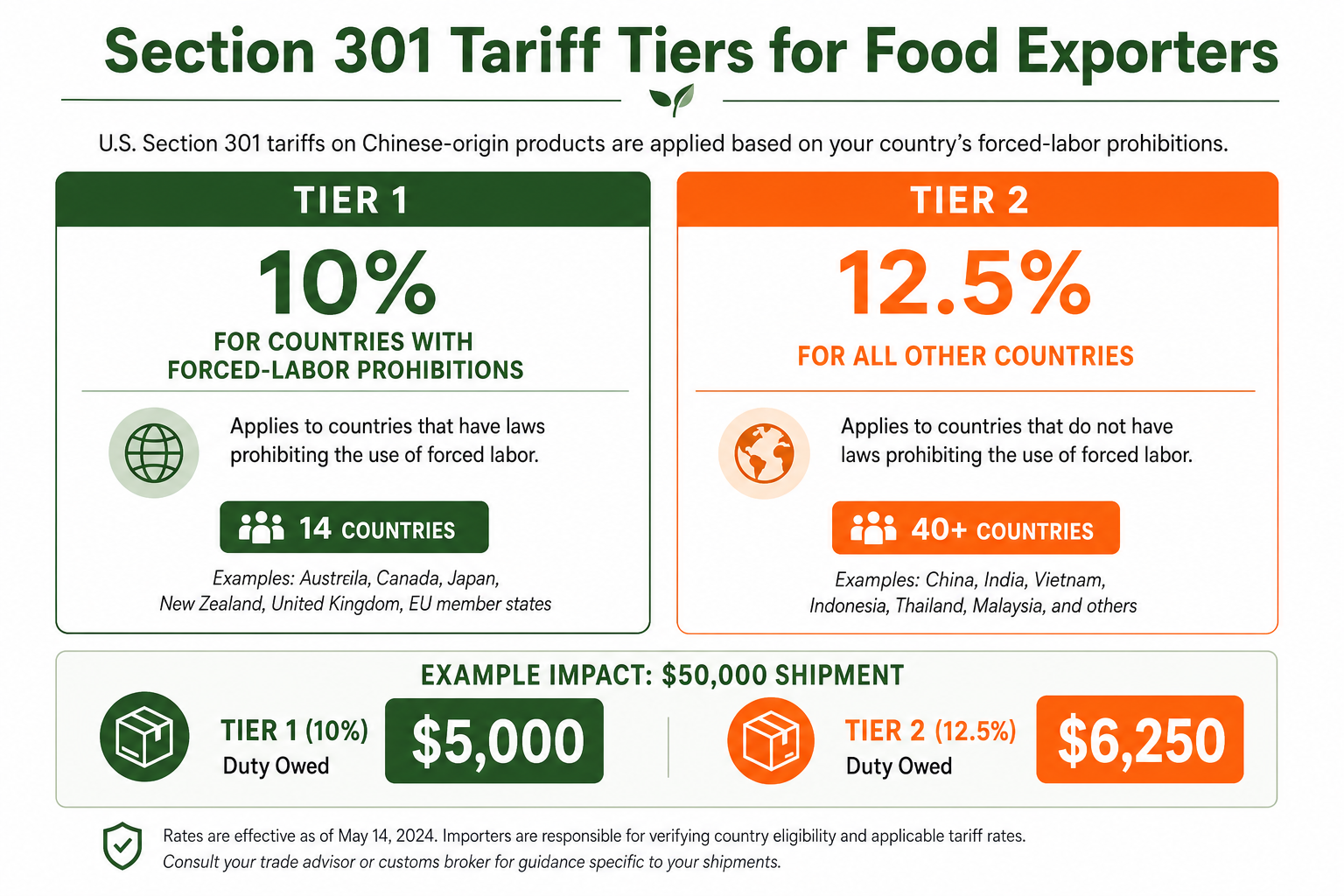
- Proposed rates: 10% for countries that committed to forced-labor prohibitions, 12.5% for all others
- Section 122 10% surcharge expires: July 24, 2026
There is no tariff gap. When Section 122 sunsets, Section 301 is designed to take over — but with a country-specific tiered structure instead of a flat rate. That means the same product from two different origins could face materially different landed costs in the US market.
This article is a practical compliance roadmap. It is not legal advice — work with your trade counsel — but it is the same 7-step workflow we use at FoodExpoConnect when evaluating regulatory shocks. Follow it before July 6.
Why Food Exporters Cannot Wait
Food is a low-margin, high-volume business. A 10-12.5% tariff applied at the border changes everything: which suppliers are competitive, which buyers can afford the price, which payment terms still make sense, and which markets are suddenly more attractive than the US.
The June 25 news digest confirmed the most important detail: the July 7 hearing is the last formal opportunity to request product exclusions or argue for lower rates. Food exporters from Africa, Latin America, and Asia who depend on the US market should be filing comments now — not in August.
If you are a US importer, the same logic applies in reverse. Your landed cost is about to change. Your suppliers may not be able to absorb a 12.5% hit. Your competitors sourcing from the 14 lower-rate countries may suddenly look cheaper.
Section 122 vs. Section 301: What Changed?
| Feature | Section 122 Surcharge | Proposed Section 301 |
|---|---|---|
| Legal authority | IEEPA emergency powers | Section 301 forced-labor / trade practices investigations |
| Rate structure | Flat 10% on covered imports | Tiered 10% or 12.5%, country-specific |
| Scope | Broad, origin-based | 60 economies + forced-labor nexus |
| Exclusion process | Limited, often expired | Comment + hearing window open now |
| Expiration | July 24, 2026 | Expected to replace Section 122 |
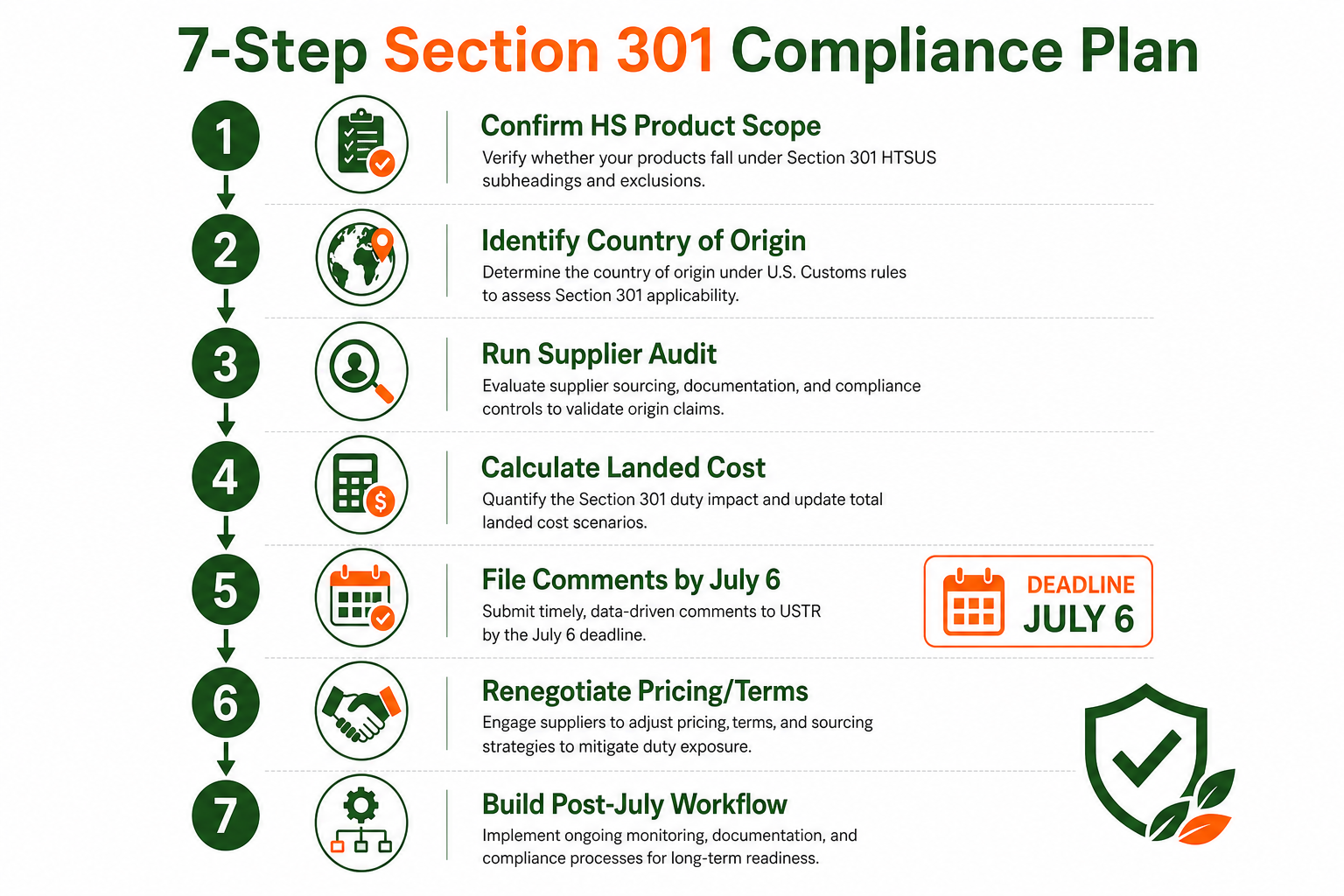
The 7-Step Section 301 Compliance Plan
Step 1: Confirm Your Product Is in Scope
The proposed action covers "all processed foods, beverages, and agricultural products" from the investigated economies — but the actual duty assessment happens at the HS code level. Your first task is to map every product you ship to the US to its 8- or 10-digit classification.
Action items:
- Pull the last 12 months of commercial invoices and customs entries.
- Confirm the HS codes your broker declared.
- Cross-check the USTR annex to see whether those codes fall under the proposed action.
- Flag any product with ambiguous classification. A reclassification can move a product in or out of scope.
Tool tip: If you do not have a structured product master, now is the time to build one. MRPeasy lets you attach HS codes, country of origin, and tariff cost per SKU — which is essential once tiered rates go live. Start a free MRPeasy trial →
Step 2: Identify Country of Origin and Forced-Labor Risk
Section 301 action is tied to the country of origin and, in many cases, to forced-labor findings. The 10% tier applies to countries that have "committed to forced-labor prohibitions." The 12.5% tier applies to countries that have not.
Action items:
- Review the USTR list of 60 economies and identify which tier applies to each of your origins.
- Document the country of origin for every SKU. Remember: origin is not where you ship from; it is where the product underwent substantial transformation.
- Screen your supply chain for forced-labor risk at the raw-material and processing levels.
This step is especially important for commodities like cocoa, coffee, palm oil, and seafood, where raw materials often pass through multiple jurisdictions before export.
Step 3: Run a Supplier Audit for Due Diligence
US Customs and Border Protection (CBP) has been aggressively enforcing the Uyghur Forced Labor Prevention Act (UFLPA) and related forced-labor prohibitions. Even if your direct supplier is clean, CBP can detain shipments if any upstream input is suspect.
Action items:
- Send forced-labor questionnaires to every critical supplier.
- Request certificates of origin, supplier declarations, and chain-of-custody documentation.
- Map your Tier 2 and Tier 3 inputs for high-risk commodities.
- Keep records for at least five years.
If a supplier cannot or will not provide documentation, treat it as a red flag. Buyers and forwarders increasingly require this paperwork before they will move cargo.
Step 4: Calculate Landed Cost Under Both Tiers
You cannot renegotiate pricing or decide whether to exit the US market without knowing your new landed cost. Build a simple model:
Landed cost = EXW price + freight + insurance + duty (new rate) + customs fees + financing cost
Run the calculation for both the 10% and 12.5% tiers. Then run it again for alternative origins you could pivot to.
| Scenario | Duty rate | Duty on $50,000 shipment | Margin impact at 18% gross margin |
|---|---|---|---|
| Current Section 122 | 10% | $5,000 | -5.6% of margin |
| Section 301 — lower tier | 10% | $5,000 | -5.6% of margin |
| Section 301 — higher tier | 12.5% | $6,250 | -6.9% of margin |
| Alternative origin (no extra duty) | 0% | $0 | No impact |
On a $50,000 shipment, the gap between the lower and higher tier is $1,250. Across 20 shipments per year, that is $25,000 — enough to justify sourcing conversations you have been postponing.
Step 5: File Written Comments by July 6
This is the single most time-sensitive action. The USTR hearing on July 7 is the last formal opportunity to shape the final determination. Comments can argue for product exclusions, lower rates, or removal of specific countries from the higher tier.
Action items:
- Draft comments focused on specific HS codes and real economic impact.
- Join industry association comments if you cannot file individually.
- Include data: US jobs supported, consumer price impact, supply-chain indispensability.
- Submit through the USTR Federal Register docket before July 6.
Even a one-page comment with a concrete example is better than silence. Silence means acceptance.
Step 6: Renegotiate Pricing and Payment Terms
Once you know your new landed cost, talk to your buyers and suppliers. Do not absorb a 12.5% duty silently.
Action items:
- Share the tariff impact transparently with US buyers. Most importers expect this conversation in 2026.
- Offer to split the cost or explore alternative Incoterms that shift duty responsibility.
- Use a CRM to track which buyers have been contacted, what they agreed to, and when terms expire. Pipedrive is built for this kind of pipeline. Try Pipedrive free →
FX risk note: If you invoice in USD but source in local currency, a weaker home currency can partially offset the tariff. If you invoice in EUR or GBP to US buyers, the strong dollar makes your goods relatively cheaper — but you still need to model the duty. A multi-currency account from Wise lets you hold funds in the buyer's currency and convert when rates are favorable. Open a Wise Business account →
Step 7: Build a Post-July Compliance Workflow
 After July 24, Section 301 will be the new normal. Build a workflow now so you are not scrambling in August.
Action items:
- Update your product master with tiered duty rates by origin.
- Add forced-labor documentation to your standard shipment file.
- Set calendar reminders for exclusion request windows and future USTR updates.
- Train your logistics and finance teams on the new cost structure.
The exporters who survive tariff shocks with margins intact are the ones who systematize the response.
Affiliate Links Used in This Article
- Wise Business — Multi-currency accounts and transparent FX for exporters navigating tariff-driven price renegotiations.
- MRPeasy — Food manufacturing ERP with HS code, origin, and landed-cost tracking per SKU.
- Pipedrive — Visual CRM for managing buyer and supplier renegotiation pipelines.
Affiliate disclosure: FoodExpoConnect earns a commission when you sign up for Wise, MRPeasy, or Pipedrive through the links in this article. This does not affect the price you pay. We only recommend tools we've tested and that genuinely help food exporters manage compliance and cost.
Questions and answers
- What are the proposed Section 301 tariff rates for food exporters?
- The USTR proposed tiered rates of 10% for countries that committed to forced-labor prohibitions (14 countries) and 12.5% for all others (40+ countries). These are designed to replace the Section 122 10% surcharge that expires July 24, 2026.
- When is the deadline to submit comments on Section 301 tariffs?
- Written comments are due July 6, 2026. Public hearings begin July 7, 2026, in Washington DC. This is the last formal opportunity to request product exclusions or argue for lower rates.
- Which food categories are affected by Section 301 tariffs?
- Affected categories include all processed foods, beverages, and agricultural products from the investigated economies. The exact scope depends on the country of origin and HS classification of each product.
- How can food exporters reduce Section 301 tariff exposure?
- Exporters can reduce exposure by confirming accurate HS classification, documenting country of origin and forced-labor due diligence, filing coalition comments, renegotiating supplier and buyer pricing, exploring alternative sourcing, and using multi-currency accounts to manage FX risk.
Written by

Jean Marc Koffi
Co-authorJournalist & Export SpecialistLondon
Jean Marc Koffi is an MBA-trained trade specialist who connects African exporters to global buyers, with over $20M in contracts facilitated and expertise recognized by major trade organizations. Noted for rapid buyer network building, he is an experienced speaker and certified in trade facilitation, origin rules, and food safety.

Alocha Massamba
Co-authorFounder, Epifresh & FoodExpoConnectLondon
Alocha Massamba is the founder of Epifresh and FoodExpoConnect. He builds the technology, data and partnerships that connect African food producers and exporters to international buyers — with a focus on fresh-produce supply chains, cold-chain logistics, and the buyer-discovery platforms small and mid-size exporters need to compete with global incumbents.
Latest briefings
Trade Policy
July 24: Section 122 Dies, Section 338 Rises — Navigating the New US Tariff Landscape for Food ExportersSection 122 import surcharge expires July 24 (effective US tariff rate drops from ~13% to ~7%), but Section 338 invokes 50% tariffs on Canadian dairy and alcohol. What food exporters must know about the new US tariff landscape.
Market Access
China's Imported Food Market 2026: GB Standards Update, CBEC Channels & Market Entry StrategyComplete guide to China food import regulations in 2026 — new GB 2763 pesticide MRLs, GB 7718 labeling update, CBEC e-commerce channels (Tmall Global, JD Worldwide), and how exporters can access $220B+ of import demand.
Certification
5 Certifications Worth More Than a Price Cut in 2026Stop competing on price. Organic, Fair Trade, Rainforest Alliance, B Corp, and SQF certifications can command 20-300% price premiums for African food exporters in 2026. Here is the ROI data for each.