
FoodExpoConnect Blog
Best ERP Software for Small Food Manufacturers in 2026: MRPeasy vs Odoo vs Katana Compared
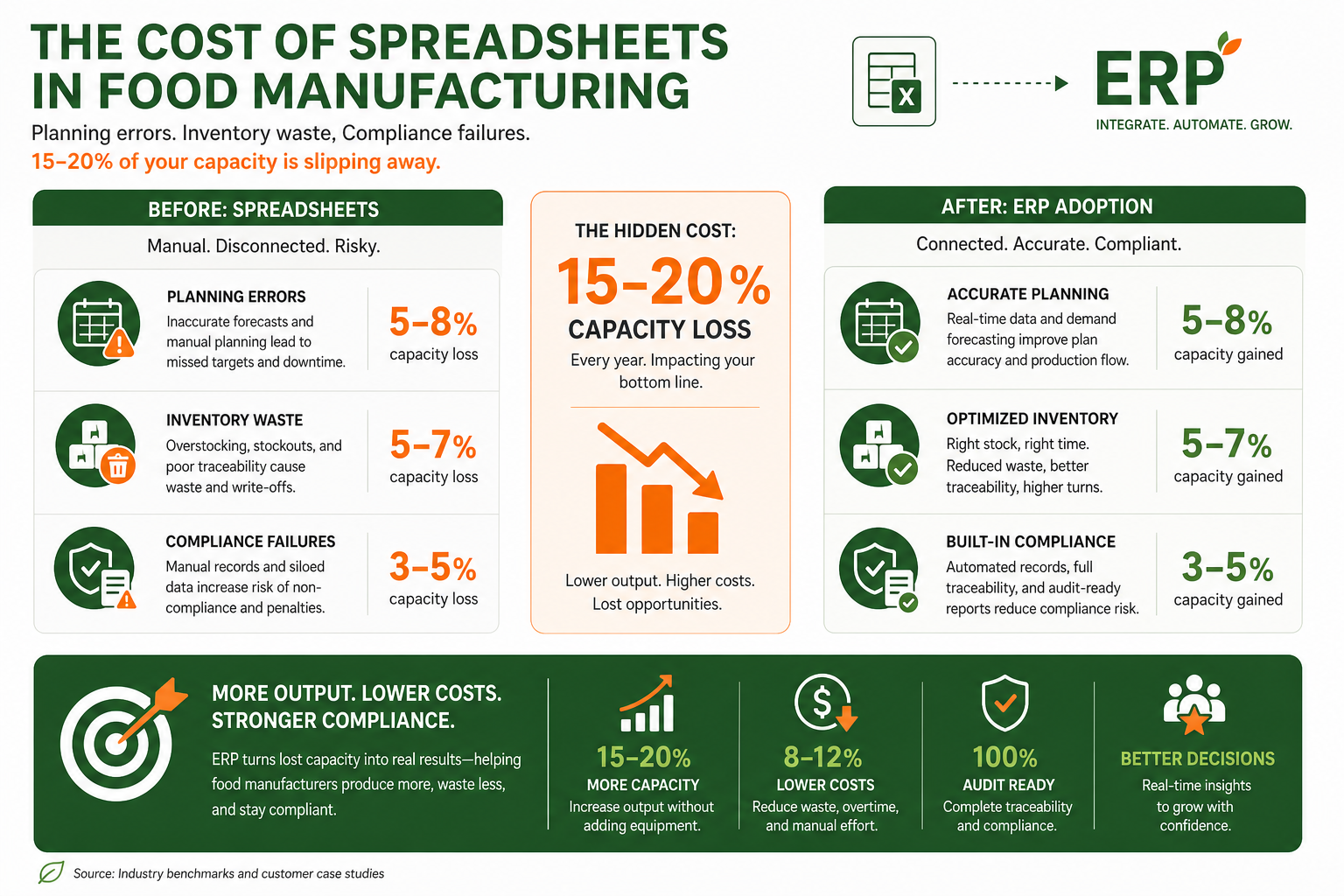
Running a food manufacturing business on spreadsheets and sticky notes costs you 15–20% of production capacity in planning errors, inventory waste, and compliance failures. We compared the top four ERP systems built for small food manufacturers — here's which one actually fits your operation.
Why Spreadsheets Break at Scale in Food Manufacturing
There is a moment every growing food manufacturer recognises. You're managing five products, three production lines, and a team of twelve. The production schedule is in a spreadsheet. Batch records are in another spreadsheet. Inventory is in a third. The HACCP documents are in a folder somewhere.
Then one batch fails a microbiological test. The recall notice goes out. And you spend the next 72 hours manually tracing which lots of which ingredient went into which batches — because the three spreadsheets were never properly linked.
This is not a hypothetical. It is the most common trigger for ERP adoption among small food manufacturers. The second most common is an unexpected retailer audit that exposes gaps in traceability documentation.
The good news: the four systems we compared in this review were all built specifically to prevent this scenario. The differences between them determine which is right for your operation.
The Four Systems We Compared
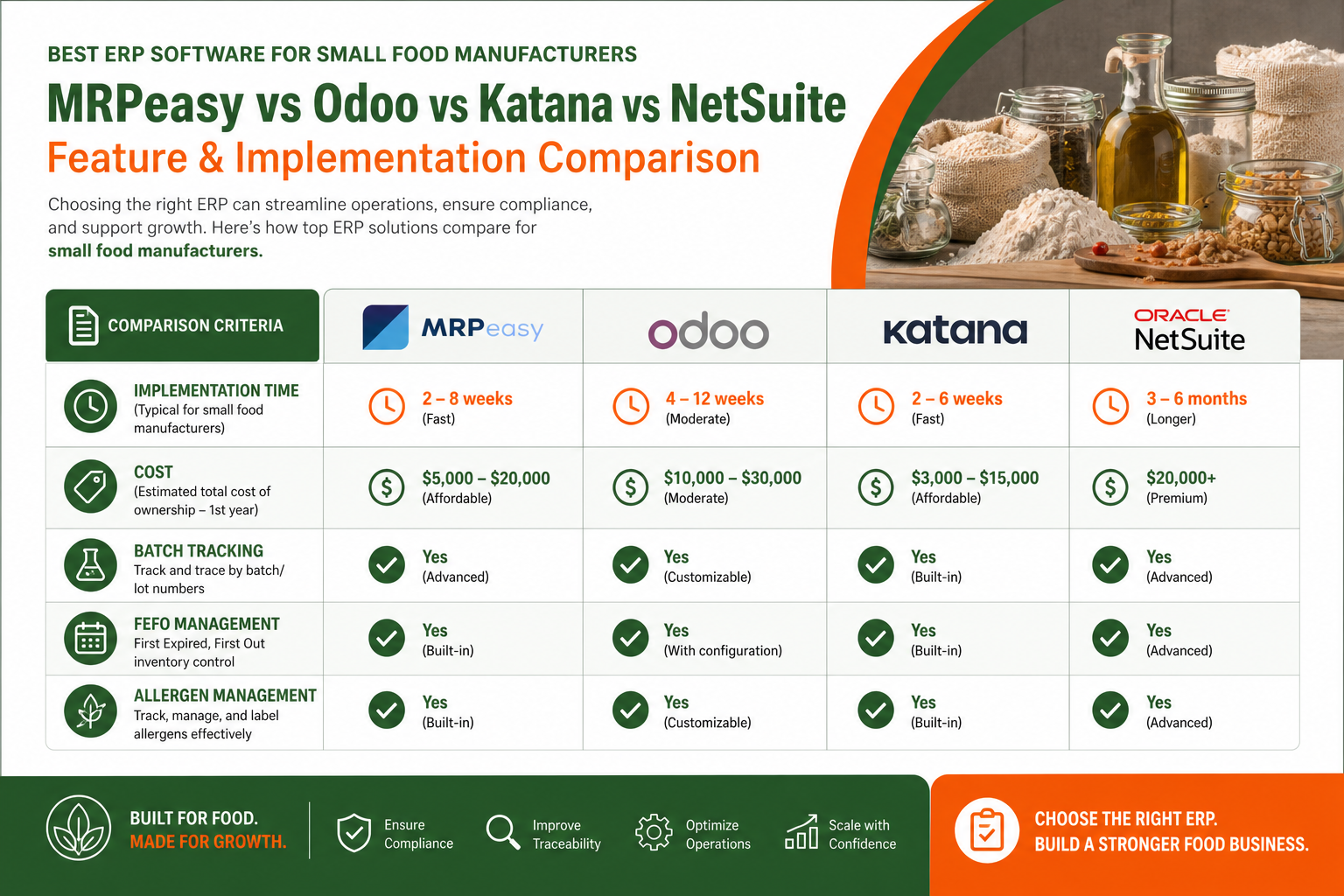
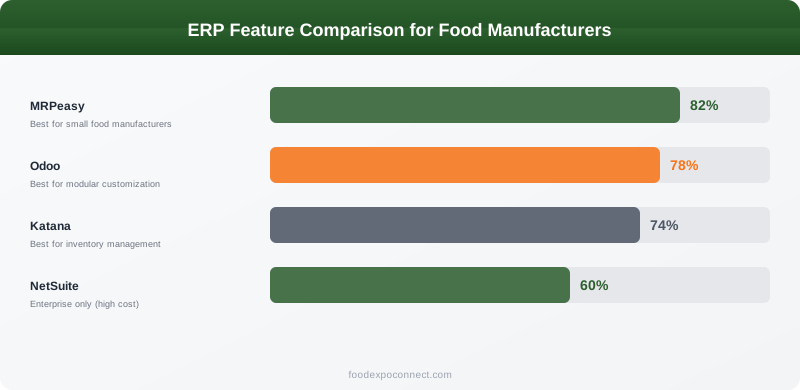
We evaluated MRPeasy, Odoo, Katana, and NetSuite specifically for small food manufacturers — defined as 20–200 employees, 5–150 SKUs, annual revenue $500,000–$15,000,000.
| MRPeasy | Odoo | Katana | NetSuite | |
|---|---|---|---|---|
| Implementation time | 2 weeks (self-setup) | 2–6 months | 1–3 weeks | 6–18 months |
| Minimum monthly cost | ~$196 (4 users) | ~$250+ modules | ~$179 | ~$1,000+ |
| Batch/lot tracking | ✅ Native | ✅ Module required | ✅ Native | ✅ Native |
| FEFO inventory | ✅ Native | ✅ Module required | ✅ Native | ✅ Native |
| Allergen management | ✅ Native | ⚠️ Partial | ❌ Not supported | ✅ Native |
| Supplier certificates | ✅ Native | ⚠️ Custom fields | ❌ Not supported | ✅ Native |
| QuickBooks integration | ✅ Native | ⚠️ Third-party | ✅ Native | ✅ Native |
| Shopify integration | ✅ Native | ✅ Native | ✅ Native | ✅ Native |
| IT team required | ❌ No | ✅ Strongly recommended | ❌ No | ✅ Required |
| Best for | ≤200 employees | Highly customised ops | ≤50 employees | Enterprise |
MRPeasy: The Purpose-Built Solution for Small Food Manufacturers
MRPeasy (Manufacturing Resource Planning — Easy) was built specifically for small and medium-sized manufacturers. It is not a scaled-down version of enterprise software. It was designed from the ground up for operations with 10–200 employees, 5–150 product lines, and no dedicated IT team.
For food manufacturers specifically, it includes capabilities that would require expensive add-on modules in competing systems.
Batch and lot tracking with full traceability. Every production run in MRPeasy gets a batch number. Every ingredient in that batch is tracked back to its supplier lot. If a retailer or regulatory authority requests a traceability report — "which products used Lot #A-2847 of flour?" — you can generate it in under 60 seconds. This is the core FSMA requirement (for US manufacturers) and EU Regulation 178/2002 requirement (for EU food businesses). MRPeasy handles it natively without configuration.
FEFO inventory management. First Expired First Out is the food industry's version of FIFO. When you have multiple lots of the same ingredient with different expiry dates, FEFO ensures your production system uses the earliest-expiring lot first. This sounds simple but is surprisingly difficult to enforce without a dedicated system. MRPeasy tracks expiry dates per lot and automatically prioritises FEFO in production scheduling.
Allergen management on bills of materials. When you configure a product recipe (Bill of Materials) in MRPeasy, you flag which ingredients carry allergens — gluten, nuts, dairy, soy, etc. If a new product or formulation creates an allergen conflict with your existing cleaning protocols or shared equipment, MRPeasy flags it. This is a direct requirement under EU Food Information Consumers Regulation (EU 1169/2011) and US FDA labelling rules.
Supplier certificate tracking. For food manufacturers selling to organic retailers, halal markets, or kosher certification bodies, certificate tracking is critical. MRPeasy lets you attach certificates (organic, halal, kosher, BRC, SQF) to supplier records and set expiry date alerts. When a certificate expires, you're notified before it affects a purchase order.
Two-week self-implementation. This is perhaps MRPeasy's most underrated advantage. Odoo requires an implementation consultant and takes 2–6 months. NetSuite implementations typically run 6–18 months. MRPeasy is designed for a small food manufacturer to set up themselves in two weeks — no IT team, no consultant, no complex data migration project.
MRPeasy Pricing: What Small Manufacturers Actually Pay
MRPeasy's pricing in 2026 is structured around user count, with four tiers:
| Plan | Price/User/Month | Users | Key Features |
|---|---|---|---|
| Starter | $49 | Up to 4 | MRP, production planning, basic BOM, QuickBooks/Xero |
| Professional | $69 | 5–7 | + CRM integration (Pipedrive/Salesforce), advanced reporting, REST API |
| Enterprise | $99 | 8–14 | + Multiple warehouses, advanced analytics, priority support |
| Unlimited | $149 | Unlimited | All features, dedicated account manager |
The minimum real-world cost is $196/month (4 users on Starter). A 6-person team on Professional runs $414/month. An annual commitment earns 2 months free.
For comparison: Odoo's Community Edition is open-source (free) but requires significant development and maintenance. Odoo Enterprise with food-relevant modules typically runs $250–600/month plus implementation costs. NetSuite starts around $1,000/month and scales to $4,000+ for food manufacturers with multiple locations.
The ROI question: if MRPeasy prevents one failed batch per quarter (average batch rejection cost in food manufacturing: $3,000–15,000 depending on product), it pays for itself within the first month.
Odoo: Powerful, But Requires Investment
Odoo is the most configurable ERP on this list. It can handle virtually any business process you can describe — because it can be customised with modules to do almost anything. For food manufacturers with highly unusual workflows, complex multi-location operations, or a technical team to manage customisation, Odoo's flexibility is genuinely valuable.
The challenge is that out of the box, Odoo is not a food manufacturing system. It is a general-purpose ERP that can become a food manufacturing system with the right modules and configuration. Specifically:
- Batch and lot tracking requires the Inventory module (included in Odoo Enterprise)
- FEFO inventory requires additional configuration
- Allergen management requires custom fields or a third-party module
- Supplier certificate tracking requires custom development
If you implement Odoo with an experienced food industry partner, you can build something excellent. But the implementation timeline (typically 2–6 months) and ongoing maintenance cost are real considerations.
Odoo Community (open-source) is free to use if you have technical resources to host and maintain it. Odoo Enterprise starts at approximately $250/month for 5 users and scales with user count and modules.
Katana: Best for Small DTC Food Brands
Katana was designed for small-batch craft manufacturers selling direct-to-consumer — think artisan chocolate makers, specialty sauce producers, or small-batch supplement brands. It has a clean, intuitive interface and genuinely excellent Shopify integration.
For food manufacturers, Katana supports batch and lot tracking and FEFO inventory, which covers the core compliance requirements. However, it does not support allergen management on bills of materials or supplier certificate tracking — a significant gap if you're selling to retailers that require detailed allergen documentation or managing certified ingredient suppliers.
Katana pricing starts at $179/month (10 users). For a direct-to-consumer food brand doing $300,000–$1,500,000 in annual revenue, Katana's simplicity and Shopify integration make it worth evaluating. For food manufacturers selling to retailers and distributors with compliance requirements, MRPeasy's food-specific features justify the slight price premium.
NetSuite: The Enterprise Choice (When You're Ready for It)
NetSuite is the destination ERP for food companies planning to scale to $10M+ in revenue with multiple sites, complex supply chains, and dedicated finance and operations teams. It is genuinely excellent software with comprehensive food industry capabilities.
It is not the right choice for a company with 20–80 employees. The implementation cost alone (typically $50,000–$200,000 with a NetSuite partner), the monthly licensing fees ($1,000–4,000+), and the 6–18 month implementation timeline put it out of reach for most of the food manufacturers this article addresses.
The common path: implement MRPeasy now, migrate to NetSuite when your operations reach a scale and complexity that requires it (typically $8–15M in revenue with 3+ production sites). MRPeasy's structured data export makes migration easier than migrating from spreadsheets.
The 2-Week MRPeasy Implementation Plan
For food manufacturers who have decided to move forward with MRPeasy, here is the realistic implementation sequence:
Day 1–3: Configuration. Create your product catalogue (items you manufacture, raw materials, packaging). Build bills of materials for each finished product — ingredient list, quantities, production steps. Configure work centres (the production lines or stations where work happens). Set up your user accounts and roles.
Day 4–5: Connect your accounting. MRPeasy connects natively to QuickBooks Online, QuickBooks Desktop, and Xero. The initial sync takes 30–60 minutes and maps your chart of accounts. After setup, purchase orders in MRPeasy automatically create bills in QuickBooks; production completions automatically update inventory values.
Day 6–7: Configure compliance settings. Enable lot tracking for all raw materials and finished goods. Configure FEFO for perishable ingredients. Set up allergen flags on relevant BOMs. Add supplier records with certificate tracking fields.
Day 8–10: Parallel running. Run MRPeasy alongside your current system for the first production week. Input all production orders into both systems. This identifies any gaps in your BOM data or configuration before you fully switch over.
Day 11–14: Go live. Switch to MRPeasy as your primary system. Archive your spreadsheets (don't delete — keep them as backup reference for the first month). Train any remaining team members who haven't been through the system yet.
Most food manufacturers who follow this sequence report feeling comfortable in MRPeasy within 3–4 weeks of going live.
Real Compliance Scenarios: What MRPeasy Handles Automatically
Scenario 1: Allergen cross-contamination alert. A new product formulation uses hazelnuts on a line that previously only produced nut-free products. When your production planner schedules the batch, MRPeasy flags the allergen conflict and requires acknowledgment of cleaning protocols before the work order can proceed.
Scenario 2: Ingredient recall. A supplier announces a voluntary recall of a specific lot of dried chillies. In MRPeasy: search by supplier and lot number. The system shows every finished batch that used that specific lot, every customer order those batches fulfilled, and the current inventory of affected product. A full traceability report — which in a spreadsheet-based operation might take 2 days — is generated in under a minute.
Scenario 3: Retailer audit preparation. A major UK retailer requests documentation for their annual supplier audit, including lot traceability, allergen management procedures, and supplier certificate status for your organic ingredients. MRPeasy generates the traceability reports directly. The allergen management documentation is the configured BOM records. Supplier certificates are in the supplier profile with expiry dates. An audit that previously required a week of document preparation takes one afternoon.
Scenario 4: FEFO failure prevention. You have two lots of cocoa butter in the warehouse: Lot A with 60 days to expiry, Lot B with 45 days. A production order is created. MRPeasy automatically allocates Lot B first (earliest expiry), preventing the scenario where production uses Lot A and Lot B expires unused.
The Total Cost of Not Having an ERP
Before making a decision based on monthly subscription cost, it's worth calculating what your current system is actually costing you.
A 10-person food manufacturing team spending an average of 3 hours per week each on production scheduling, inventory reconciliation, and compliance documentation: 30 person-hours per week × $25/hour average = $750/week, $39,000/year in labour devoted to processes that an ERP automates.
Production planning errors (wrong quantities, missed schedule changes, raw material shortages): industry average 15–20% of capacity lost to planning-related issues in operations without ERP. On a $1,000,000 annual production value: $150,000–200,000 in lost capacity annually.
Ingredient waste from FEFO failures: a small food manufacturer without FEFO tracking typically writes off 2–5% of perishable ingredient value annually to expiry. On $200,000 in annual ingredient spend: $4,000–10,000 in avoidable waste.
Against these numbers, MRPeasy at $200–400/month ($2,400–4,800/year) is not a cost. It is a recovery of costs you are already incurring.
📘 Get the ERP Requirements Workbook →
Requirements gathering workbook for small food manufacturers evaluating ERP systems. Batch tracking, lot traceability, recipe management, and compliance documentation needs mapped to vendor capabilities.
Free download — no email required.
Start Your Free 15-Day MRPeasy Trial
Try MRPeasy free for 15 days →
No credit card required · Includes batch tracking, allergen management, QuickBooks integration · Free onboarding support
FoodExpoConnect earns a commission if you purchase MRPeasy through this link (20% recurring commission for 3 years). We only recommend tools we believe deliver genuine value for food manufacturers and exporters.
Frequently asked questions
Do small food manufacturers really need an ERP system?
What ERP features are specific to food manufacturing?
How long does it take to implement a food manufacturing ERP?
What is MRPeasy pricing for food manufacturers?
Does MRPeasy integrate with QuickBooks and Shopify?
Quick facts
Published: 6/8/2026
Reading time: 15 min
Pillars: Manufacturing, Operations
Written by

Jean Marc Koffi
Co-authorJournalist & Export SpecialistLondon
Jean Marc Koffi is an MBA-trained trade specialist who connects African exporters to global buyers, with over $20M in contracts facilitated and expertise recognized by major trade organizations. Noted for rapid buyer network building, he is an experienced speaker and certified in trade facilitation, origin rules, and food safety.

Alocha Massamba
Co-authorFounder, Epifresh & FoodExpoConnectLondon
Alocha Massamba is the founder of Epifresh and FoodExpoConnect. He builds the technology, data and partnerships that connect African food producers and exporters to international buyers — with a focus on fresh-produce supply chains, cold-chain logistics, and the buyer-discovery platforms small and mid-size exporters need to compete with global incumbents.
Explore more export intelligence
Certification • Pricing Strategy • Market Access
5 Certifications Worth More Than a Price Cut in 2026
Stop competing on price. Organic, Fair Trade, Rainforest Alliance, B Corp, and SQF certifications can command 20-300% price premiums for African food exporters in 2026. Here is the ROI data for each.
Coffee Export • Market Access • EU Regulations
Coffee Export 2026: African Origins, Fair Trade Pricing & EU Market Access
Complete guide to coffee export from Ethiopia, Kenya and Rwanda — EUDR compliance, fair trade pricing, certification requirements, and how to access €12-18/kg EU buyer contracts in 2026.
Market Access • Africa Trade • Export Strategy
China Zero-Tariff Policy for African Food Exporters: Coffee Imports Surge 145.7% — How to Enter the World's Largest Market Duty-Free
China's zero-tariff policy covering 53 African countries is already producing dramatic results — coffee imports surged 145.7% in the first five months. How food exporters can access this duty-free window and bypass traditional tariff barriers.