
FoodExpoConnect Blog
SeriesCompliance Deadlines 2026EUDR Compliance 2026: What the Deforestation Regulation Means for Food Exporters (Deadline + Checklist)
The EU Deforestation Regulation enforcement deadline is December 2026. A May 2026 simplification package cut compliance costs by 75%. Here's what coffee, cocoa, palm oil, and soy exporters need to do now.
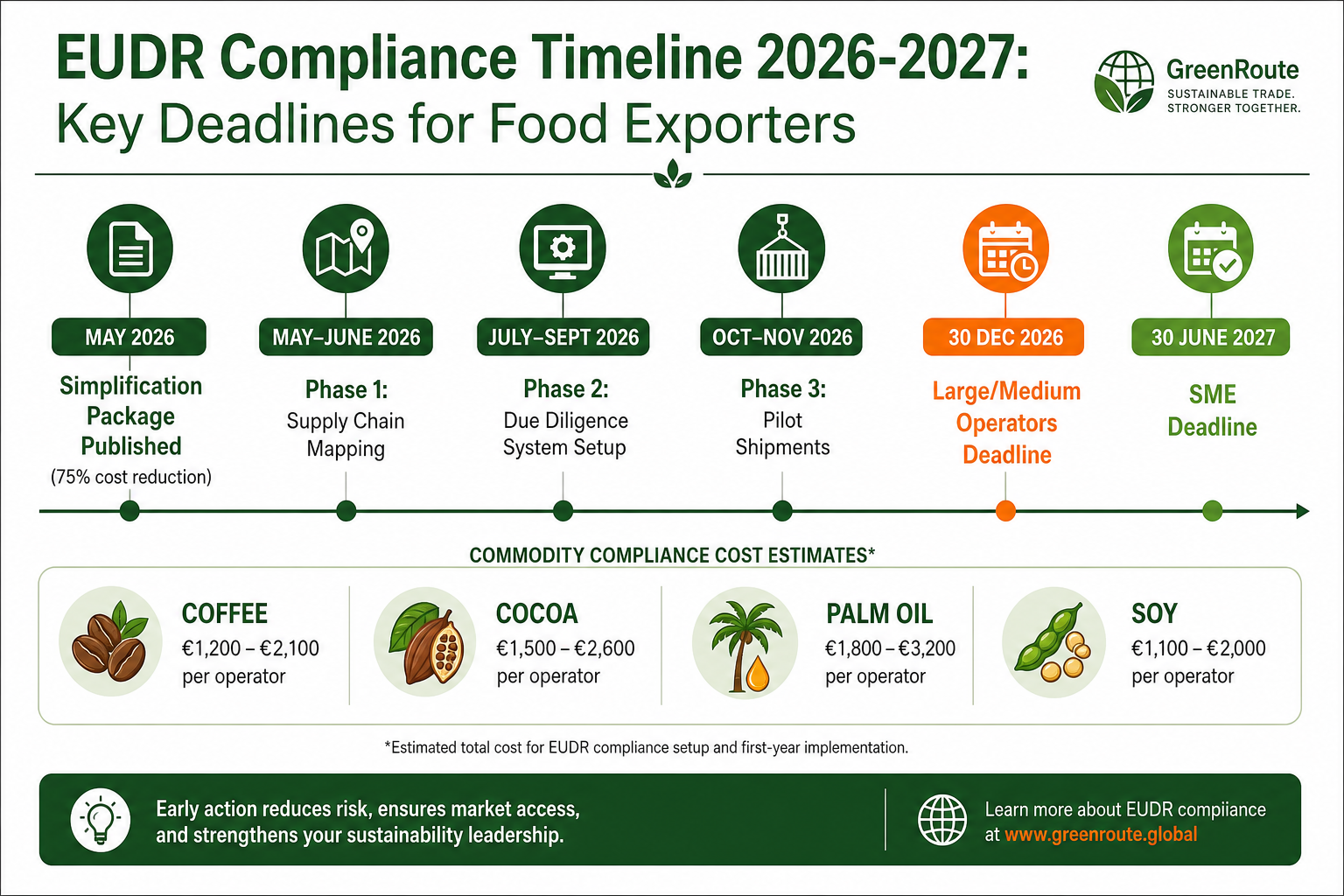
If you export coffee, cocoa, palm oil, soy, or wood products to the European Union, the EU Deforestation Regulation (EUDR) is the single most consequential regulatory change your business will face this decade. The enforcement clock is ticking: 30 December 2026 for large and medium operators, 30 June 2027 for small enterprises.
But here's what most coverage misses: a May 2026 simplification package has quietly cut compliance costs by roughly 75%, introduced a streamlined due diligence path for smaller operators, and clarified product scope — including explicitly adding soluble coffee and palm oil derivatives. If you've been putting off EUDR preparation because it seemed impossibly complex or expensive, the calculus has changed.
What the EUDR Actually Requires
The regulation's central prohibition is straightforward: commodities and products placed on the EU market must be deforestation-free — produced on land not subject to deforestation after 31 December 2020 — and legally produced under the country of origin's laws.
The practical requirements for exporters fall into four categories:
1. Geolocation Data
This is the most operationally demanding requirement. For every shipment, operators must provide precise geolocation coordinates (latitude and longitude) of all plots of land where the commodities were produced. For farms larger than 4 hectares, polygon mapping is required. For smaller plots, a single coordinate point may suffice.
For a cocoa exporter sourcing from 500 smallholder farmers across Côte d'Ivoire, this means mapping 500 individual plots — a significant data collection exercise. Industry estimates suggest the geolocation requirement alone accounts for 40-60% of total compliance costs.
2. Due Diligence Statement
Before placing products on the EU market, operators must submit a due diligence statement through the EU's electronic information system. The statement must include:
- Product description (HS code, quantity, country of production)
- Geolocation of production plots
- Evidence that the product is deforestation-free
- Evidence of legal production
- Risk assessment conclusion
- Risk mitigation measures taken (if any)
The May 2026 simplification introduced a Simplified Due Diligence Statement for micro and small primary operators, reducing the required information fields by roughly half.
3. Risk Assessment and Mitigation
Operators must assess and document the risk that their products are linked to deforestation. The EU provides a country benchmarking system that classifies countries as low, standard, or high risk. Products from low-risk countries face simplified due diligence; products from high-risk countries face enhanced scrutiny and a mandatory 9% check rate by competent authorities.
4. Traceability to Plot
This is the requirement that separates EUDR from previous certification schemes. It is not enough to be "certified sustainable" — you must trace each shipment to the specific plot(s) of land where it was produced. Mass balance and book-and-claim systems do not satisfy EUDR. Physical segregation and identity preservation are effectively required.
The May 2026 Simplification: What Changed
On 8 May 2026, the European Commission published a simplification package that substantially reduces the compliance burden. The key changes:
Simplified Due Diligence Statement for SMEs: Micro and small primary operators can now use a reduced-information due diligence statement, cutting the number of required fields by approximately 50%.
Voluntary grouping provisions: Multiple small operators can now form a "group" and submit a single consolidated due diligence statement covering all members' products. This is particularly valuable for cooperative structures — a cocoa cooperative with 2,000 farmer-members can file one statement rather than 2,000 individual ones.
Updated product scope: The simplification explicitly added soluble coffee and palm oil derivatives to the covered products list, resolving ambiguity that had created compliance uncertainty. It also clarified that composite products (e.g., a chocolate bar containing both cocoa and palm oil) require due diligence for each covered ingredient.
Upgraded IT system: The EU's electronic due diligence submission system has been rebuilt with simplified user interfaces, API access for integration with exporter ERP systems, and pre-populated country risk data.
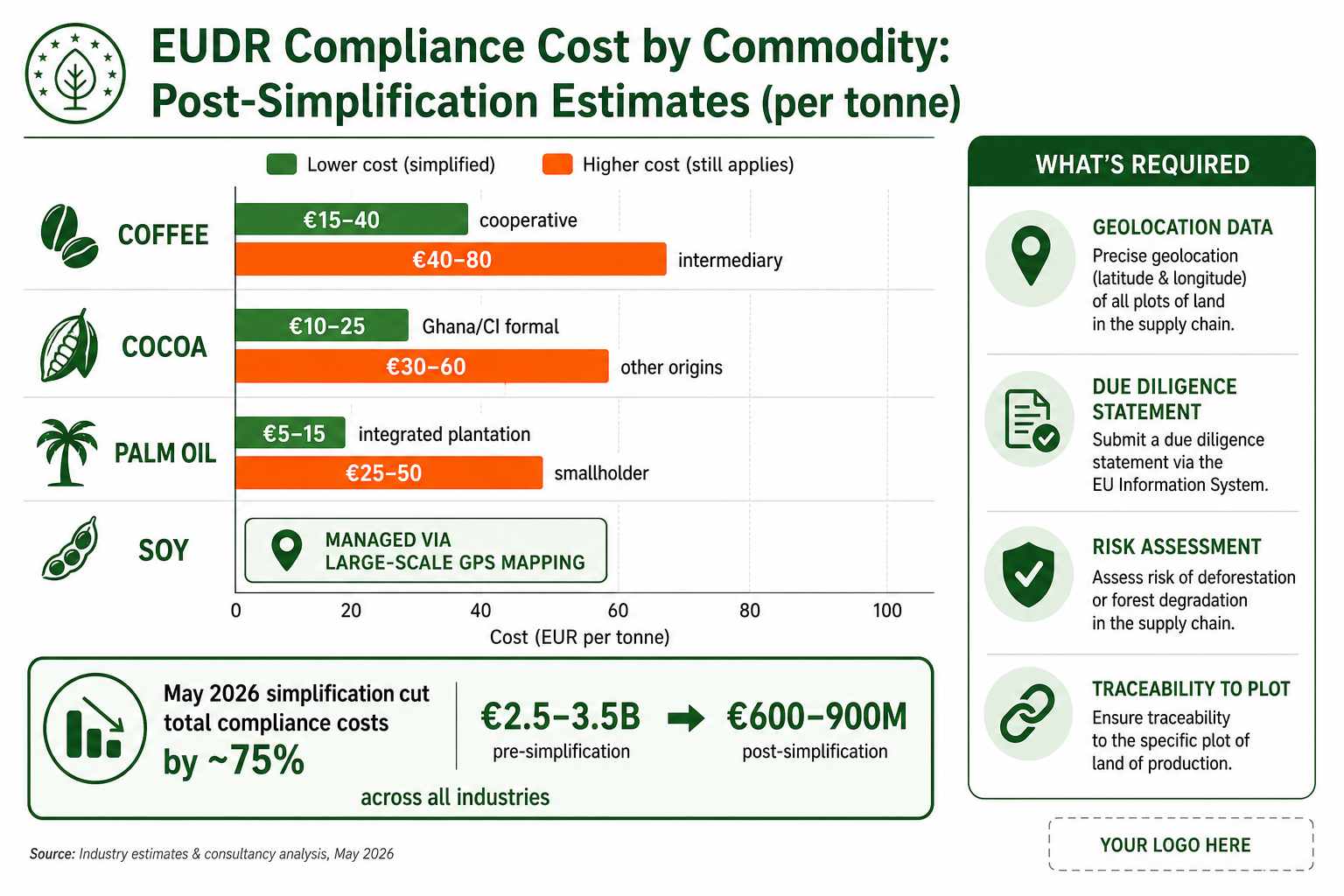
Cost reduction: The Commission estimates the simplification package reduces total annual compliance costs across affected industries by approximately 75% — from an estimated €2.5-3.5 billion to roughly €600-900 million.
Who Is Affected and When
The EUDR applies to "operators" (entities that place covered products on the EU market for the first time) and "traders" (entities that further distribute products already on the market). Both EU-based and non-EU companies are covered.
| Operator category | Compliance deadline |
|---|---|
| Large and medium operators | 30 December 2026 |
| Micro and small enterprises (SMEs) | 30 June 2027 |
| Traders (non-SME) | 30 December 2026 |
| SME traders | 30 June 2027 |
The SME threshold is defined by the EU's standard criteria: fewer than 250 employees and either annual turnover ≤ €50 million or balance sheet total ≤ €43 million. Most food exporters from developing countries fall into the SME category.
Commodity-by-Commodity Impact
Coffee
Coffee is one of the most EUDR-impacted commodities. The EU imports roughly 40% of the world's coffee, and approximately 60% of that comes from smallholder farmers cultivating plots under 5 hectares. The geolocation requirement hits coffee particularly hard because supply chains are fragmented — a single export container may contain beans from hundreds of individual farmers.
The May 2026 simplification's voluntary grouping provision is especially valuable for coffee cooperatives. A cooperative can now map all member farms and submit a single consolidated due diligence statement, dramatically reducing per-farmer compliance costs.
Estimated compliance cost per tonne (post-simplification): €15-40 for cooperative-structured supply chains; €40-80 for intermediary-buyer supply chains.
Cocoa
Cocoa faces similar structural challenges to coffee — smallholder-dominated supply chains in West Africa (Côte d'Ivoire and Ghana produce roughly 60% of the world's cocoa). However, cocoa has an advantage: the industry has already invested heavily in traceability through the Ghana Cocoa Board's Cocoa Management System and Côte d'Ivoire's Conseil du Café-Cacao farmer registration programme.
Cocoa exporters who source through these national traceability systems will find EUDR compliance more straightforward than those sourcing through informal channels. The EU has signalled that these national systems will be recognised for due diligence purposes.
Estimated compliance cost per tonne (post-simplification): €10-25 for Ghana/Côte d'Ivoire formal supply chains; €30-60 for other origins.
Palm Oil
Palm oil is the most politically sensitive EUDR commodity. Indonesia and Malaysia — which together produce roughly 85% of the world's palm oil — have protested the regulation as discriminatory and have filed a WTO complaint.
However, large palm oil exporters generally have better traceability infrastructure than coffee or cocoa exporters because the industry is more vertically integrated. Major plantation companies already maintain plot-level production data. The compliance burden falls disproportionately on independent smallholders who supply mills without formal traceability systems.
Estimated compliance cost per tonne (post-simplification): €5-15 for integrated plantation supply chains; €25-50 for smallholder supply chains.
Soy
Soy is the commodity where EUDR has the greatest trade flow impact. The EU imports roughly 33 million tonnes of soy annually (primarily for animal feed), mostly from Brazil, the United States, and Argentina. Brazilian soy in particular faces scrutiny due to Cerrado and Amazon deforestation.
The geolocation requirement is manageable for large-scale soy producers in Brazil's Mato Grosso state, where farms average thousands of hectares and GPS mapping is standard practice. But the "legal production" requirement is more complex — Brazil's Forest Code allows varying levels of deforestation depending on the biome, and determining compliance requires legal expertise.
Practical Compliance Roadmap
For food exporters facing the December 2026 deadline, here is a phased approach:
Phase 1: Supply Chain Mapping (May-June 2026)
Map every source of covered commodities in your supply chain. For each source, document:
- GPS coordinates of production plots
- Farm size (to determine polygon vs. point requirement)
- Deforestation status (satellite imagery or official land-use records)
- Legal production status (land title, environmental permits, harvest authorisations)
- Country risk classification under the EU benchmarking system
Phase 2: Due Diligence System Setup (July-September 2026)
Establish or procure a due diligence management system. Options include:
- EU electronic system (free): The official submission portal. Basic functionality, suitable for operators with simple supply chains.
- Third-party compliance platforms: Companies like TraceX, PSQR, and Preferred by Nature offer EUDR-specific compliance software with API integration, automated risk assessment, and document management. Costs range from €5,000-25,000 annually for SME-scale operations.
- ERP integration: For larger exporters, integrating EUDR compliance into existing ERP systems avoids duplicate data entry.
Phase 3: Pilot Shipments (October-November 2026)
Run 2-3 pilot shipments through the complete EUDR compliance process before the deadline. Identify data gaps, procedural bottlenecks, and supplier compliance issues. Fix them before they become enforcement problems.
Phase 4: Full Compliance (December 2026)
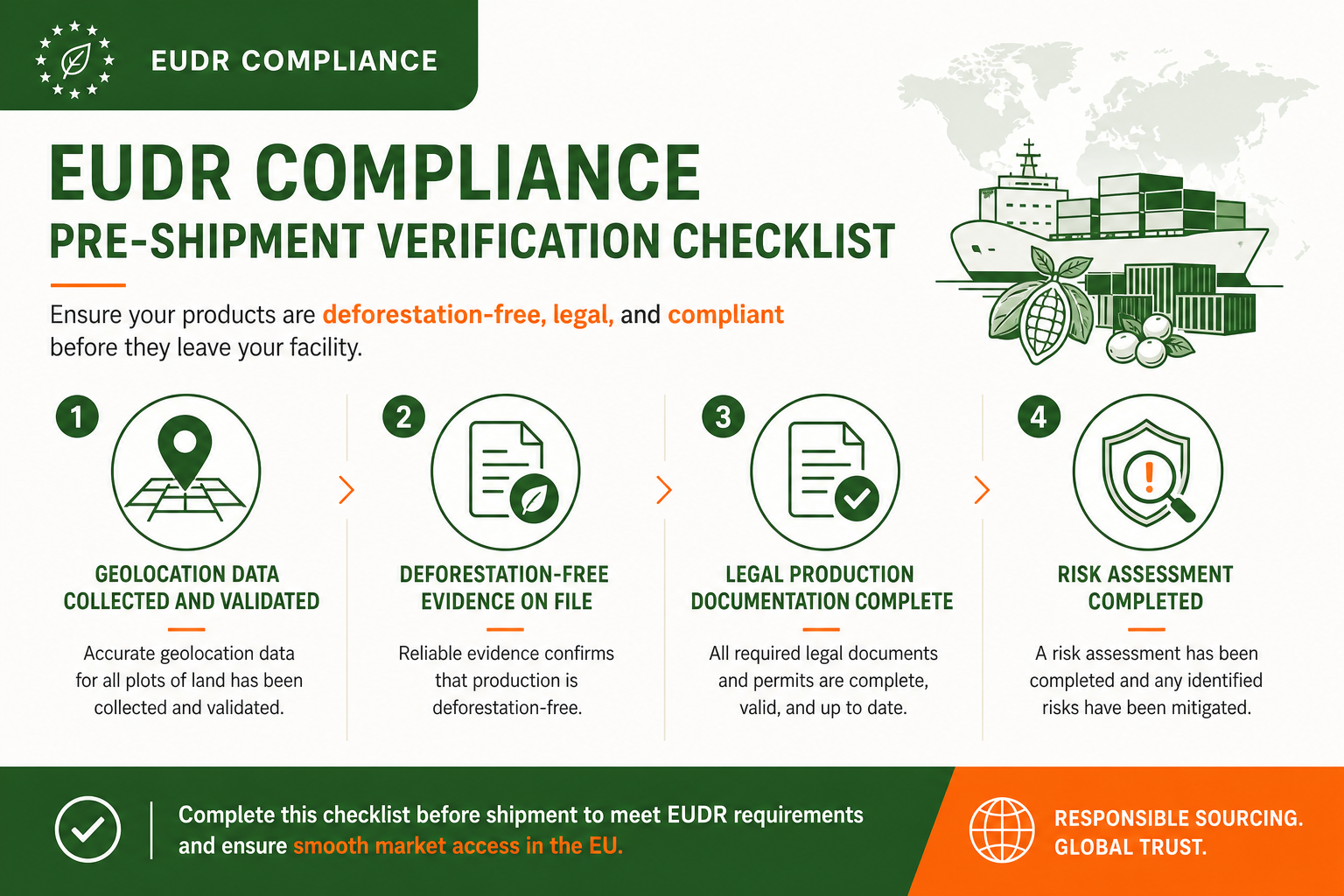
All shipments to the EU from the deadline date must include complete EUDR due diligence. Establish a pre-shipment checklist that verifies:
- Geolocation data collected and validated
- Deforestation-free evidence on file
- Legal production documentation complete
- Risk assessment completed
- Due diligence statement submitted
What Happens If You Don't Comply
EU member states are responsible for enforcement. The regulation mandates that competent authorities check at least 1% of operators from low-risk countries, 3% from standard-risk, and 9% from high-risk. These checks can include:
- Examination of due diligence documentation
- On-the-ground inspections in producing countries
- Satellite monitoring and isotopic testing to verify origin claims
- DNA testing for timber species verification
Penalties for non-compliance include:
- Fines of up to 4% of the operator's annual EU turnover
- Confiscation of non-compliant products
- Exclusion from public procurement for up to 12 months
- Temporary prohibition from placing products on the EU market
Critically, EUDR enforcement applies at the point of entry. If a shipment of coffee arrives at Rotterdam without complete due diligence, it cannot be cleared through customs. The exporter bears the cost of destruction, re-export, or compliance retrofitting.
📅 Download the EUDR Compliance Timeline →
Month-by-month compliance timeline for EUDR 2026 deadline. Due diligence template, commodity-specific requirements, and geolocation data standards for food exporters.
Free download — no email required.
The Strategic Opportunity
For exporters who invest in EUDR compliance early, the regulation creates a competitive advantage. EU buyers — facing their own compliance obligations and liability — will preferentially source from suppliers who can demonstrate robust EUDR compliance. The exporters who show up in November 2026 with complete geolocation data, documented due diligence, and a demonstrable compliance system will win business that less-prepared competitors lose.
Several EU food manufacturers have already announced that they will require full EUDR compliance from all suppliers by September 2026 — three months ahead of the legal deadline — to ensure their own compliance buffers.
The May 2026 simplification makes this achievable for most exporters. The cost has come down. The process has been streamlined. The tools exist. What's left is execution.
Jean-Marc du Plessis is a food export strategist and former trade compliance officer. He holds certifications in ECOWAS trade regulations, AfCFTA rules of origin, and HACCP food safety management, and has advised over 60 African food exporters on EU market access.
Frequently asked questions
When is the EUDR enforcement deadline?
What food commodities does the EUDR cover?
What information do exporters need to provide for EUDR compliance?
What happens if my exports don't comply with EUDR?
How much does EUDR compliance cost?
Quick facts
Published: 5/8/2026
Reading time: 14 min
Pillars: EU Market, Certification
Written by

Jean Marc Koffi
Co-authorJournalist & Export SpecialistLondon
Jean Marc Koffi is an MBA-trained trade specialist who connects African exporters to global buyers, with over $20M in contracts facilitated and expertise recognized by major trade organizations. Noted for rapid buyer network building, he is an experienced speaker and certified in trade facilitation, origin rules, and food safety.

Alocha Massamba
Co-authorFounder, Epifresh & FoodExpoConnectLondon
Alocha Massamba is the founder of Epifresh and FoodExpoConnect. He builds the technology, data and partnerships that connect African food producers and exporters to international buyers — with a focus on fresh-produce supply chains, cold-chain logistics, and the buyer-discovery platforms small and mid-size exporters need to compete with global incumbents.
Series
More in Compliance Deadlines 2026
How to Get HACCP Certification for Food Export: Step-by-Step Guide 2026
Have you ever wondered what it takes for a small coffee exporter to thrive in a competitive global market? Picture this: a bustling warehouse filled with the aroma of freshly roasted beans, ready to ship to discerning buyers in Europe who demand high food safety standards. For many exporters, ach...
EU Organic Certification vs USDA Organic: Which One Do You Need for Export?
Compare EU Organic and USDA Organic certification standards across produce, grains, dairy, meat, and processed foods to choose the right certification for your export markets.

How to Export Organic Products: Certification, Markets & Pricing Premium Guide 2026
Learn how to obtain organic certification, identify lucrative export markets, and implement premium pricing strategies to boost your organic product revenue by 15-30% in 2026.
Explore more export intelligence
Certification • Pricing Strategy • Market Access
5 Certifications Worth More Than a Price Cut in 2026
Stop competing on price. Organic, Fair Trade, Rainforest Alliance, B Corp, and SQF certifications can command 20-300% price premiums for African food exporters in 2026. Here is the ROI data for each.
Coffee Export • Market Access • EU Regulations
Coffee Export 2026: African Origins, Fair Trade Pricing & EU Market Access
Complete guide to coffee export from Ethiopia, Kenya and Rwanda — EUDR compliance, fair trade pricing, certification requirements, and how to access €12-18/kg EU buyer contracts in 2026.
Market Access • Africa Trade • Export Strategy
China Zero-Tariff Policy for African Food Exporters: Coffee Imports Surge 145.7% — How to Enter the World's Largest Market Duty-Free
China's zero-tariff policy covering 53 African countries is already producing dramatic results — coffee imports surged 145.7% in the first five months. How food exporters can access this duty-free window and bypass traditional tariff barriers.