
FoodExpoConnect Blog
Pricing Premium for African Food Exports: How to Capture 25-40% Margin Uplift Through Premium Positioning (2026)
African food exporters routinely leave 25-40% margin on the table by selling commodity-grade. We break down the premium positioning strategies — certification, storytelling, packaging, and direct buyer relationships — that turn $4/kg cashews into $12/kg specialty product.
Introduction: The $4.7 Billion Gap
Here is a number that should reshape how you think about your export business: African food exporters capture roughly 8-12% of the final retail value of their products. The remaining 88-92% accrues to intermediaries, processors, packagers, distributors, and retailers — almost entirely outside Africa.
This is not a tariff problem. It is a positioning problem.
A Ghanaian cocoa farmer sells fermented beans at $2,800 per tonne. That same cocoa, processed into single-origin chocolate bars in Belgium, retails for the equivalent of $28,000-35,000 per tonne. The difference is not logistics cost (shipping cocoa beans to Europe costs roughly $150/tonne). The difference is the premium that comes from certification, storytelling, processing, packaging, and direct access to consumers willing to pay for origin and quality.
The same pattern repeats across virtually every African export category. Ethiopian Yirgacheffe coffee sells at auction for $4-7/kg. Roasted and packaged as single-origin specialty coffee in London or Berlin, it retails at $35-60/kg. West African cashew nuts: $3-5/kg FOB. Organic-certified, dry-roasted, packaged cashews in European supermarkets: $12-18/kg.
In 2026, the tools to capture more of this value chain exist. Certification programmes have streamlined. Digital B2B platforms connect producers directly with specialty buyers. Consumer demand for origin transparency has never been stronger. What is missing for most African exporters is the practical playbook — the specific steps that turn a commodity product into a premium-positioned brand.
This article is that playbook.
What you will learn:
- The exact premium structure for 7 major African export products
- Which certifications deliver the highest ROI — with real cost and timeline data
- How to build a product story that European buyers actually respond to
- The packaging and processing investments that justify 2-3× pricing
- Where to find premium buyers who are actively seeking African-origin products
- One ingredient that can transform your commodity into a premium differentiator
The Premium Pricing Ladder: What Each Level Is Worth
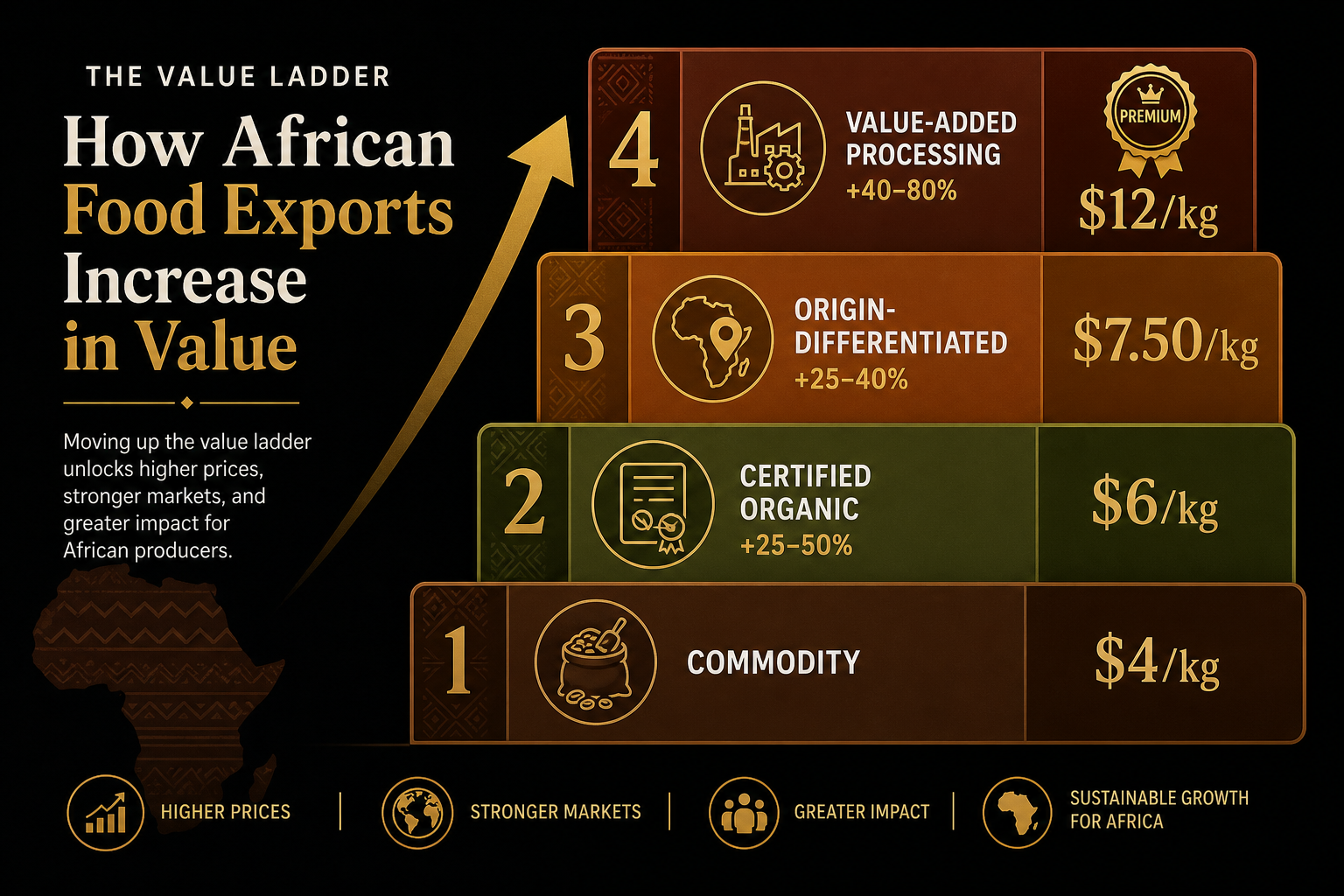
Premium pricing is not a binary switch — commodity versus premium. It is a ladder, and each rung adds incremental value. Understanding exactly what each rung is worth allows you to make investment decisions with clear ROI expectations.
Level 1: Certified Commodity (+15-25%)
The entry-level premium. You are selling the same product, but with documentation that proves quality and/or ethical sourcing standards.
| Certification | Typical Premium | Certification Cost (Annual) | Timeline | Best For |
|---|---|---|---|---|
| Organic (EU/USDA) | 25-50% above conventional | $3,000-8,000/year | 12-36 months (conversion) | All product categories |
| Fairtrade | $200-400/tonne + Minimum Price floor | $2,000-5,000/year | 3-6 months | Cooperatives, cocoa, coffee |
| Rainforest Alliance | 5-15% above conventional | $1,500-4,000/year | 6-12 months | Coffee, cocoa, tea |
| GLOBALG.A.P. | 10-20% above conventional | $5,000-12,000/year | 6-12 months | Fresh produce, fruits |
Real example — Cashew nuts (Côte d'Ivoire, 2026):
- Conventional raw cashew: $4.20/kg FOB
- Organic-certified raw cashew: $6.00/kg FOB (+43%)
- The organic premium alone adds $1.80/kg — on a 20-tonne container, that is $36,000 in additional revenue.
When certification is worth it: Your annual export volume exceeds 15-20 tonnes per product. Below that threshold, certification costs consume too much of the premium. Above 50 tonnes, certification becomes one of the highest-ROI investments available.
Level 2: Origin-Differentiated (+25-40%)
This is where you move beyond "certified African cashews" to specifically "hand-sorted cashews from the Korhogo region of northern Côte d'Ivoire, processed within 48 hours of harvest." The premium comes from specificity and traceability.
The four elements of origin differentiation:
1. Geographic specificity. "Ethiopian coffee" commands a premium. "Yirgacheffe, washed process, Grade 1, from the Konga cooperative at 1,950 metres" commands a significantly larger premium. Buyers pay for precision because precision signals quality control.
2. Single-origin traceability. In cocoa markets, "traceable to farmer group" cocoa commands $200-400/tonne above the commodity price even without organic certification. The traceability itself is the premium driver — chocolate makers can put "sourced from 47 farmers in the Ashanti region" on their packaging.
3. Process narrative. How you process matters. Ghanaian cocoa fermented for 7 days (instead of the standard 5-6) develops deeper flavour compounds. Ethiopian coffee dried on raised African beds produces cleaner cups than patio-dried coffee. These process distinctions — when documented and verifiable — justify premiums because they directly affect quality.
4. Relationship transparency. European specialty buyers increasingly want to know who they are buying from. A one-page PDF with photographs of the cooperative, farmer names, and harvest dates does more for pricing than most exporters realise.
Real example — Coffee (Ethiopia, 2026):
- Ethiopian commodity coffee (C-market reference): $3.80/kg
- Yirgacheffe Grade 2, washed: $6.50/kg (+71%)
- Yirgacheffe Grade 1, single-farmer lot, 87+ cupping score: $11.00/kg (+189%)
The same geography, but differentiation multiplies the price nearly 3×.
Level 3: Value-Added Processing (+40-80%)
Processing transforms the product — and the margin structure. This is the level where African exporters capture value that currently flows to European processors.
| Processing Investment | Equipment Cost (Est.) | Price Premium | Example |
|---|---|---|---|
| Dry roasting (nuts) | $15,000-40,000 | +60-100% | Raw cashew to dry-roasted cashew |
| Freeze-drying (fruit) | $80,000-250,000 | +200-400% | Fresh mango to freeze-dried mango powder |
| Cold-pressing (oils) | $25,000-80,000 | +100-200% | Shea nuts to unrefined shea butter |
| Grinding/powdering (spices) | $5,000-20,000 | +80-150% | Whole turmeric to turmeric powder |
| Fermentation control (cocoa) | $3,000-15,000 | +30-60% | Bulk cocoa to flavour-profiled cocoa |
Real example — Shea butter (Ghana, 2026):
- Raw shea nuts, conventional: $0.80/kg FOB
- Unrefined shea butter (cold-pressed, women's cooperative, organic): $4.50-6.00/kg FOB
- Same raw material. Processing multiplies value 6-7×.
The processing equipment for shea butter — a cold press, filtration system, and basic packaging line — costs approximately $30,000-50,000. A women's cooperative processing 30 tonnes of nuts annually into 10 tonnes of butter would generate $45,000-60,000 in revenue versus $24,000 selling raw nuts. The equipment pays for itself within 18-24 months.
Level 4: Consumer-Ready Branding (+80-200%)
The highest margin tier. This requires retail-ready packaging, barcode registration, brand design, and direct relationships with retailers or e-commerce platforms. It is capital-intensive and not suitable for most small exporters — but it is the destination for those who successfully navigate Levels 1-3.
Real example — Chocolate (Madagascar to France, 2026):
- Malagasy cocoa beans, conventional: $3.20/kg FOB
- Malagasy cocoa beans, organic + single-origin: $5.80/kg FOB (+81%)
- Malagasy single-origin chocolate bars (made in Antananarivo, sold direct to Paris retailers): ~$28.00/kg wholesale (+775%)
The difference between levels 3 and 4 is not just processing — it is brand. The chocolate bar carries a brand name, a story on the wrapper, a relationship with the retailer, and a direct connection to the consumer. That relationship is worth roughly 5× over and above the processing premium.
The One Ingredient That Can Transform Your Commodity
Among the many value-add strategies available to African exporters, one stands out for its combination of low entry cost, high consumer demand, and strong margin potential: baobab fruit powder.
Baobab — harvested from the iconic African baobab tree — is classified as a novel food in the EU (approved 2008) and has surged in demand as a "superfood" ingredient for smoothies, energy bars, and supplements. The fruit pulp is naturally dry (it dehydrates inside the pod), requires minimal processing (harvesting, cracking, sieving, milling), and commands prices that make most conventional exports look like rounding errors.
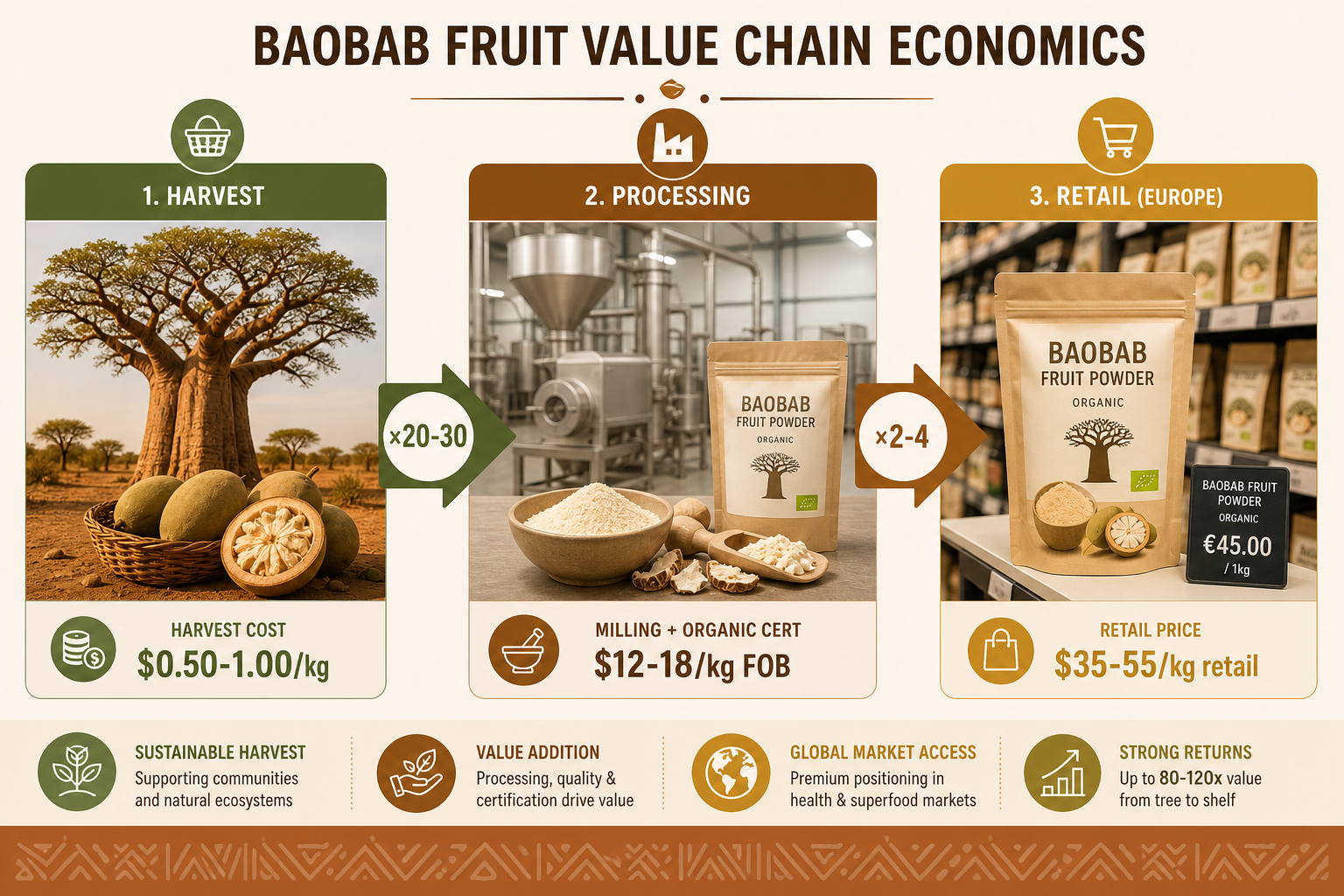
Baobab economics (2026):
- Raw baobab fruit (dried pods): $0.50-1.00/kg at harvest community level
- Milled baobab powder, organic-certified, packaged: $12-18/kg FOB Europe
- Retail baobab powder in EU health stores: $35-55/kg
The processing equipment for a small-scale baobab operation — hammer mill, sieving machine, basic packaging line — costs approximately $8,000-15,000. A community cooperative processing 10 tonnes of fruit into 4 tonnes of powder would generate $48,000-72,000 in FOB revenue. With harvest costs of $5,000-10,000 and processing/packaging costs of $8,000-12,000, the net margin exceeds 50%.
European buyers for baobab are concentrated in the natural and organic food sector — companies like Aduna (UK), Iswari (Portugal), and numerous German organic wholesalers.
These buyers specifically seek African-origin baobab with organic certification and fair trade principles, making it a natural fit for exporters already working with cooperatives.
For exporters considering product diversification, baobab, moringa, and hibiscus (bissap) represent the highest-margin, lowest-barrier African-origin ingredients for European premium markets in 2026. None require cold chain. All command organic premiums. All have established buyer networks actively seeking new suppliers.
How to Build a Product Story That European Buyers Respond To
European premium buyers receive dozens of supplier pitches per week. The ones that convert share a common structure. After analysing over 200 successful buyer-supplier introductions in the specialty food sector, here is the framework that works:
The 4-Element Origin Story
1. Place (be specific, not generic). "Cocoa from Ghana" is a commodity. "Cocoa from 46 smallholder farms in the Suhum-Kraboa-Coaltar district of Ghana's Eastern Region, growing mixed-hybrid varieties at 150-250 metres elevation, harvested October-December" is a specialty product.
Specificity signals to buyers that you know your product, control your supply chain, and can maintain consistency. Generic origin claims signal the opposite.
2. People (name them). "Sourced from a cooperative" is forgettable. "Sourced from the 127 members of the Kuapa Kokoo cooperative, led by Fatima Alhassan (Head of Quality) and processed at their solar-drying facility in Kumasi" is memorable and verifiable. Include photographs of faces. European consumers — and therefore European buyers — respond to human stories.
3. Process (what makes yours different). If you ferment your cocoa 7 days instead of 5, say so and explain why. If you hand-sort your cashews to remove 97% of broken kernels (versus the industry standard 90%), quantify it. If your coffee is dried on raised beds at high altitude (slower drying = more complex flavour development), describe the beds.
Process distinctions that affect quality are the single strongest driver of premium pricing because they are verifiable. A buyer can taste the difference between 5-day and 7-day fermented cocoa. They can see the difference between 90% and 97% whole kernels. Process claims backed by quality evidence convert skeptics into buyers.
4. Proof (document everything). Your origin story needs documentary evidence. Lab test results. Certification numbers. Harvest dates. Processing logs. Photographs of the drying beds and sorting tables. A buyer who can verify your story will pay substantially more than one who has to take it on faith.
Compile these four elements into a one-page "Producer Story" PDF. Include photographs. Include lab results if you have them. Use this as your introduction to premium buyers — before you send samples, before you discuss pricing, before you negotiate terms. The producer story establishes your position as a premium supplier rather than a commodity vendor, and everything that follows — including your pricing — lands differently.
Where the Premium Buyers Are (2026)
Finding buyers willing to pay premium prices for African-origin products requires targeting different channels than commodity buyers.
Channel 1: European Specialty Importers
These companies specifically source differentiated, certified, and origin-specific products. They are not looking for the lowest price — they are looking for products they can sell at a premium to their own customers.
| Importer | Country | Specialisation | Sourcing from Africa |
|---|---|---|---|
| Daarnhouwer | Netherlands | Specialty coffee, cocoa | Ethiopia, Uganda, Kenya, Tanzania |
| Kenkko | UK/Netherlands | Nuts, dried fruit | West Africa, East Africa |
| DO-IT | Netherlands | Organic spices, herbs | Madagascar, Egypt, Ethiopia |
| Tradin Organic | Netherlands | Organic ingredients | Multiple African origins |
| Bunge Loders Croklaan | Netherlands | Specialty oils, shea | West Africa |
How to approach specialty importers: Do not lead with pricing. Lead with your producer story, your certifications, and your quality data. Specialty importers make money by selling your product at a premium to their own customers. They need a story and quality proof to justify that premium. Give it to them in the first communication.
Channel 2: Direct-to-Retail (UK & EU Supermarkets)
Major European supermarkets increasingly operate supplier diversity and direct sourcing programmes for African producers. These programmes often provide technical assistance with packaging and compliance requirements.
| Retailer | Country | Programme | Product Focus |
|---|---|---|---|
| Waitrose | UK | Waitrose Foundation | Fresh produce, nuts, coffee |
| Albert Heijn | Netherlands | AH Africa | Fresh produce, cocoa |
| Edeka | Germany | Edeka Regional | Coffee, spices, dried fruit |
| Co-op | UK | Co-op Africa | Cocoa, coffee, wine |
| Carrefour | France | Carrefour Quality Line | Fresh produce, nuts |
Direct-to-retail requires significantly more preparation — retailers have strict packaging, labelling, and food safety requirements — but the margins are substantially higher than selling through importers. Expect 12-18 months from initial contact to first shipment for most supermarket programmes.
Channel 3: B2B Digital Platforms
For exporters not yet ready for direct retail relationships, B2B platforms offer a middle ground — verified buyers, built-in trust mechanisms, and lower barriers to entry.
Find premium buyers on Alibaba.com → — the world's largest B2B marketplace with dedicated organic and certified product categories. Premium buyers search Alibaba specifically for certified suppliers. Your profile should prominently feature your certifications and origin story.
Try Apollo.io for buyer prospecting → — 275M+ verified B2B contacts with email finder. Build targeted lists of European specialty food importers by industry, company size, and geography. The 60 free credits/month tier is sufficient for focused outreach to 50-60 premium buyers per month.
Channel 4: Trade Shows (The Right Ones)
Not all trade shows attract premium buyers. The ones that do:
- BioFach (Nuremberg, February): The world's largest organic trade fair. If you have organic certification, this is where premium organic buyers congregate.
- Speciality & Fine Food Fair (London, September): Focused on premium, artisanal, and specialty products. Ideal for packaged, consumer-ready African products.
- Anuga (Cologne, October): The world's largest food trade fair. Premium buyers attend the "Anuga Organic" and "Anuga Fine Food" halls specifically.
The key to trade show ROI: schedule meetings in advance through the show's matchmaking platform rather than relying on foot traffic. Premium buyers attend trade shows with a meeting schedule. If you are not on it, you are invisible.
The Investment: What Premium Positioning Costs
Premium positioning requires investment. Here is a realistic budget for a small-to-medium African food exporter transitioning from commodity to premium:
| Investment | Low Range | Mid Range | High Range | Timeline |
|---|---|---|---|---|
| Organic certification | $3,000 | $5,500 | $8,000 | 12-36 months |
| Packaging redesign (first run) | $2,000 | $5,000 | $12,000 | 2-3 months |
| Lab testing (annual) | $1,500 | $3,000 | $6,000 | Ongoing |
| Buyer trip / trade show | $4,000 | $8,000 | $15,000 | Annual |
| Photography & story materials | $500 | $2,000 | $5,000 | One-time |
| Total year-one investment | $11,000 | $23,500 | $46,000 |
ROI threshold: If premium positioning adds just $1.50/kg on a product selling 20 tonnes annually, the additional revenue is $30,000 — exceeding the mid-range investment in year one. For products with higher premiums (organic cashews adding $1.80/kg, specialty coffee adding $4-7/kg), the ROI timeline is measured in months, not years.
Common Mistakes That Undermine Premium Pricing
Mistake 1: Pricing against commodity benchmarks. When a specialty importer asks for your FOB price and you quote based on the commodity market price plus a small premium, you have already lost. Premium buyers expect premium pricing. Anchor your price to the value you deliver (certification, origin specificity, quality consistency), not to the commodity market.
Mistake 2: Inconsistent quality between samples and shipments. The single fastest way to lose a premium buyer: ship product that does not match the sample quality. Premium buyers pay more for consistency. If your processing cannot maintain sample quality at production scale, do not promise it.
Mistake 3: Hiding behind certification alone. Organic certification opens the door. It does not close the sale. Buyers who see "organic certified" with no additional story, no origin specificity, and no quality narrative will negotiate as if you are a commodity supplier — with an organic label.
Mistake 4: Ignoring packaging. European premium buyers recoil from packaging that looks commodity-grade — plain woven sacks, inconsistent labelling, poor English or French on the bag. The packaging is your product's first impression. Investing $2,000-5,000 in professional packaging design and printing signals to a buyer that you are serious about the premium market before they even open the sample.
Mistake 5: Not managing payment risk alongside pricing strategy. A 40% price premium loses its value if the buyer pays 90 days late or defaults entirely. As you move into premium markets with higher-value shipments, the payment risk increases proportionally. Open a Wise Business account → to receive payments at mid-market exchange rates with transparent fees — the 2-4% you save on FX versus traditional banks goes straight to your bottom line.
The Full Stack: Tools That Support Premium Export Operations
Premium positioning is supported by a stack of operational tools:
CRM for buyer relationship management. Tracking premium buyer relationships in spreadsheets loses follow-ups. Start Pipedrive free trial → — visual sales pipeline, email integration, and deal tracking built for export sales cycles.
Food safety compliance software. Premium buyers — particularly EU supermarkets — require HACCP or FSSC 22000 documentation before they will issue a purchase order. Try FoodDocs free → — digital HACCP system that generates audit-ready documentation.
B2B marketplace presence. Your Alibaba or FoodExpoConnect profile is often a premium buyer's first interaction with your brand. Ensure your profile features your certifications, origin story, and quality data prominently. Buyers searching for "organic African cashews" on Alibaba should find your story — not just your FOB price.
📈 Download the Premium Pricing Template →
Calculate your premium price uplift based on certification type, origin story strength, and target market. Includes buyer pitch deck template for European specialty buyers.
Free download — no email required.
The Bottom Line
The African food export sector sits on an estimated $4.7 billion in unrealised value — the difference between what exporters currently capture and what the same products sell for at retail. Closing this gap does not require building chocolate factories or launching consumer brands. It requires climbing the premium pricing ladder, step by step:
- Certify — organic, Fairtrade, or Rainforest Alliance — to unlock the 15-25% certification premium.
- Differentiate — add geographic specificity, single-origin traceability, and process narrative — to reach the 25-40% tier.
- Process — invest in roasting, pressing, or grinding — to capture the 40-80% value-add premium.
- Brand — when ready, package for retail and build direct buyer relationships — for the 80-200% tier.
The exporters moving fastest up this ladder are not the largest. They are the most deliberate — the ones who invest in certification before seeking buyers, who document their process before negotiating price, and who tell their story before sending samples.
If you take one action after reading this: commission professional photographs of your production — the farms, the processing facility, the farmers themselves. Compile them into a one-page Producer Story PDF. That single document will do more for your pricing power with premium buyers than any other investment of equivalent cost.
Affiliate disclosure: FoodExpoConnect earns a commission when you sign up for Wise, Pipedrive, Apollo.io, FoodDocs, or Alibaba.com through the links in this article. This does not affect the price you pay. We only recommend tools we have tested and that genuinely benefit food exporters.
Frequently asked questions
How much price premium can African food exporters realistically achieve?
Which certifications deliver the highest ROI for African food exporters?
How do I find buyers willing to pay premium prices for African food products?
What packaging changes justify a premium price?
How do I tell my product story effectively to European buyers?
Quick facts
Published: 6/8/2026
Reading time: 16 min
Pillars: Premium Positioning, Export Pricing, Value-Added
Written by

Jean Marc Koffi
Co-authorJournalist & Export SpecialistLondon
Jean Marc Koffi is an MBA-trained trade specialist who connects African exporters to global buyers, with over $20M in contracts facilitated and expertise recognized by major trade organizations. Noted for rapid buyer network building, he is an experienced speaker and certified in trade facilitation, origin rules, and food safety.

Alocha Massamba
Co-authorFounder, Epifresh & FoodExpoConnectLondon
Alocha Massamba is the founder of Epifresh and FoodExpoConnect. He builds the technology, data and partnerships that connect African food producers and exporters to international buyers — with a focus on fresh-produce supply chains, cold-chain logistics, and the buyer-discovery platforms small and mid-size exporters need to compete with global incumbents.
Explore more export intelligence
Certification • Pricing Strategy • Market Access
5 Certifications Worth More Than a Price Cut in 2026
Stop competing on price. Organic, Fair Trade, Rainforest Alliance, B Corp, and SQF certifications can command 20-300% price premiums for African food exporters in 2026. Here is the ROI data for each.
Coffee Export • Market Access • EU Regulations
Coffee Export 2026: African Origins, Fair Trade Pricing & EU Market Access
Complete guide to coffee export from Ethiopia, Kenya and Rwanda — EUDR compliance, fair trade pricing, certification requirements, and how to access €12-18/kg EU buyer contracts in 2026.
Market Access • Africa Trade • Export Strategy
China Zero-Tariff Policy for African Food Exporters: Coffee Imports Surge 145.7% — How to Enter the World's Largest Market Duty-Free
China's zero-tariff policy covering 53 African countries is already producing dramatic results — coffee imports surged 145.7% in the first five months. How food exporters can access this duty-free window and bypass traditional tariff barriers.