
FoodExpoConnect Blog
SeriesQ2 2026 Logistics SeriesOcean Freight Q2 2026: Why Container Rates Are Dropping on Some Routes and Surging on Others
A tale of two shipping markets: transpacific rates have collapsed 70% from their 2022 peak while Asia-Europe spot rates surge 40% on Iran disruption. Here's what it means for food exporters and how to route around the volatility.
International Buyer Directory
Verified contact information for international food buyers in 50+ countries
Introduction
If you shipped a 40-foot container of frozen mangoes from Mombasa to Shanghai in January 2022, you probably paid north of $8,000. If you shipped the same container in May 2026, you'd pay roughly $2,400.
But if you shipped a container of Ghanaian cocoa butter from Tema to Rotterdam? Your rate hasn't dropped — it's gone up. A lot.
This is the paradox of ocean freight in Q2 2026: the market has split in two. On some trade lanes, carriers are drowning in capacity and slashing rates to fill ships. On others, they're imposing emergency surcharges and blanking sailings to defend pricing. Understanding which lane you're on — and why — is the difference between competitive margins and losing money on freight alone.
What you'll learn:
- Route-by-route rate analysis for the corridors that matter to food exporters
- Why blank sailings are back — and which lanes are most affected
- The Iran disruption's ripple effects on global container availability
- Strategic contracting advice for Q3-Q4 2026
- How to build a multi-carrier strategy that survives rate volatility
The Numbers: Container Rates by Trade Lane, May 2026
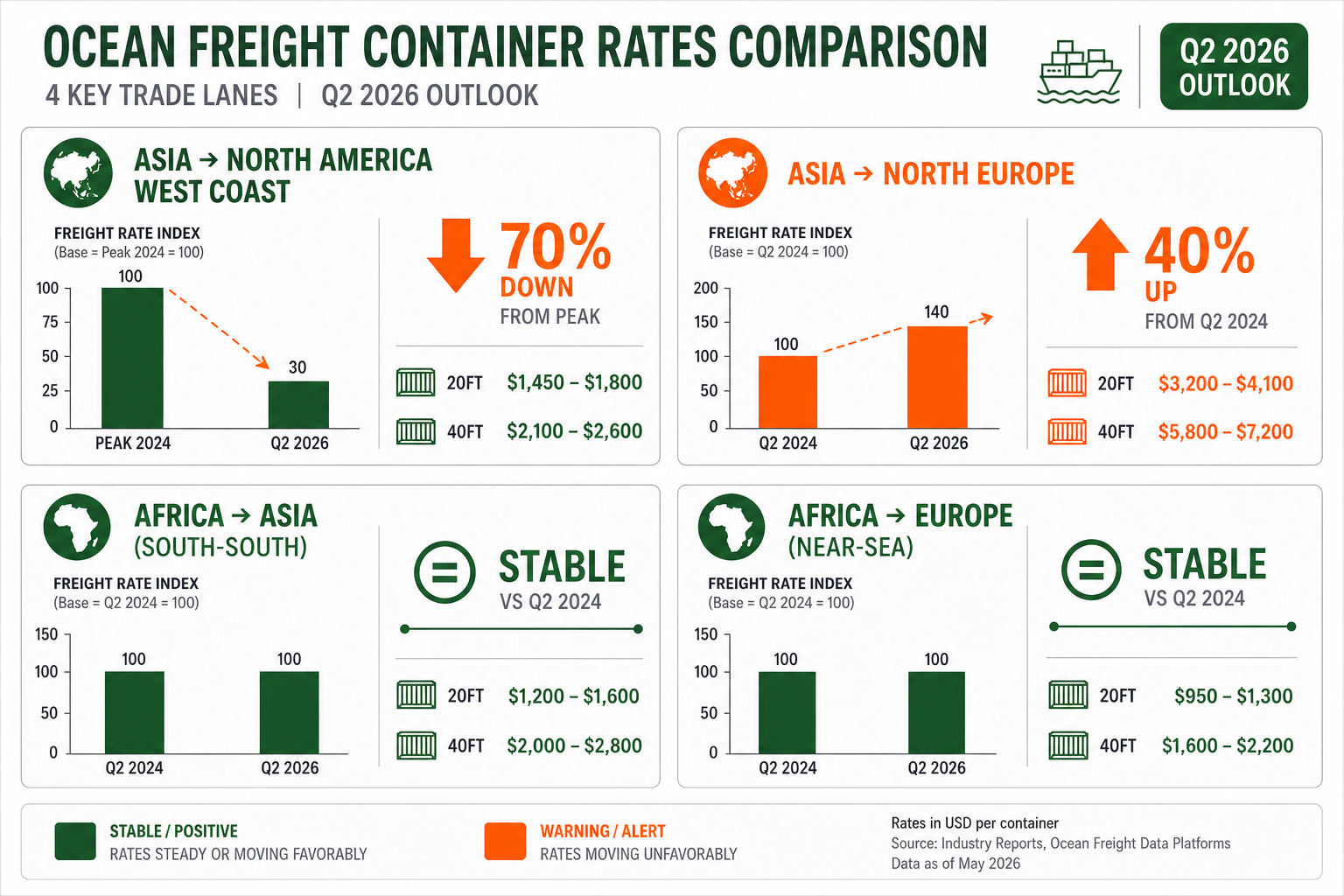
Let's cut through the noise. Here are the real numbers, sourced from Xeneta, Freightos Baltic Index, and forwarder spot quotes as of mid-May 2026.
Asia to North America West Coast (Transpacific)
- 20ft container: $1,450-$1,800
- 40ft container: $2,100-$2,600
- Change since Feb 2026: -5% to flat
- Change from 2022 peak: -70% to -75%
The transpacific is a buyer's market and has been for over a year. Massive vessel overcapacity — newbuilds ordered during the 2021-2022 container shortage are now entering service — has created a structural surplus of slots. According to DocShipper, spot rates on this corridor are the lowest they've been (adjusted for inflation) since early 2020.
For food exporters shipping from Asia to North America (think Vietnamese coffee, Thai rice, Chinese garlic), this is excellent news. But the carriers aren't taking it lying down.
Asia to North Europe
- 20ft container: $3,200-$4,100
- 40ft container: $5,800-$7,200
- Change since Feb 2026: +35% to +45%
- Change from 2022 peak: -40% (still elevated)
This is the disrupted lane. The Iran conflict has made the Red Sea-Suez passage too risky for most carriers. Vessels are routing via the Cape of Good Hope, adding 10-14 days to transit times and burning substantially more fuel. Carriers have imposed emergency bunker surcharges of $400-$800 per container, and war risk insurance premiums are being passed through.
Africa to Asia (South-South)
- East Africa to China, 20ft: $1,800-$2,400
- West Africa to China, 20ft: $2,200-$3,100
- Southern Africa to Southeast Asia, 20ft: $1,500-$2,100
These south-south routes are the stable corridor of 2026. Serviced primarily by smaller container vessels (1,000-3,000 TEU) unaffected by the deep-sea disruptions, rates have been consistent for six months. There's no overcapacity glut (these routes were never overbuilt) and no geopolitical disruption premium (these vessels don't transit the Middle East).
For African food exporters — this is your competitive advantage. While a Brazilian soy exporter faces elevated rates to China on the Asia-Europe feeder network, an Ethiopian sesame exporter on the Africa-Asia direct route pays stable, predictable freight.
Africa to Europe (Near-Sea)
- West Africa to Mediterranean, 20ft: $1,400-$1,900
- East Africa to Mediterranean, 20ft: $1,600-$2,200
Near-sea African routes are the best-kept secret in food export logistics. Short transit times (5-10 days), no canal dependencies, and competition among regional carriers (MSC, Maersk subsidiary Seago Line, CMA CGM's Africa feeder network) keep rates competitive.
The Blank Sailing Playbook: Why Carriers Are Cancelling Sailings
If you've had a container booking cancelled in the last 60 days, you've experienced a blank sailing. Carriers cancel or skip scheduled port calls to reduce capacity and support rates.
In Q2 2026, blank sailings are concentrated on two types of routes:
-
Asia-Europe routes where capacity exceeds demand. Even with the Iran disruption reducing effective capacity (longer routings = fewer trips per vessel per year), carriers are blanking additional sailings to maintain rate discipline.
-
Transpacific routes during seasonal troughs. The post-Chinese New Year lull (March-April) saw elevated blank sailings as carriers tried to prevent the rate floor from collapsing entirely. As we enter the pre-peak season build (June-July), blank sailings should moderate.
For food exporters, the blank sailing risk is highest for:
- Perishable goods with fixed delivery windows
- Less-than-container-load (LCL) shipments (consolidators have less leverage to demand space)
- Smaller exporters without annual volume commitments
How to Protect Yourself
Confirm bookings 72 hours before sailing. Don't assume a booking made three weeks ago is still valid. Carriers reshuffle allocations constantly. A quick email to your forwarder: "Confirming sailing date for booking REF-XXXXX, vessel MSC DIANA voyage 2417W" — takes 30 seconds, saves 10 days of delay.
Maintain relationships with two carriers. If Maersk blanks your sailing, can MSC or CMA CGM take your container on the same route? Having an existing relationship (even a single previous shipment) with a backup carrier means you're not starting from zero when a blank sailing hits.
Consider premium services for critical shipments. Most carriers offer guaranteed-loading products (Maersk's "Maersk Spot" guarantees loading or compensates you). The premium is typically $150-$300 per container — expensive, but cheaper than missing a supermarket delivery window and losing the contract.
The Iran Disruption: More Than a Middle East Problem
On the surface, the Iran conflict looks like a problem for tankers in the Persian Gulf. But container shipping is a globally integrated system — and the disruption's ripple effects reach every trade lane.
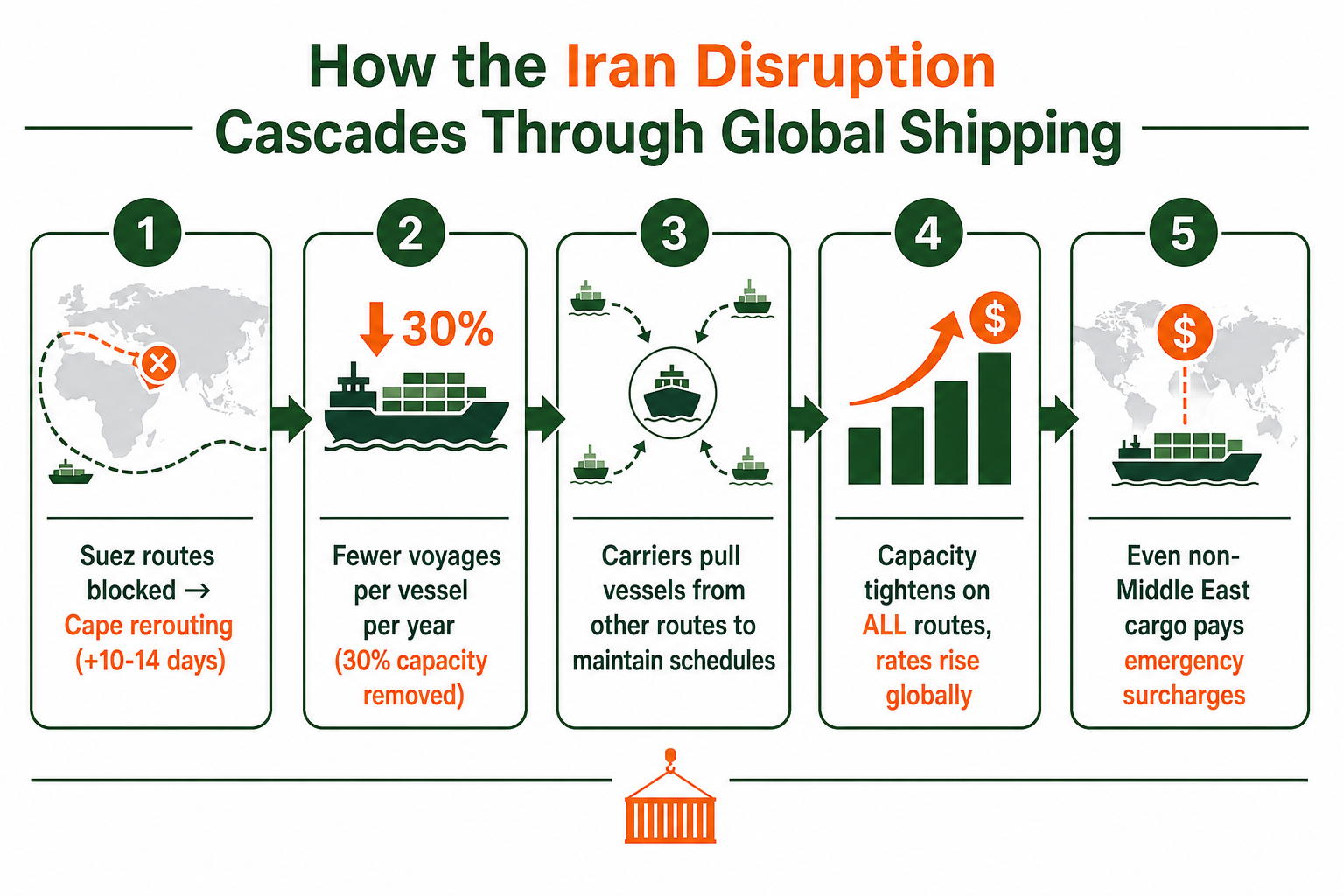
Here's how it cascades:
Step 1: Vessels that would transit the Red Sea and Suez Canal (connecting Asia to Europe) are rerouted via the Cape of Good Hope. Each voyage now takes 10-14 days longer.
Step 2: Those extra 10-14 days per voyage mean each vessel completes fewer round-trips per year. A vessel that could do 5 Asia-Europe rotations annually on the Suez routing can only do 3.5 on the Cape routing. This effectively removes ~30% of capacity from the Asia-Europe trade without a single vessel leaving the fleet.
Step 3: To maintain weekly sailing frequency on Asia-Europe, carriers must deploy additional vessels. Those vessels are pulled from other routes — typically Asia-Mediterranean, Asia-Africa, or intra-Asia feeder services.
Step 4: The routes those vessels were pulled from now have less capacity, pushing up rates. Smaller carriers on those routes see the opportunity and raise rates to capture margin.
Step 5: Bunker fuel costs rise globally because the Cape routings consume more fuel across the fleet. Carriers pass this through as general rate increases or emergency bunker surcharges on all routes, not just the disrupted ones.
The net effect: even if your container never goes near Iran, the Middle East, or the Red Sea, you're paying more. The global container fleet is a single pool of capacity, and a hole anywhere in the pool lowers the water level everywhere.
Strategy: How to Contract for Q3-Q4 2026
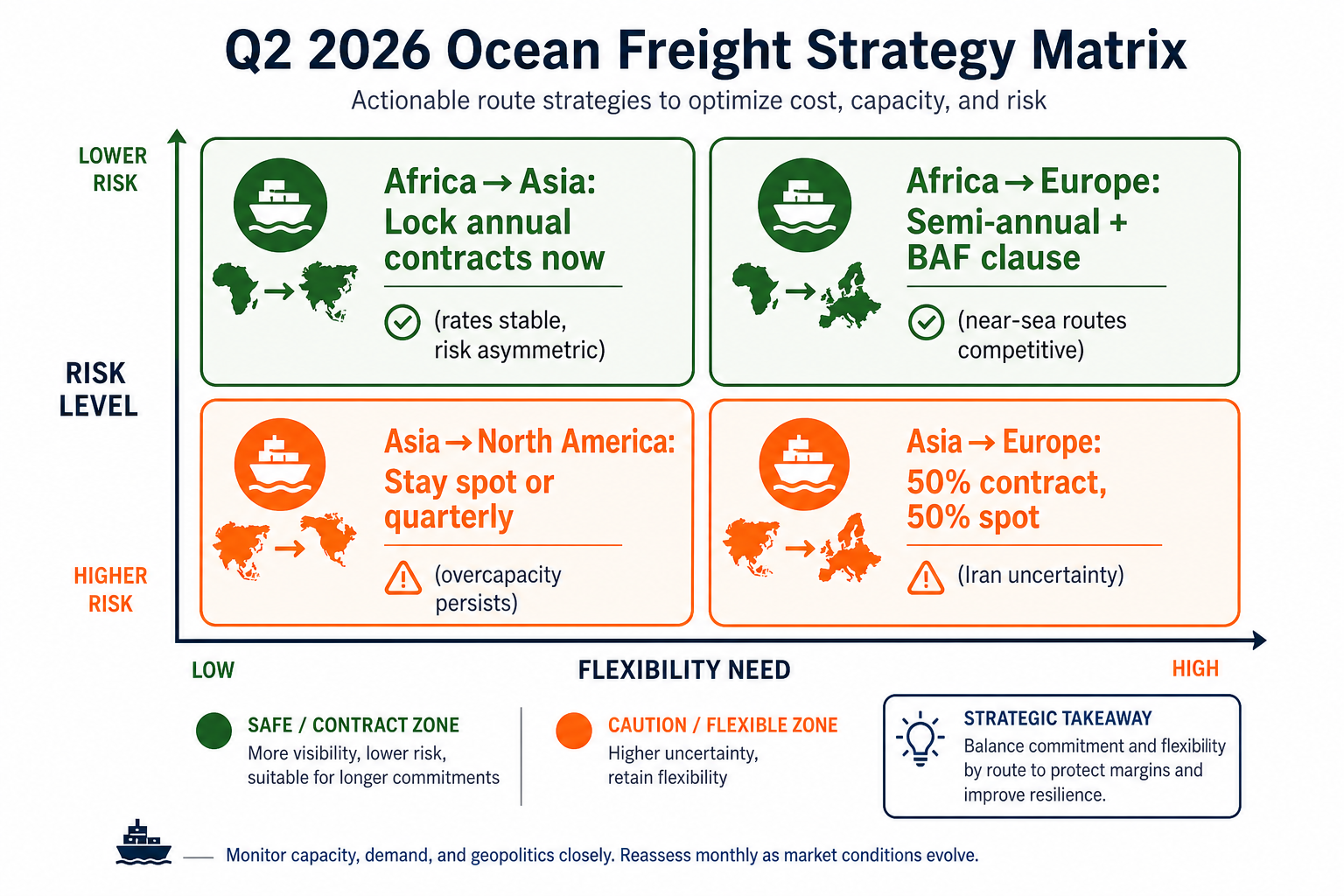 Given these dynamics, here's the contracting strategy I'm recommending to FoodExpoConnect clients:
If You Ship Africa → Asia
Lock in annual contracts now. Current rates are stable and competitive. The risk is asymmetric: rates are unlikely to drop significantly (these routes are already efficiently priced), but they could rise if the Iran disruption widens or if more vessels get pulled from south-south routes to cover Asia-Europe capacity gaps. A fixed-rate contract through Q1 2027 protects the downside.
If You Ship Africa → Europe
Semi-annual contracts with fixed base rate and a bunker adjustment factor (BAF). The base rate on near-sea routes is competitive. The BAF protects the carrier if fuel costs spike further while capping your exposure to surcharge creep.
If You Ship Asia → North America
Stay on spot or negotiate quarterly contracts. The overcapacity situation isn't resolving in 2026 — too many newbuilds are still entering the fleet. Annual contracts signed in late 2025 are now above spot rates, and forwarders who locked in annual deals are losing money on every container. Don't be that exporter. Quarterly contracts let you capture rate declines while providing enough commitment to secure space during the peak season.
If You Ship Asia → Europe
This is the hardest lane to contract right now. Rates could move sharply in either direction depending on Iran conflict developments. A ceasefire would see rates drop rapidly as vessels return to Suez routings. An escalation would push rates higher as more carriers avoid the region entirely.
The pragmatic approach: contract 50% of your volume semi-annually to guarantee space, keep 50% on spot. Accept that you'll be wrong on one half of your volume, but you won't be catastrophically wrong on either.
📈 Download the Freight Rate Reference Sheet →
Route-by-route container rates for the 6 major food export corridors. Updated blank sailing schedule, Iran disruption surcharge tracker, and Q3 contracting recommendations.
Free download — no email required.
The Long View: 2027 and Beyond
The container shipping industry is cyclical by nature, and the cycle is turning. The vessel orderbook — ships contracted for delivery in 2027 and 2028 — remains substantial. The overcapacity that's driving down transpacific rates will eventually spread to other lanes as newbuilds cascade through the global fleet.
For food exporters, the strategic lesson of 2021-2026 is clear: freight is no longer a fixed cost you can model as a percentage of goods value. It's a variable cost that requires active management, the same way you manage commodity price risk or currency exposure.
The exporters who thrive in the 2026-2028 environment will be those who:
- Maintain multi-carrier relationships instead of single-forwarder dependency
- Build freight cost flexibility into buyer contracts (indexed pricing, shared surcharge exposure)
- Understand their lane-specific dynamics rather than treating "ocean freight" as a single cost line
- Use near-sea and south-south routes strategically when deep-sea lanes are disrupted
The market is telling you what it costs to move goods. Listen to it — and route accordingly.
Rate data sourced from Xeneta, Freightos Baltic Index, and carrier spot quotes, May 2026. Shipping analysis based on Kearney Q2 2026 Shippers' Compass, DocShipper 2026 Freight Rate Forecast, and carrier earnings calls.
Frequently asked questions
Why are ocean freight rates so different between trade lanes in Q2 2026?
What are blank sailings and how do they affect food exporters?
Which shipping routes are cheapest for African food exporters right now?
Should I lock in annual shipping contracts or use the spot market in 2026?
How does the Iran disruption impact food exporters who don't ship through the Middle East?
Quick facts
Published: 5/17/2026
Reading time: 14 min
Pillars: Logistics, Cost Management
Written by

Jean Marc Koffi
Co-authorJournalist & Export SpecialistLondon
Jean Marc Koffi is an MBA-trained trade specialist who connects African exporters to global buyers, with over $20M in contracts facilitated and expertise recognized by major trade organizations. Noted for rapid buyer network building, he is an experienced speaker and certified in trade facilitation, origin rules, and food safety.

Alocha Massamba
Co-authorFounder, Epifresh & FoodExpoConnectLondon
Alocha Massamba is the founder of Epifresh and FoodExpoConnect. He builds the technology, data and partnerships that connect African food producers and exporters to international buyers — with a focus on fresh-produce supply chains, cold-chain logistics, and the buyer-discovery platforms small and mid-size exporters need to compete with global incumbents.
Series
More in Q2 2026 Logistics Series
Container Shipping Rates Q2 2026: What Food Exporters Need to Know About Falling Freight Costs, Blank Sailings, and the Suez Return
Container rates have dropped 70% from pandemic peaks, Suez transits are resuming, and fleet overcapacity is 3-5%. But the rate bottom may be short-lived. Here's how food exporters should position their logistics strategy for Q2-Q3 2026.
How the Red Sea Crisis Is Reshaping Global Food Export Routes in 2026: What Every Exporter Must Know
The Red Sea shipping crisis is adding $1,500 per container and 14 extra days to food export routes. Here's how smart exporters are adapting their logistics, insurance, and buyer relationships.
How the Middle East Conflict Is Disrupting Global Food Trade: What Every Exporter Must Know in 2026
The 2026 Iran war and Strait of Hormuz closure have shattered global shipping routes, spiked freight costs by 300%, and triggered a fertiliser crisis. Here is what food exporters need to do right now.
Explore more export intelligence
Certification • Pricing Strategy • Market Access
5 Certifications Worth More Than a Price Cut in 2026
Stop competing on price. Organic, Fair Trade, Rainforest Alliance, B Corp, and SQF certifications can command 20-300% price premiums for African food exporters in 2026. Here is the ROI data for each.
Coffee Export • Market Access • EU Regulations
Coffee Export 2026: African Origins, Fair Trade Pricing & EU Market Access
Complete guide to coffee export from Ethiopia, Kenya and Rwanda — EUDR compliance, fair trade pricing, certification requirements, and how to access €12-18/kg EU buyer contracts in 2026.
Market Access • Africa Trade • Export Strategy
China Zero-Tariff Policy for African Food Exporters: Coffee Imports Surge 145.7% — How to Enter the World's Largest Market Duty-Free
China's zero-tariff policy covering 53 African countries is already producing dramatic results — coffee imports surged 145.7% in the first five months. How food exporters can access this duty-free window and bypass traditional tariff barriers.