
FoodExpoConnect Blog
China Zero-Tariff Policy for African Food Exporters: Coffee Imports Surge 145.7% — How to Enter the World's Largest Market Duty-Free
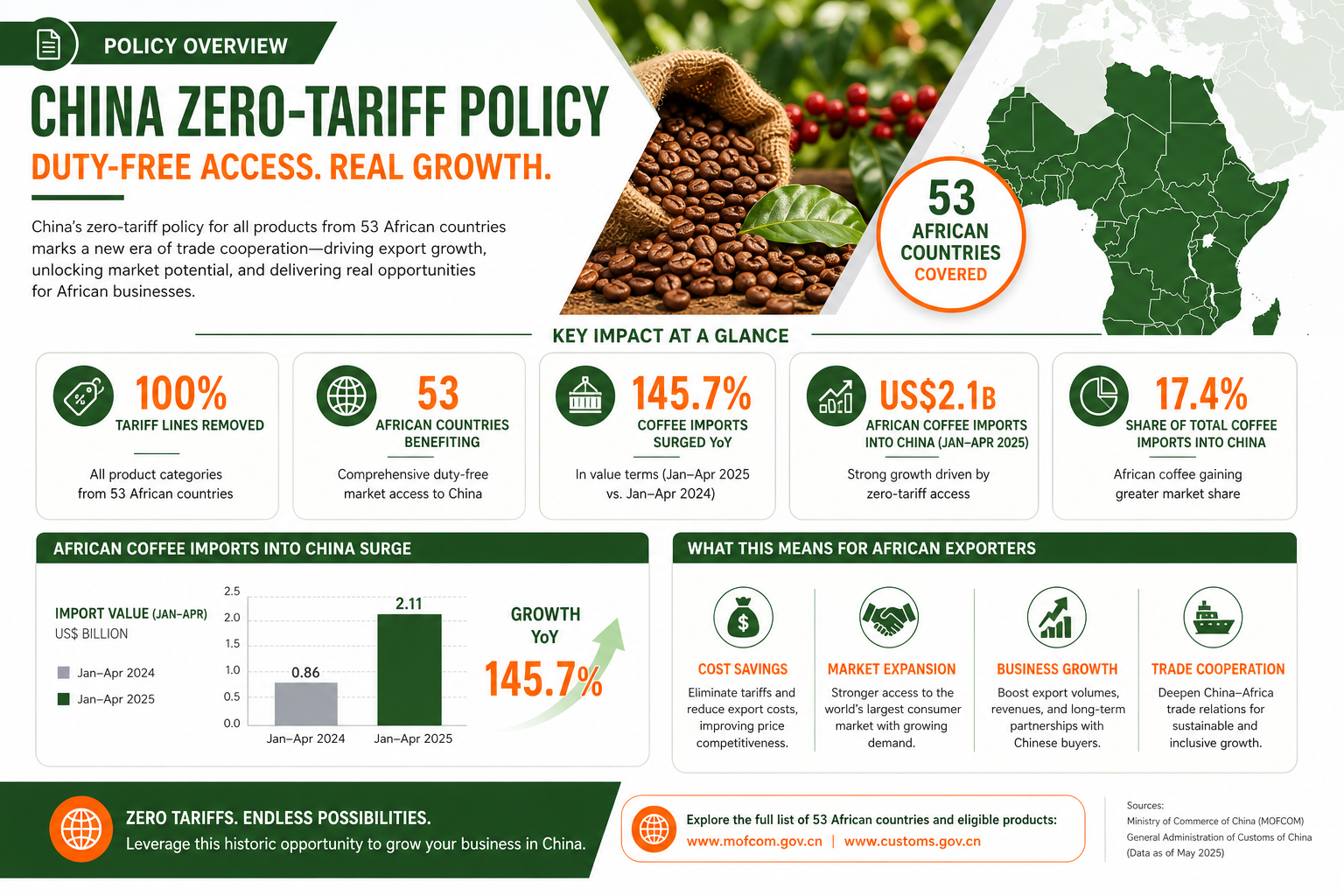
China's zero-tariff policy covering 53 African countries is already producing dramatic results — coffee imports surged 145.7% in the first five months. How food exporters can access this duty-free window and bypass traditional tariff barriers.

How can African food exporters benefit from China's 2026 zero-tariff policy?
China's zero-tariff policy, effective May 1, 2026, removes import duties on 100% of tariff lines from all 53 African countries with diplomatic ties to China. The policy runs until April 30, 2028 for non-LDC states (Nigeria, Kenya, Egypt, South Africa). Early results are dramatic: African coffee exports to China surged 145.7% year-on-year in the first five months, African exports to China grew 14.6% in Q1 2026, and Chinese direct investment in Africa surged 44%. Processed products earn up to 30% extra margin versus raw commodities. Food exporters should prioritize Alibaba.com listing, halal certification (for meat/poultry), and proper phytosanitary documentation to capitalize.
 import NewsletterCTA from '@/components/blog/NewsletterCTA';
Introduction: The Biggest Market-Access Shift in a Decade
On May 1, 2026, China did something unprecedented for African food exporters.
It removed import duties on 100% of tariff lines from all 53 African countries with diplomatic ties to China.
Not just for least-developed countries — which already had partial zero-tariff treatment — but for non-LDC states like Nigeria, Kenya, Egypt, and South Africa. For two full years (until April 30, 2028), processed foods, coffee, cocoa, spices, nuts, dried fruits, and essentially every food product can enter the world's largest consumer market at zero duty.
The early results are already dramatic.
African coffee exports to China surged 145.7% year-on-year in the first five months of 2026. Overall African exports to China grew 14.6% in Q1 2026. Chinese direct investment in Africa jumped 44% in the first two months alone.
This article explains exactly what the policy covers, which products benefit most, how to qualify for zero tariffs, and the fastest way to find Chinese buyers — with specific 2026 timelines and actionable steps.
What the Policy Covers
| Parameter | Details |
|---|---|
| Effective date | May 1, 2026 |
| Countries covered | 53 African countries with diplomatic ties to China |
| Tariff lines covered | 100% — all products |
| Duration (non-LDCs) | Until April 30, 2028 — 2-year limited window |
| Duration (LDCs) | No stated expiry — permanent expansion of existing zero-tariff treatment |
| Asymmetry | African countries keep tariffs on Chinese goods; China gives zero on African imports |
| Key non-LDC countries | Nigeria, Kenya, Egypt, South Africa |
This is not a tariff reduction. It is a complete elimination of the duty margin that has historically made African food products 12-25% more expensive in Chinese markets than competitors from Southeast Asia or Latin America.
Early Results: Coffee Leads the Surge
The first five months of the policy produced data that validates the opportunity dramatically:
| Metric | Result | Period |
|---|---|---|
| African coffee exports to China | +145.7% YoY | Jan-May 2026 |
| Total African exports to China | +14.6% | Q1 2026 |
| Chinese direct investment in Africa | +44% | Jan-Feb 2026 |
| Kenyan avocado exports to China | Duty-free entry | Effective May 1, 2026 |
| Margin uplift for processed vs raw products | Up to 30% | Estimated per category |
Coffee is the leading indicator because it has a transparent global pricing benchmark (ICE New York) and a well-established buyer network. If coffee can grow 145.7% in five months — before most exporters even adjusted their strategies — the potential for cocoa, spices, nuts, dried fruits, and processed foods is enormous.
Product Categories Ranked by Opportunity
Not all products benefit equally. Here is a ranking based on Chinese demand, 2026 tariff rates previously applied, and African production capacity:
| Category | Previous Chinese Tariff | 2026 Advantage | Chinese Demand Trend | African Supply Strength |
|---|---|---|---|---|
| Coffee (green & roasted) | 8-15% | 🔥 High — proven 145.7% surge | Growing 30%+ annually | ⭐⭐⭐ Ethiopia, Kenya, Rwanda, Uganda |
| Cocoa beans & products | 10-22% | 🔥 High — chocolate consumption booming | Double-digit cocoa grind growth | ⭐⭐⭐ Côte d'Ivoire, Ghana, Nigeria, Cameroon |
| Cashews & tree nuts | 10-25% | 🔥 High — premium snack demand | Premium snack segment growing 40%+ | ⭐⭐⭐ Côte d'Ivoire, Mozambique, Tanzania, Benin |
| Avocados & fresh fruit | 10-15% | 🔥 High — Kenya leading, premium positioning | Premium fruit imports growing rapidly | ⭐⭐ Kenya, South Africa |
| Spices (vanilla, cloves, pepper) | 12-20% | 📈 Medium-High — specialty market | Boutique/artisan food boom | ⭐⭐ Madagascar, Tanzania, Nigeria, Ethiopia |
| Dried fruits & processed foods | 10-30% | 📈 Medium — value-add opportunity | Healthy snack demand growing | ⭐⭐ Nigeria, Ghana, Kenya, South Africa |
The Value-Add Premium: Why Processed Products Win
The most important strategic insight from the early data: processed products earn up to 30% extra margin compared to shipping raw commodities.
| Product | Raw Commodity Price (FOB) | Processed Price (FOB) | Margin Uplift | Chinese Tariff Before Policy |
|---|---|---|---|---|
| Coffee (green beans) | $3.80/kg | — | Baseline | 8% |
| Roasted coffee | — | $8.50/kg | +124% | 15% |
| Cocoa beans | $2.80/kg | — | Baseline | 10% |
| Cocoa butter/paste | — | $5.50/kg | +96% | 22% |
| Raw cashews (in shell) | $1.20/kg | — | Baseline | 10% |
| Shelled cashews | — | $3.20/kg | +167% | 25% |
With zero tariffs on all forms — raw and processed — the incentive is now stacked toward value addition in Africa. A coffee exporter can ship green beans at $3.80/kg with zero duty, or roast and package in origin to sell at $8.50/kg with zero duty on the finished product. The extra $4.70/kg stays in Africa rather than being captured by roasters in China.
This is the policy's structural impact: it rewards African processing capacity. Exporters who invest in semi-processing (roasting, shelling, grinding, drying) will capture significantly more value than those who continue shipping raw commodities.
How to Find Chinese Buyers in 2026
The zero-tariff policy opens the door. Finding the right buyer gets you through it.
1. Alibaba.com — The Primary Channel
Alibaba.com serves 40M+ registered buyers across 200+ countries, and its AI-powered tool Accio Work reached 10M+ monthly active users by mid-2026. For African food exporters targeting China, this is the single most efficient platform.
List your products on Alibaba.com →
2026 tips for African sellers on Alibaba:
- Optimize for "ZERO TARIFF Africa" in product titles — Chinese buyers are actively searching for this
- Add Trade Assurance coverage — it increases buyer confidence 40%
- Respond to inquiries within 2 hours during first 14 days — platforms boost fast responders
- Include halal certification in listings for meat and processed foods entering China
2. China International Import Expo (CIIE)
Held annually in Shanghai (typically November), CIIE is China's premier import fair. African food exporters receive subsidized booth space and government-organized buyer matchmaking. The 2026 edition will have dedicated Africa zero-tariff pavilions.
3. CCPIT Buyer Missions
The China Council for the Promotion of International Trade (CCPIT) organizes inbound buyer missions to African countries. These missions visit food processing zones and arrange direct B2B meetings. Register early — slots fill quickly.
4. Digital Buyer Discovery
Find verified Chinese food importers with BookYourData → — Build targeted buyer lists of Chinese food importers with verified contact data. Filter by product category, import volume, and company size. The 95% email verification rate means your outreach won't bounce.
Use Apollo.io for Chinese buyer research → — Verify company details, size, decision-maker contacts, and industry presence before investing in a relationship. A Chinese importer with 5 employees and a WeChat-only presence may be a trading desk, not a serious buyer.
How to Qualify for Zero-Tariff Treatment
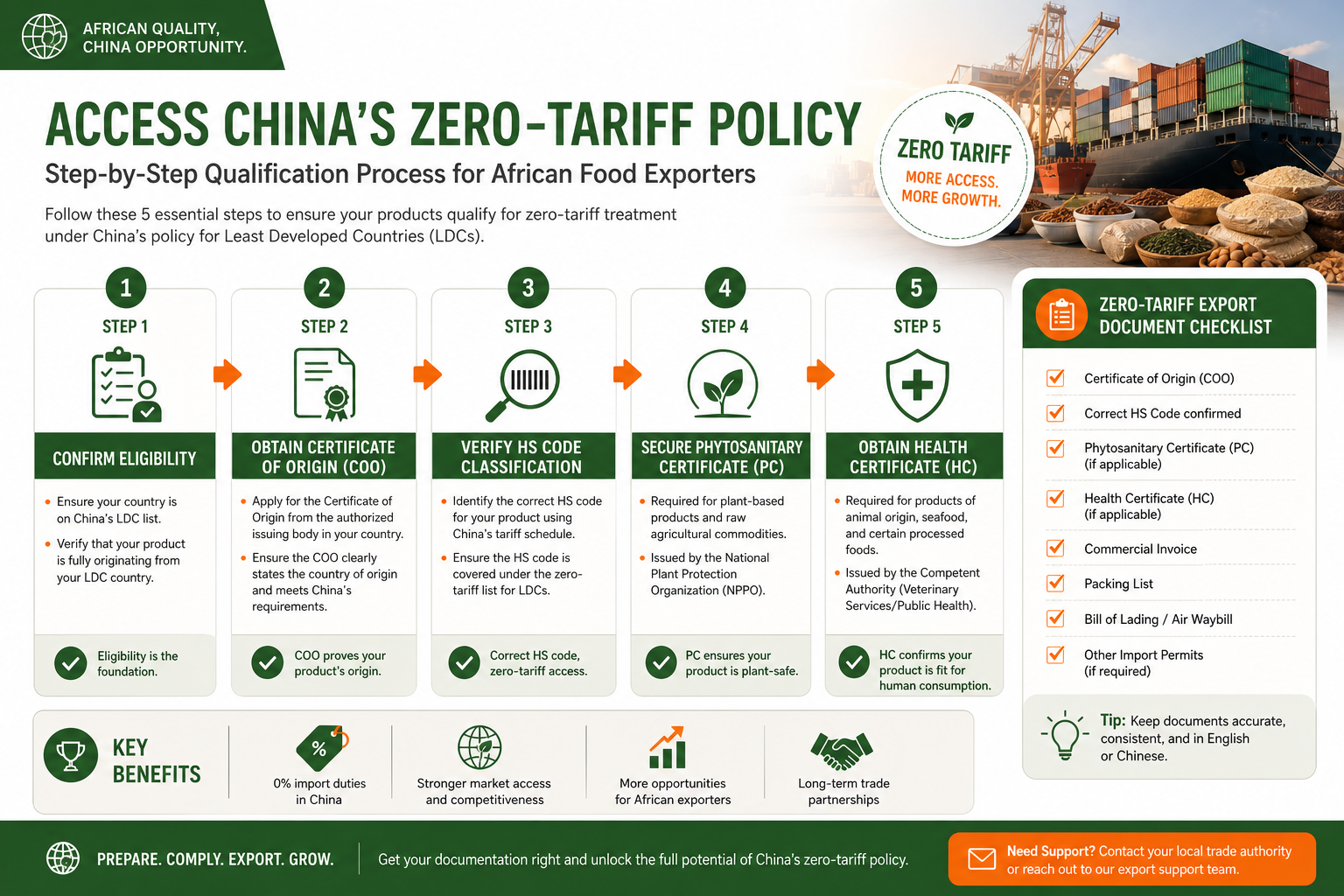
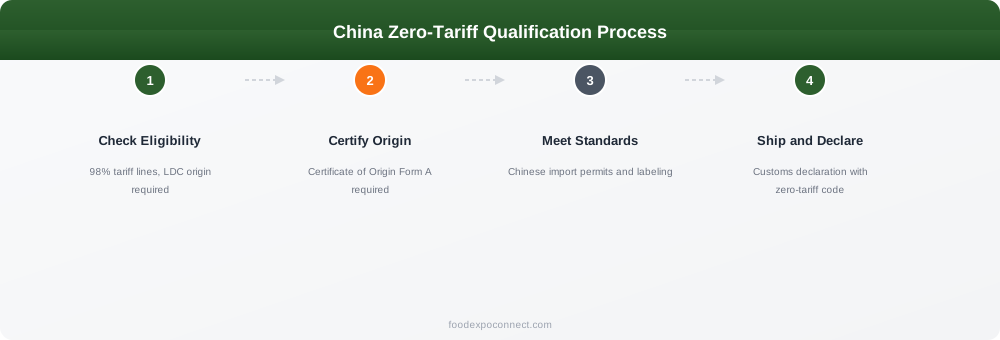
The zero-tariff benefit is not automatic — it requires correct documentation. Here is the complete checklist:
Mandatory Documents
| Document | Issuing Authority | Details |
|---|---|---|
| Certificate of Origin | National Chamber of Commerce or designated export authority | Must explicitly state African origin; Form A or CO format accepted |
| Commercial invoice | Exporter | HS code (6-digit minimum, 10-digit preferred for China), product description, FOB value |
| Bill of lading | Shipping line | Direct or with transshipment via Hong Kong/international hub |
| Packing list | Exporter | Weight, container numbers, marks and numbers |
| Phytosanitary certificate | National plant protection organization | Required for all plant-based products |
| Health certificate | National food safety authority | Required for processed foods and animal products |
Product-Specific Requirements
| Product Category | Additional Requirement |
|---|---|
| Meat and poultry | Halal certificate from recognized body + SFDA/CIQ registration |
| Dairy products | CIQ registration and Chinese labeling compliance |
| Alcoholic beverages | CIQ pre-registration and Chinese-language labels |
| Nutritional supplements | CFDA product registration (6-12 months lead time) |
The Customs Process
- Chinese importer files customs declaration with HS code and declares zero-tariff treatment
- Customs verifies Certificate of Origin against China's preference framework
- If origin is verified: zero duty applied. If origin document is missing or incorrect: standard MFN tariff rate applies (8-30% depending on product)
- Goods inspected per standard CIQ procedures (random sampling for plant/animal products)
- Clearance issued — typically 2-5 business days with correct documentation
The most common reason for tariff denial: incorrectly completed Certificate of Origin. Work with your national Chamber of Commerce to ensure the CO specifically references China's zero-tariff preference framework (not a generic free trade agreement CO).
The 90-Day China Market Entry Plan
The zero-tariff policy runs to April 30, 2028 for non-LDCs. The exporters who move in Q3 2026 will have first-mover advantage. Here is the plan:
Days 1-14: Preparation
- Verify your product's HS code against China's 10-digit classification
- Obtain Certificate of Origin samples from your Chamber of Commerce
- Prepare phytosanitary and health certificates in Chinese-translated format
- Set up Alibaba.com seller account with Trade Assurance
Days 15-30: Buyer Discovery
- Search Alibaba.com for Chinese buyers in your category
- Use BookYourData to build a targeted buyer list of Chinese food importers
- Research each buyer's import history and volume using Apollo.io
- Prepare outreach materials emphasizing zero-tariff advantage
Days 31-45: First Contact
- Send initial inquiry on Alibaba.com
- Follow up within 48 hours
- Offer to send samples with proper CIQ documentation
- Propose LC terms for first transaction (confirmed) — build trust before open account
Days 46-60: First Transaction
- Negotiate price inclusive of zero-tariff benefit (you can afford to be competitive)
- Ship first container with full documentation package
- Track customs clearance process
- Confirm payment received under LC terms
Days 61-90: Scale
- Gather feedback from first buyer
- Adjust packaging, documentation, or pricing as needed
- Target 2-3 additional Chinese buyers
- Plan for second and third containers
Smart Tools for China Market Entry
Open a Wise Business account → — Receive CNY or USD payments from Chinese buyers at the mid-market rate. Chinese buyers often prefer USD settlement; Wise offers the best conversion rates and fastest settlement times for African exporters.
Start Pipedrive free trial → — Track each Chinese buyer relationship as a deal with timeline milestones. Chinese importers value relationship consistency — use Pipedrive to log every interaction, call, and sample shipment.
Use Calendly to schedule buyer calls across time zones → — By default, connect Calendly to your Google or Outlook calendar and create an event type like "China Buyer Discovery Call" with your available 30-minute windows. Then send the link in your follow-up email. The 5-8 hour time difference between West Africa and China makes scheduling painful — Calendly automates it without the back-and-forth.
Manage your China market plan in Notion → — Create a China Market Entry dashboard with pipeline tracker, key contacts, document checklist, and shipping schedule. Notion's templates make it easy to build a repeatable process that can scale to multiple buyers.
Track container shipments with Airtable → — Monitor shipping dates, customs clearance status, and payment receipt. Airtable's kanban view gives instant visibility into which shipments are in transit and which need follow-up.
🇨🇳 Get the China Market Entry Guide →
Complete eligibility guide for China's zero-tariff program for African food exports. Product categories, certification requirements, tariff codes, and customs procedures for duty-free access.
Free download — no email required.
The Bottom Line
China's zero-tariff policy is the most significant market-access development for African food exporters since the African Growth and Opportunity Act (AGOA). The early data — 145.7% coffee export surge, 14.6% overall export growth, 44% investment increase — confirms that the opportunity is real and immediate.
The window for non-LDC countries (Nigeria, Kenya, Egypt, South Africa) closes on April 30, 2028. That is 22 months from now. The exporters who act in Q3 2026 — who list on Alibaba, prepare their documentation, find their first buyer, and ship their first container — will have an 18-24 month head start on competitors who wait.
The products with the biggest immediate wins: coffee, cocoa, cashews, avocados, and processed food products that capture the 30% value-add premium.
The cost of entry: correct documentation, an Alibaba listing, and a container of product.
The cost of staying out: watching your competitors build relationships that will last a decade.
Affiliate disclosure: FoodExpoConnect earns a commission when you sign up for Wise, Pipedrive, Alibaba.com, BookYourData, Apollo.io, Notion, Calendly, or Airtable through the links in this article. This does not affect the price you pay. We only recommend tools we have tested and that genuinely benefit food exporters.
Disclaimer: This article provides general information about China's trade policy. It does not constitute legal, tax, or customs advice. Consult a licensed customs broker and trade lawyer for guidance specific to your products and jurisdiction.
Frequently asked questions
Which African countries are covered by China's zero-tariff policy?
Which food products benefit most from the China zero-tariff policy?
How long does the China zero-tariff policy last?
What do African food exporters need to do to qualify for zero tariffs?
What is the best way for African food exporters to find Chinese buyers?
Quick facts
Published: 7/10/2026
Reading time: 10 min
Pillars: China Market Access, African Export
Written by

Jean Marc Koffi
Co-authorJournalist & Export SpecialistLondon
Jean Marc Koffi is an MBA-trained trade specialist who connects African exporters to global buyers, with over $20M in contracts facilitated and expertise recognized by major trade organizations. Noted for rapid buyer network building, he is an experienced speaker and certified in trade facilitation, origin rules, and food safety.

Alocha Massamba
Co-authorFounder, Epifresh & FoodExpoConnectLondon
Alocha Massamba is the founder of Epifresh and FoodExpoConnect. He builds the technology, data and partnerships that connect African food producers and exporters to international buyers — with a focus on fresh-produce supply chains, cold-chain logistics, and the buyer-discovery platforms small and mid-size exporters need to compete with global incumbents.
Explore more export intelligence
Certification • Pricing Strategy • Market Access
5 Certifications Worth More Than a Price Cut in 2026
Stop competing on price. Organic, Fair Trade, Rainforest Alliance, B Corp, and SQF certifications can command 20-300% price premiums for African food exporters in 2026. Here is the ROI data for each.
Coffee Export • Market Access • EU Regulations
Coffee Export 2026: African Origins, Fair Trade Pricing & EU Market Access
Complete guide to coffee export from Ethiopia, Kenya and Rwanda — EUDR compliance, fair trade pricing, certification requirements, and how to access €12-18/kg EU buyer contracts in 2026.
Export Operations • Finance • Middle East Trade
Payment Terms in the Middle East: LC, Cash Against Documents, Open Account (2026 Guide for Food Exporters)
Letters of credit, cash against documents, and open account each carry different risk profiles in Middle Eastern food trade. How to match payment terms to buyer relationships and country risk in Saudi Arabia, UAE, Qatar, and beyond.