
FoodExpoConnect Blog
Complete Guide to Food Safety Certifications for Export: HACCP, ISO 22000, FSSC 22000 Explained
Compare HACCP, ISO 22000, and FSSC 22000 to choose the right food safety certification for exporting into the EU, US, and Asia.
Export Documentation Checklist
Product-specific documentation checklists for sesame, shea, coffee, cocoa, fresh produce, and processed foods
Picture this: you're standing in front of a bustling export terminal, the aroma of fresh produce wafting through the air. Your small business is ready to take its first steps into the global market, but there's one crucial question hanging over you: Which food safety certification should you pursue to ensure your products meet international standards? With options like HACCP, ISO 22000, and FSSC 22000, the choices can be overwhelming.
In this guide, we'll help you navigate the complexities of food safety certifications for your export business. You’ll discover the costs involved, the timeframes for implementation, and which certifications are most accepted in key markets like the EU, US, and Asia. By the end, you’ll have the tools to choose the right certification that aligns with your business goals—without getting lost in the jargon.
If you're still validating your target market requirements, start here:
Authority insight (export reality check): Many markets expect you to operate with HACCP principles in practice (hazard analysis, control measures, monitoring, corrective actions, records), even if the exact “certificate name” differs by buyer, sector, and destination.
Sources: Codex HACCP principles (CCFH) and EU hygiene framework.
Understanding Food Safety Certifications
Before we dive into the specifics, let's clarify what these certifications entail:
What is HACCP?
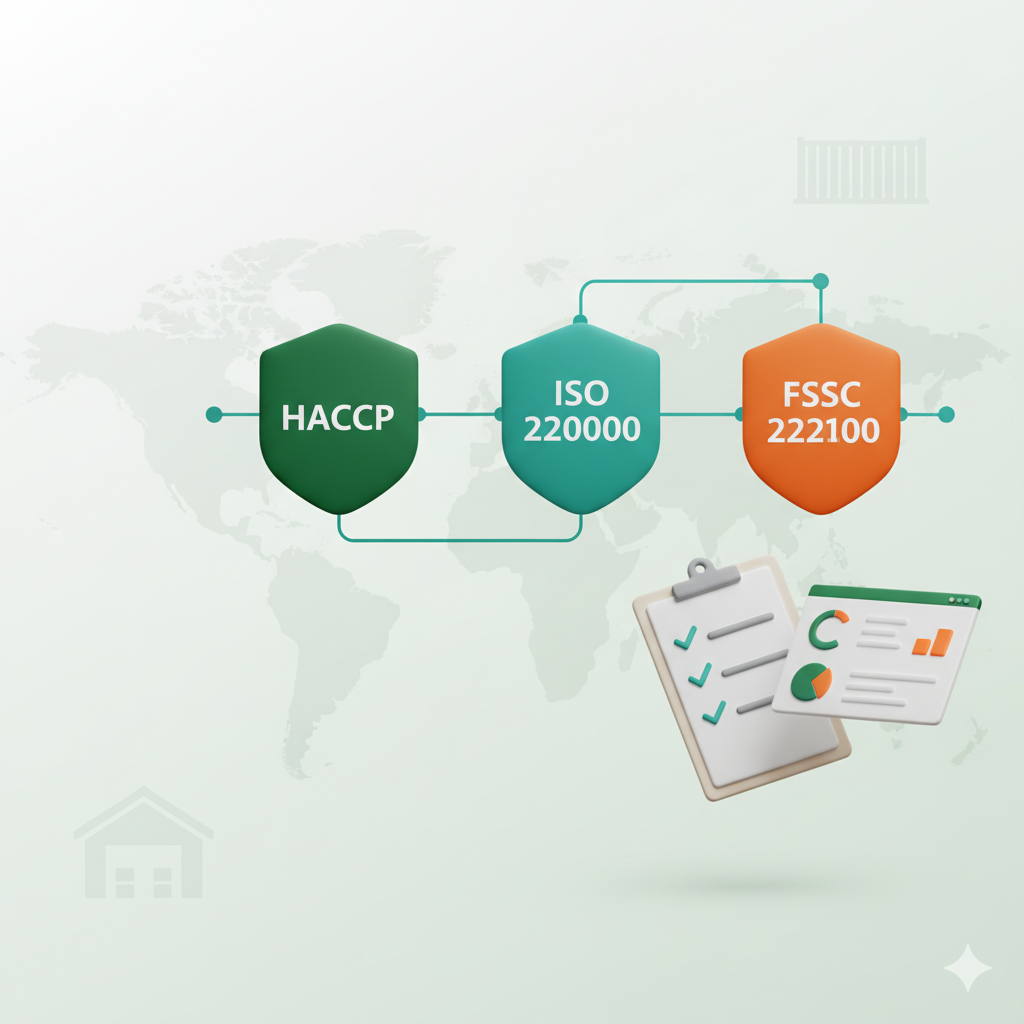
HACCP (Hazard Analysis and Critical Control Points) is a systematic preventive approach to food safety. It focuses on identifying and controlling hazards throughout the production process. This certification is often a fundamental requirement for food exporters. For more information, check out this overview of HACCP.
What is ISO 22000?
ISO 22000 is an international standard that specifies the requirements for a food safety management system (FSMS). It incorporates HACCP principles and is recognized globally, offering a comprehensive framework for managing food safety. Learn more about ISO 22000 in this complete guide.
What is FSSC 22000?
FSSC 22000 is built upon ISO 22000 but includes additional requirements for certification. It is particularly recognized in Europe and is increasingly demanded by larger retailers and food service companies. For a detailed understanding, refer to this guide on FSSC 22000.
Certification Selection Blueprint
<Mermaid chart="graph TD; Start([Start Certification Journey]) --> Scale{Production Scale?}; Scale -->|Small/Micro| Small[HACCP Focus]; Scale -->|Medium/Large| Large{Target Market?};
Small --> HACCP[HACCP Certificate]; HACCP --> US[US & Basic Global Markets];
Large -->|European Union| EU[FSSC 22000]; Large -->|Middle East/Asia| ME[ISO 22000];
EU --> Retailers[Major EU Retailers]; ME --> Supply[Global Supply Chains];
style HACCP fill:#f0fdf4,stroke:#16a34a,stroke-width:2px; style ISO fill:#f0f9ff,stroke:#0369a1,stroke-width:2px; style FSSC fill:#fffbf0,stroke:#d97706,stroke-width:2px;" />
Authority insight (how these standards relate): ISO 22000 is a food safety management system standard that incorporates HACCP concepts and prerequisite programs; FSSC 22000 builds on ISO 22000 with additional sector requirements and is benchmarked by GFSI.
Automate Your Food Safety Audit Preparation
Get the exact ChatGPT prompts we use to draft HACCP plans and ISO 22000 documentation in minutes instead of weeks.
Join 5,000+ exporters using this tool
Sources: ISO 22000 overview and FSSC 22000 / GFSI benchmarking information.
Costs of Certification
Let’s break down the costs associated with each certification. You'll want to consider audit fees, consultant expenses, and annual maintenance:
| Certification | Initial Audit Cost | Consultant Fees | Annual Maintenance | Total Estimated Cost |
|---|---|---|---|---|
| HACCP | $1,000 - $3,000 | $500 - $2,000 | $300 - $1,000 | $1,800 - $6,000 |
| ISO 22000 | $1,500 - $4,000 | $1,000 - $3,000 | $600 - $1,500 | $3,100 - $8,500 |
| FSSC 22000 | $2,000 - $5,000 | $1,500 - $4,000 | $800 - $1,800 | $4,300 - $10,800 |
Insights:
- HACCP is typically the most cost-effective option for small exporters, making it a solid starting point.
- ISO 22000 provides a good balance of cost and recognition, suitable for businesses looking to enter global markets.
- FSSC 22000, while more expensive, is gaining traction among larger retailers, especially in Europe, making it a worthwhile investment for companies targeting that market.
Calculate Your Certification ROI
Before investing, use our margin calculator to see how an organic or certified premium affects your bottom line.
Export Profitability Modeler
Interactive Net Margin & ROI Calculator
Net Profit Margin
30%💡 Pro Tip: For African food exports, target a 25%+ net margin to absorb currency fluctuations and shipping delays. If you are below 20%, focus on "Value Addition" (processing/packaging) rather than raw commodity exports.
Implementation Timelines
Now let’s talk about how long it takes to implement each certification. Here’s a realistic breakdown of the steps involved, from documentation to audits:
| Certification | Documentation (Weeks) | Training (Weeks) | Audit Preparation (Weeks) | Total Implementation Time |
|---|---|---|---|---|
| HACCP | 2-4 | 1-2 | 1-2 | 4-8 weeks |
| ISO 22000 | 4-6 | 2-3 | 2-3 | 8-12 weeks |
| FSSC 22000 | 6-8 | 3-4 | 2-4 | 11-16 weeks |
Tips for Implementation:
- Allocate time for thorough documentation; it’s crucial for compliance.
- Don’t rush training—engaged employees are key to successful implementation.
- Prepare for audits by conducting internal reviews and mock audits.
Market Acceptance: Which Certification is Right for You?
Market acceptance varies by region. Here’s a snapshot of which certifications are most favored in major export markets:
United States
- HACCP: Required for meat and poultry products; preferred by many importers.
- ISO 22000: Gaining traction among retailers but not mandatory.
- FSSC 22000: Increasingly accepted by larger food service companies.
European Union
- HACCP: Required for all food businesses.
- ISO 22000: Widely recognized, especially in retail.
- FSSC 22000: Preferred by many major retailers—essential for market entry.
Asia
- HACCP: Commonly accepted across various sectors.
- ISO 22000: Growing in recognition, especially in health-conscious markets.
- FSSC 22000: Best for exporters targeting high-end markets in Japan and South Korea.
Key Takeaway:
In the current landscape, FSSC 22000 is becoming increasingly vital for businesses aiming to penetrate European and upscale Asian markets. However, if you're starting out or focused on the U.S. market, HACCP is a solid choice.
Real-World Examples
Let’s take a look at how real businesses have navigated these certifications:
-
La Real Expedition: A Colombian coffee exporter started with HACCP certification to enter the U.S. market. Within a year, they upgraded to ISO 22000 due to increased demand from retailers.
-
Green Valley Foods: This U.S.-based company opted for FSSC 22000 to cater to high-end Asian markets. Their investment paid off, leading to a 15% increase in export sales within the first year.
Common Mistakes to Avoid
- Underestimating Costs: Always budget for both initial and ongoing expenses.
- Skipping Employee Training: Lack of training can lead to compliance failures.
- Neglecting Market Research: Ensure the certification you choose aligns with your target market’s requirements.
Expert Tips & Best Practices
- Start with HACCP: If you’re new to food safety certifications, beginning with HACCP can ease you into the process.
- Consider Future Growth: Choose a certification that aligns not just with your current market but also your future aspirations.
- Utilize Available Resources: Many organizations offer free or low-cost training and resources to help you navigate certification processes.
- Plan for Logistics: Remember that certification is only half the battle. Use our freight calculator to estimate its impact on your landed costs.
Freight Rate Intelligence Kit
Red Sea Disruption Cost Modeling — Feb 2026
Baseline (Fixed)
$1,350
Adjusted Total
+$346 disruption cost
Negotiation Insight: Disruption surcharges should be strictly time-bound. Ask your forwarder to provide the exact vessel name and rerouting details to justify the 25% uplift you are calculated here.
Frequently Asked Questions (FAQ)
Q: What is the best certification for small exporters?
A: HACCP is generally the most cost-effective and widely accepted for small exporters.
Q: How long does it take to get certified?
A: Depending on the certification, it can take anywhere from 4 to 16 weeks to get fully certified.
Q: Are there grants available for certification costs?
A: Yes, programs like USDA’s Market Access Program can help cover certification costs.
Q: Which certification is most recognized in the EU?
A: FSSC 22000 is increasingly preferred among major retailers in the EU.
Q: Can I switch certifications later?
A: Yes, many businesses start with HACCP and upgrade to ISO 22000 or FSSC 22000 as they grow.
References
- Codex Alimentarius Commission (FAO/WHO) — General Principles of Food Hygiene and HACCP system guidance: https://www.fao.org/fao-who-codexalimentarius/
- European Union — Food hygiene framework (incl. HACCP-based procedures): https://eur-lex.europa.eu/
- U.S. FDA — Food Safety Modernization Act (FSMA) and preventive controls overview: https://www.fda.gov/food/food-safety-modernization-act-fsma
- ISO — ISO 22000 food safety management systems overview: https://www.iso.org/iso-22000-food-safety-management.html
- FSSC — FSSC 22000 scheme information: https://www.fssc.com/
Conclusion
Choosing the right food safety certification for your export business might feel daunting, but with the right information, you can make a confident decision. Remember to evaluate the costs, implementation timelines, and market acceptance of HACCP, ISO 22000, and FSSC 22000. Take action now—whether you're beginning with HACCP or aiming for FSSC 22000 to enhance your market access, the right certification can set your business up for success in the global marketplace.
Ready to take your export business to the next level? Start researching certifications today and position yourself for growth in 2026 and beyond! For more insights on export regulations and market research, check out our resources.
Free Export Food Safety Checklist
Don
Join 5,000+ exporters using this tool
Quick facts
Published: 2/18/2026
Reading time: 6 min
Written by

Jean Marc Koffi
Co-authorJournalist & Export SpecialistLondon
Jean Marc Koffi is an MBA-trained trade specialist who connects African exporters to global buyers, with over $20M in contracts facilitated and expertise recognized by major trade organizations. Noted for rapid buyer network building, he is an experienced speaker and certified in trade facilitation, origin rules, and food safety.

Alocha Massamba
Co-authorFounder, Epifresh & FoodExpoConnectLondon
Alocha Massamba is the founder of Epifresh and FoodExpoConnect. He builds the technology, data and partnerships that connect African food producers and exporters to international buyers — with a focus on fresh-produce supply chains, cold-chain logistics, and the buyer-discovery platforms small and mid-size exporters need to compete with global incumbents.
Explore more export intelligence
Certification • Pricing Strategy • Market Access
5 Certifications Worth More Than a Price Cut in 2026
Stop competing on price. Organic, Fair Trade, Rainforest Alliance, B Corp, and SQF certifications can command 20-300% price premiums for African food exporters in 2026. Here is the ROI data for each.
Coffee Export • Market Access • EU Regulations
Coffee Export 2026: African Origins, Fair Trade Pricing & EU Market Access
Complete guide to coffee export from Ethiopia, Kenya and Rwanda — EUDR compliance, fair trade pricing, certification requirements, and how to access €12-18/kg EU buyer contracts in 2026.
Market Access • Africa Trade • Export Strategy
China Zero-Tariff Policy for African Food Exporters: Coffee Imports Surge 145.7% — How to Enter the World's Largest Market Duty-Free
China's zero-tariff policy covering 53 African countries is already producing dramatic results — coffee imports surged 145.7% in the first five months. How food exporters can access this duty-free window and bypass traditional tariff barriers.