
FoodExpoConnect Blog
SeriesPayments & FX for ExportersInternational Payment Solutions for Food Exporters: Complete 2026 Comparison Guide
Compare the best international payment methods for food exporters. Learn about costs, speed, and features of traditional banks, Wise, PayPal, and specialized platforms to choose the right solution for your export business.
Introduction
Managing international payments is one of the biggest challenges food exporters face. Hidden bank fees, unfavorable exchange rates, and slow transfers can significantly impact your profit margins and cash flow. For small and mid-sized food export businesses, choosing the right payment solution can mean the difference between sustainable growth and struggling to stay profitable.
What you'll learn:
- How different international payment methods compare in cost, speed, and reliability
- The true cost of traditional bank transfers vs modern alternatives
- Which payment solution best fits your export business size and volume
- How to reduce payment fees by up to 85% on international transactions
- Key features to look for when evaluating payment providers
The Hidden Cost of Traditional Bank Transfers
Click to reveal the hidden costs
Most food exporters start by using their traditional bank for international payments. While familiar and seemingly straightforward, this approach often comes with significant hidden costs.
Understanding Bank Transfer Fees
Traditional banks typically charge fees in three ways:
- Transfer Fees: Flat fees ranging from $25-$50 per transaction
- Exchange Rate Markup: Banks add 3-6% above the mid-market exchange rate
- Intermediary Bank Fees: Additional $10-$30 charged by correspondent banks
Real-world example
Let's say you're a Nigerian cocoa exporter receiving €50,000 from a German buyer:
- Mid-market rate: €1 = ₦1,850
- Bank's rate: €1 = ₦1,740 (6% markup)
- Exchange rate loss: €50,000 × (₦1,850 - ₦1,740) = ₦5,500,000 ($3,500)
- Transfer fees: $45
- Total cost: ~$3,545 (7.1% of transaction)
Processing Times
Traditional bank transfers (SWIFT payments) typically take:
- 3-5 business days for major currency corridors (USD, EUR, GBP)
- 7-10 business days for less common routes
- Up to 15 days during holiday periods or for compliance reviews
For food exporters dealing with perishable goods, these delays can create cash flow challenges and complicate inventory management.
Modern Payment Solutions: A Comprehensive Comparison
The fintech revolution has brought numerous alternatives to traditional banking. Here's how the major players compare for food export businesses.
1. Wise (formerly TransferWise)
Click to view Wise details (Cost, Speed, Features)
Overview
Best for: Regular international payments, multi-currency needs
How it works
Wise uses a peer-to-peer model that matches transfers going in opposite directions, avoiding traditional SWIFT networks. This allows them to offer the real mid-market exchange rate with transparent fees.
Cost Structure
- Exchange rate: Mid-market rate (0% markup)
- Transfer fee: 0.41% - 2.0% depending on currency pair and payment method
- No hidden fees: What you see is what you pay
Example cost
(Based on €50,000 transfer from Germany to Nigeria)
- Mid-market rate applied: €50,000 × ₦1,850 = ₦92,500,000
- Transfer fee (0.75%): €375 ($400)
- Total cost: ~$400 (0.8% of transaction)
- Savings vs bank: $3,145 (88% cheaper)
Processing time
- Major currencies: 1-2 business days
- Emerging markets: 2-4 business days
Key features
- Multi-currency account: Hold and manage 50+ currencies
- Local bank details: Get local account numbers in USD, EUR, GBP, AUD, etc.
- Batch payments: Send multiple payments at once
- API integration: Automate payments via API
- Business debit card: Spend in multiple currencies
- Accounting software integration: Connects with QuickBooks, Xero
Limitations
- Not available in all countries
- Some currency routes have higher fees
- Cash deposit/pickup not available
- May require business verification documents
Best suited for
- Exporters with monthly volume of $10,000+
- Businesses dealing with multiple currencies
- Companies seeking transparency and low fees
2. PayPal Business
Click to view PayPal details (Cost, Speed, Features)
Overview
Best for: Small transactions, buyers who prefer PayPal checkout
Cost Structure
- International sales: 4.4% + fixed fee (varies by currency)
- Currency conversion: 3-4% above mid-market rate
- Withdrawal fees: Free for bank transfers in most countries
Example cost
(Based on €50,000 transfer)
- Currency conversion markup: ~€1,500 ($1,600)
- Transaction fee (4.4%): €2,200 ($2,350)
- Total cost: ~$3,950 (7.9% of transaction)
Processing time
Instant for PayPal-to-PayPal, 3-5 days for bank withdrawal
Key features
- Buyer/seller protection: Dispute resolution system
- Invoicing: Send professional invoices
- Global reach: Accepted in 200+ countries
- Easy integration: Simple payment buttons for websites
Limitations
- High fees for large transactions
- Account holds/freezes can occur
- Limited currency support for holds (25 currencies)
- Dispute process can favor buyers
Best suited for
- Small exporters (<$5,000/month volume)
- Businesses selling to consumers (B2C)
- One-time or occasional international sales
3. Western Union Business Solutions
Click to view Western Union details (Cost, Speed, Features)
Overview
Best for: Cash-based markets, urgent transfers
Cost Structure
- Fees: Negotiated based on volume, typically 1-3%
- Exchange rate markup: 2-4% above mid-market
Example cost
(Based on €50,000 transfer)
- Exchange rate markup: ~€1,500 ($1,600)
- Transfer fee (2%): €1,000 ($1,070)
- Total cost: ~$2,670 (5.3% of transaction)
Processing time
Same-day to 1 business day
Key features
- Cash pickup: Receiver can collect cash at 500,000+ locations
- Dedicated account manager: For business accounts
- Hedging tools: Lock in exchange rates for future payments
- Risk management: Compliance and fraud protection
Limitations
- Higher fees than Wise for standard transfers
- Requires business account setup
- May have minimum volume requirements
Best suited for
- Exporters working with buyers in cash-based economies
- Time-sensitive payments (same-day delivery needed)
- Businesses with high monthly volume ($100,000+)
4. Revolut Business
Click to view Revolut details (Cost, Speed, Features)
Overview
Best for: European and UK exporters, expense management
Cost Structure
- Exchange rate: Inter-bank rate for major currencies
- Transfer fees: Vary by plan (€0-€30 per transfer)
- Monthly subscription: €25-€100 depending on plan
Key features
- Multi-currency accounts: 30+ currencies
- Corporate cards: With spending controls
- Expense management: Built-in tools
- Integrations: Connects with accounting software
Limitations
- Limited coverage in Africa and Latin America
- Some features require higher-tier plans
- Customer support varies by plan level
Best suited for
- EU/UK-based food exporters
- Teams needing expense management tools
- Businesses wanting all-in-one financial platform
5. Payoneer
Click to view Payoneer details (Cost, Speed, Features)
Overview
Best for: Receiving payments from marketplaces and platforms
Cost Structure
- Receiving payments: 0-3% depending on source
- Currency conversion: Up to 2% markup
- Bank withdrawal: $1.50 flat fee
Key features
- Marketplace integration: Easy setup for Amazon, Alibaba, etc.
- Multi-currency receiving accounts: USD, EUR, GBP, JPY, CNY
- Mass payout services: Pay multiple suppliers/partners
- Prepaid Mastercard: Access funds anywhere
Limitations
- Higher fees for card payments
- Limited business tools compared to Wise
- Customer service response times vary
Best suited for
- Exporters selling on B2B marketplaces
- Receiving payments from multiple sources
- China trade corridor
Comparison Table: Quick Reference
Click to view comparison table
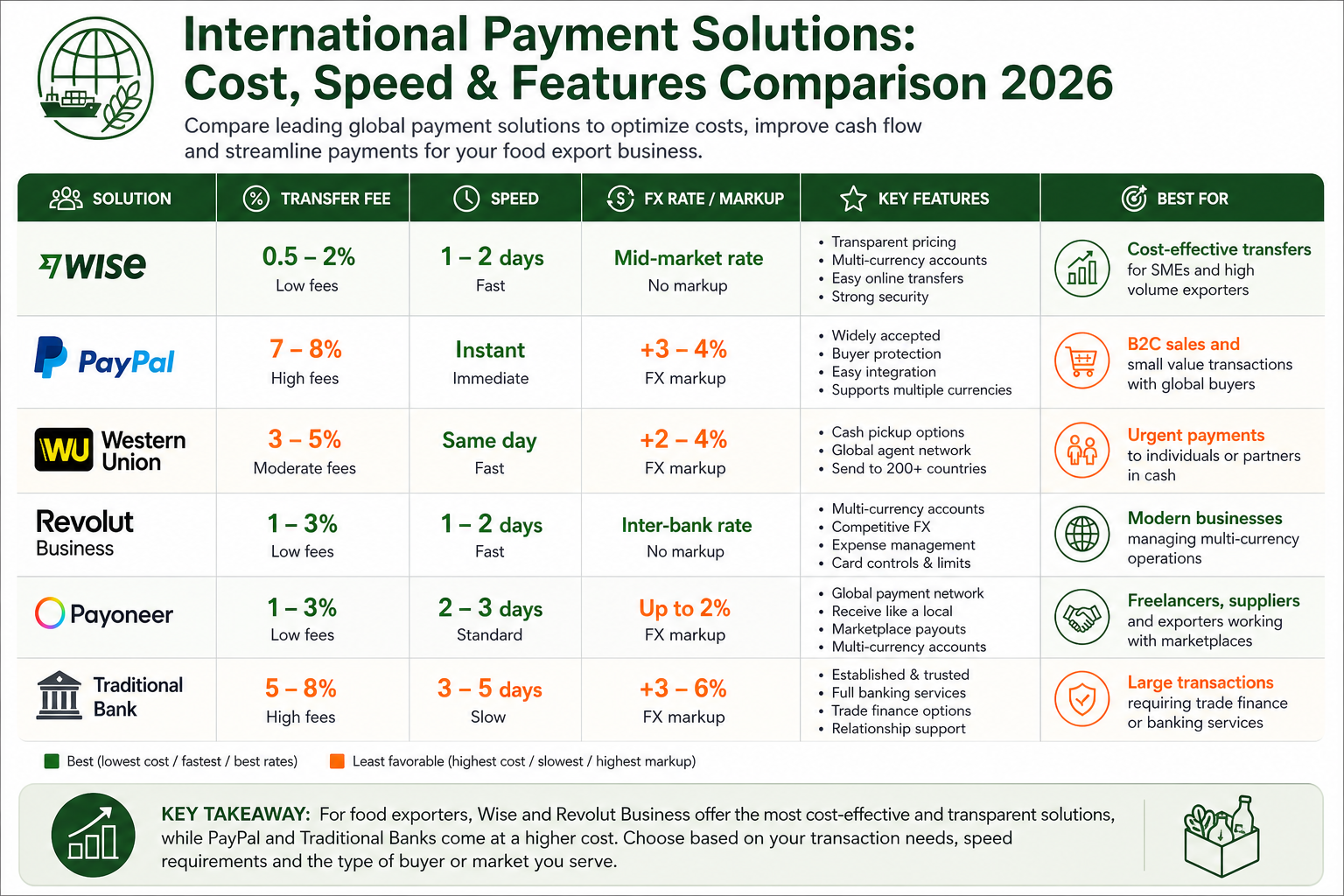
| Provider | Best For | Avg. Cost | Speed | Multi-Currency Account | API Available |
|---|---|---|---|---|---|
| Traditional Bank | Large transfers (>$500k) | 5-8% | 3-5 days | No | Limited |
| Wise | Regular transfers, transparency | 0.5-2% | 1-2 days | Yes (50+ currencies) | Yes |
| PayPal | Small amounts, buyer protection | 7-8% | Instant | Limited (25 currencies) | Yes |
| Western Union | Cash markets, urgent | 3-5% | Same day | No | Yes |
| Revolut Business | EU/UK businesses | 1-3% | 1-2 days | Yes (30+ currencies) | Yes |
| Payoneer | Marketplace payments | 1-3% | 2-3 days | Yes (5 currencies) | Yes |
Choosing the Right Solution for Your Export Business
The best payment solution depends on your specific needs. Here's a decision framework:
By Business Size
Click to view recommendations by business size
Small exporters (<$50,000/year)
- Primary: Wise for transparency and low fees
- Backup: PayPal for buyers who insist on it
Medium exporters ($50,000-$500,000/year)
- Primary: Wise for most transactions
- Specialized: Western Union for cash markets
- Consider: Revolut Business if EU-based
Large exporters (>$500,000/year)
- Primary: Wise or negotiate rates with traditional bank
- Hedging: Western Union Business Solutions for FX risk management
- Multi-tool: Use different providers for different routes
By Geographic Focus
Click to view recommendations by region
Exporting to EU/UK
- Wise (excellent coverage, local IBANs)
- Revolut Business (if based in EU)
Exporting to USA
- Wise (US ACH routing numbers available)
- Payoneer (if selling on US marketplaces)
Exporting to Middle East/North Africa
- Western Union (strong cash network)
- Wise (growing coverage in UAE, Egypt)
Exporting to Asia
- Payoneer (strong China corridor)
- Wise (good coverage for Singapore, Hong Kong, Japan)
By Payment Frequency
Click to view recommendations by frequency
Regular monthly payments
- Wise (best for predictable, recurring transfers)
- Set up automated payments via API
Occasional/seasonal
- PayPal (pay-as-you-go, no monthly fees)
- Traditional bank (if already established relationship)
High-frequency daily
- Wise API with automation
- Consider dedicated account manager at Western Union
How to Set Up Wise for Your Food Export Business
Click to view setup guide
Since Wise offers the best combination of low fees, transparency, and features for most food exporters, here's a step-by-step setup guide:
Step 1: Create Your Wise Business Account
1. Visit wise.com/business and click "Get Started"
2. Provide your business details:
- Business legal name and registration number
- Business address and tax ID
- Industry (select "Food & Beverage" or "Agriculture")
- Estimated monthly volume
3. Verify your identity:
- Government-issued ID (passport or driver's license)
- Proof of address (utility bill or bank statement)
4. Verify your business:
- Certificate of incorporation
- Proof of business address
- Shareholder information (if applicable)
Verification time: 1-3 business days
Step 2: Activate Currency Accounts
1. Navigate to "Balances" in your Wise dashboard
2. Click "Open a balance" for each currency you need
3. Get local bank details instantly for:
- USD (ACH routing number)
- EUR (IBAN)
- GBP (Sort code + account number)
- AUD, NZD, CAD, and 40+ more
Use case: Share these local account numbers with your international buyers so they can pay you as if you're a local business, avoiding their international transfer fees.
Step 3: Make Your First Transfer
1. Click "Send" in your Wise dashboard
2. Enter:
- Amount and currency
- Recipient details (bank account or Wise account)
- Purpose of payment (for compliance)
3. Review the breakdown:
- Exact exchange rate (always mid-market)
- Transfer fee (fixed percentage)
- Expected delivery time
4. Fund the transfer via:
- Bank transfer (cheapest)
- Debit card (instant, small fee)
- Existing Wise balance
Pro tip: Fund transfers via bank transfer to avoid debit card fees. For urgent payments, card funding is worth the small extra cost for instant processing.
Step 4: Integrate with Your Accounting Software
1. Go to "Settings" → "Integrations"
2. Connect your accounting software:
- Xero
- QuickBooks
- FreeAgent
- Or use CSV export for other systems
3. Enable automatic transaction sync
Benefit: Eliminate manual reconciliation and reduce accounting time by 70%.
Step 5: Set Up the Wise Business Debit Card
1. Order your Wise Business debit card (free)
2. Receive it within 7-10 business days
3. Use it to:
- Pay for trade show expenses in local currency
- Make supplier payments abroad
- Withdraw cash at ATMs worldwide (up to $200/month free)
Advantage: Card automatically converts at mid-market rate when you spend in foreign currency—no 3% credit card foreign transaction fees.
Step 6: Enable API Access (Optional, for High-Volume Exporters)
1. Contact Wise to request API access
2. Integrate with your ERP/accounting system
3. Automate:
- Batch payments to multiple suppliers
- Regular payment schedules
- Currency conversions based on triggers
Reducing Payment Costs: Advanced Strategies
1. Timing Your Transfers
Learn about timing strategies
Exchange rates fluctuate constantly. For large transfers:
- Use rate alerts: Set up notifications when your target rate is reached (available in Wise)
- Consider forward contracts: Lock in a rate for future payments (available through Western Union Business Solutions or specialized FX brokers)
- Avoid weekends: Exchange rate spreads are wider when markets are closed
2. Optimize Payment Terms
Learn about payment terms optimization
Negotiate with buyers to:
- Accept local currency payments: Use your Wise local bank details to receive payments in your buyers' currencies, then convert on your schedule
- Net payment terms: Batch multiple smaller invoices into one larger monthly payment to reduce per-transaction costs
- Prepayment discounts: Offer 2-3% discount for advance payment to improve cash flow and reduce currency risk
3. Multi-Currency Strategy
Learn about multi-currency strategies
Hold balances in your major trading currencies:
1. Identify your top 3 currencies by volume (e.g., EUR, USD, GBP)
2. Keep working capital in these currencies (~1-2 months of expenses)
3. Convert strategically when rates are favorable, not when you need the money urgently
4. Pay suppliers directly in their currency without double conversion
Example
If you're a Ghanaian cashew exporter selling to EU buyers and buying raw nuts from Ivory Coast:
- Receive EUR payments → Hold in EUR balance
- Pay Ivorian suppliers in XOF (West African CFA franc)
- Convert EUR → XOF only when needed at favorable rates
- Avoid unnecessary GHS (Ghana Cedi) conversions
4. Leverage Volume Discounts
Learn about volume discounts
For exporters with monthly volumes exceeding $100,000:
- Negotiate with Wise: Contact their team for reduced fees on high volumes
- Western Union Business Solutions: Dedicated rates for regular clients
- Traditional banks: Use your volume as leverage to negotiate better rates
- Specialized FX brokers: Consider OFX, TorFX, or Currencies Direct for very large transfers
Common Mistakes to Avoid
1. Not Calculating Total Cost
View mistake details
Mistake
Comparing only transfer fees without considering exchange rate markups.
Solution
Always calculate the total cost as a percentage of the transfer amount. Use comparison tools like Wise's calculator to see the full picture.
2. Using Credit Cards for International Payments
View mistake details
Mistake
Paying foreign suppliers with credit cards due to convenience.
Problem
Credit card foreign transaction fees (3%) + cash advance fees (5%) + interest can exceed 10% total cost.
Solution
Use Wise or bank transfer for B2B payments. Reserve credit cards only for small, urgent purchases where the reward points offset the fees.
3. Not Diversifying Payment Providers
View mistake details
Mistake
Relying on a single payment method.
Risk
If your primary provider has downtime, compliance holds, or doesn't support a specific route, your business operations stop.
Solution
Have at least two payment providers set up and tested. For example:
- Primary: Wise (for 90% of transactions)
- Backup: PayPal or traditional bank (for when Wise doesn't support a route)
4. Ignoring Compliance Requirements
View mistake details
Mistake
Providing incomplete or inconsistent documentation.
Consequence
Payment delays, account holds, or rejected transfers.
Solution
- Keep digital copies of all invoices and contracts
- Provide clear purpose of payment descriptions
- Maintain consistent business information across all platforms
- Respond promptly to verification requests
5. Converting Currency Too Many Times
View mistake details
Mistake
USD → EUR → GBP → USD conversions lose money at each step.
Solution
- Hold balances in your actual trading currencies
- Pay directly in recipient's currency when possible
- Use multi-currency accounts to avoid round-tripping
Tax and Compliance Considerations
Record Keeping
What records do you need to keep?
For tax purposes, maintain records of:
- All international transfers: Amount, date, exchange rate used, fees paid
- Invoices and contracts: Proving the commercial purpose of each payment
- Exchange rate documentation: For calculating tax liability in your local currency
Pro tip: Wise automatically provides detailed statements with all this information, making year-end tax filing much easier.
Reporting Requirements
What are the reporting requirements?
Depending on your country, you may need to report:
- Foreign exchange transactions above certain thresholds to central banks
- Foreign currency holdings in annual tax returns
- International payments to trade/customs authorities
Example
In Nigeria, the CBN requires exporters to repatriate export proceeds within 90 days. Wise transfers provide audit trails proving compliance.
Anti-Money Laundering (AML) Compliance
Understanding AML compliance
All reputable payment providers will:
- Verify your business identity and beneficial owners
- Ask for source of funds documentation
- Monitor transactions for suspicious activity
- Report large or unusual transactions to authorities
What you need
- Clear documentation of your export business (contracts, invoices, shipping documents)
- Transparent ownership structure
- Consistent transaction patterns matching your business model
Frequently Asked Questions (FAQ)
Can I use my personal bank account for export business?
While possible for very small starts, it's not recommended. Personal accounts often have lower transaction limits, higher fees for international transfers, and lack essential business features like multi-currency holding. Plus, it looks unprofessional to international buyers.Which currency should I invoice in?
Ideally, invoice in a major currency (USD, EUR, GBP) that your buyer is comfortable with. If you use a multi-currency account like Wise, you can provide local bank details for these currencies, making it easier for buyers to pay you without them incurring international wire fees.How do I protect myself from exchange rate fluctuations?
For short-term protection, use limit orders (auto-convert when rate hits a target). For long-term contracts, consider "forward contracts" offered by providers like Western Union Business Solutions, which allow you to lock in an exchange rate for a future date.Are fintech banks like Wise safe?
Yes. Reputable fintechs are regulated by the same financial authorities as traditional banks (e.g., FCA in the UK, FinCEN in the US). They are required to safeguard customer funds in separate accounts from their own operating capital.📥 Export Payment Checklist
Don't lose money on your next shipment. Download our free 10-point checklist to ensure you're using the most cost-effective payment method.
- Compare mid-market vs. bank rates
- Verify hidden intermediary fees
- Check compliance document requirements
🌍 Find Verified International Buyers
Ready to export but need reliable partners? Access our directory of 500+ verified food importers across Europe, Asia, and North America.
Access Buyer Directory💳 Get the Payment Implementation Planner →
Step-by-step implementation guide for integrating Wise, Payoneer, or traditional bank solutions into your export payment workflow. Fee comparison tables, settlement time analysis, and multi-currency account setup checklist.
Free download — no email required.
Conclusion: Making the Switch
For most small and mid-sized food exporters, switching from traditional banks to modern payment platforms like Wise can result in:
- Cost savings of 70-90% on international transfer fees
- Faster payment processing (1-2 days vs 5-7 days)
- Better cash flow management with multi-currency accounts
- Simplified accounting through software integrations
- Greater transparency with real-time tracking and no hidden fees
Your Action Plan
This week
- Calculate your current annual cost of international payments (fees + exchange rate markups)
- Sign up for a Wise business account (or your chosen alternative)
- Make one test transfer to verify the process and timing
This month
- Migrate 50% of your international payments to your new provider
- Set up local currency accounts for your top 3 trading partners
- Integrate with your accounting software
This quarter
- Analyze cost savings achieved vs traditional banking
- Optimize your currency holding strategy based on actual payment patterns
- Train your finance team on the new platform
Long-term
- Negotiate better rates based on proven volume
- Explore API integration for automation
- Consider forward contracts for large, planned future payments
Need More Help?
International payments are just one piece of successfully scaling your food export business. At FoodExpoConnect, we help African and emerging market food exporters connect with verified international buyers, navigate export regulations, and build sustainable global trade relationships.
Explore our resources
- How to Find International Food Buyers: 7 Proven Strategies
- Complete Guide to Food Export for African Businesses 2025
- Food Safety Certifications for Export: HACCP, ISO 22000, FSSC 22000 Explained
Disclaimer: This article is for educational purposes and does not constitute financial advice. Exchange rates, fees, and features of payment providers are subject to change. Always verify current rates and terms with providers before making decisions. FoodExpoConnect may earn affiliate commissions from some of the providers mentioned when you sign up through our referral links, at no extra cost to you.
Quick facts
Published: 12/16/2025
Reading time: 12 min
Pillars: export-success
Written by

Jean Marc Koffi
Co-authorJournalist & Export SpecialistLondon
Jean Marc Koffi is an MBA-trained trade specialist who connects African exporters to global buyers, with over $20M in contracts facilitated and expertise recognized by major trade organizations. Noted for rapid buyer network building, he is an experienced speaker and certified in trade facilitation, origin rules, and food safety.

Alocha Massamba
Co-authorFounder, Epifresh & FoodExpoConnectLondon
Alocha Massamba is the founder of Epifresh and FoodExpoConnect. He builds the technology, data and partnerships that connect African food producers and exporters to international buyers — with a focus on fresh-produce supply chains, cold-chain logistics, and the buyer-discovery platforms small and mid-size exporters need to compete with global incumbents.
Series
More in Payments & FX for Exporters

Best Payment Platforms for Food Exporters in 2026: Wise vs Payoneer vs Banks (Real Fee Comparison)
International payment fees quietly eat 3-7% of your export revenue. We tested Wise, Payoneer, and traditional banks with real transaction scenarios. Here's which platform saves you the most money — and when to use each one.
Explore more export intelligence
Certification • Pricing Strategy • Market Access
5 Certifications Worth More Than a Price Cut in 2026
Stop competing on price. Organic, Fair Trade, Rainforest Alliance, B Corp, and SQF certifications can command 20-300% price premiums for African food exporters in 2026. Here is the ROI data for each.
Coffee Export • Market Access • EU Regulations
Coffee Export 2026: African Origins, Fair Trade Pricing & EU Market Access
Complete guide to coffee export from Ethiopia, Kenya and Rwanda — EUDR compliance, fair trade pricing, certification requirements, and how to access €12-18/kg EU buyer contracts in 2026.
Market Access • Africa Trade • Export Strategy
China Zero-Tariff Policy for African Food Exporters: Coffee Imports Surge 145.7% — How to Enter the World's Largest Market Duty-Free
China's zero-tariff policy covering 53 African countries is already producing dramatic results — coffee imports surged 145.7% in the first five months. How food exporters can access this duty-free window and bypass traditional tariff barriers.