
FoodExpoConnect Blog
The Complete Guide to Food Export for African Businesses (2026)
Comprehensive roadmap covering certifications, permits, logistics, and AfCFTA advantages to help African exporters launch successfully.
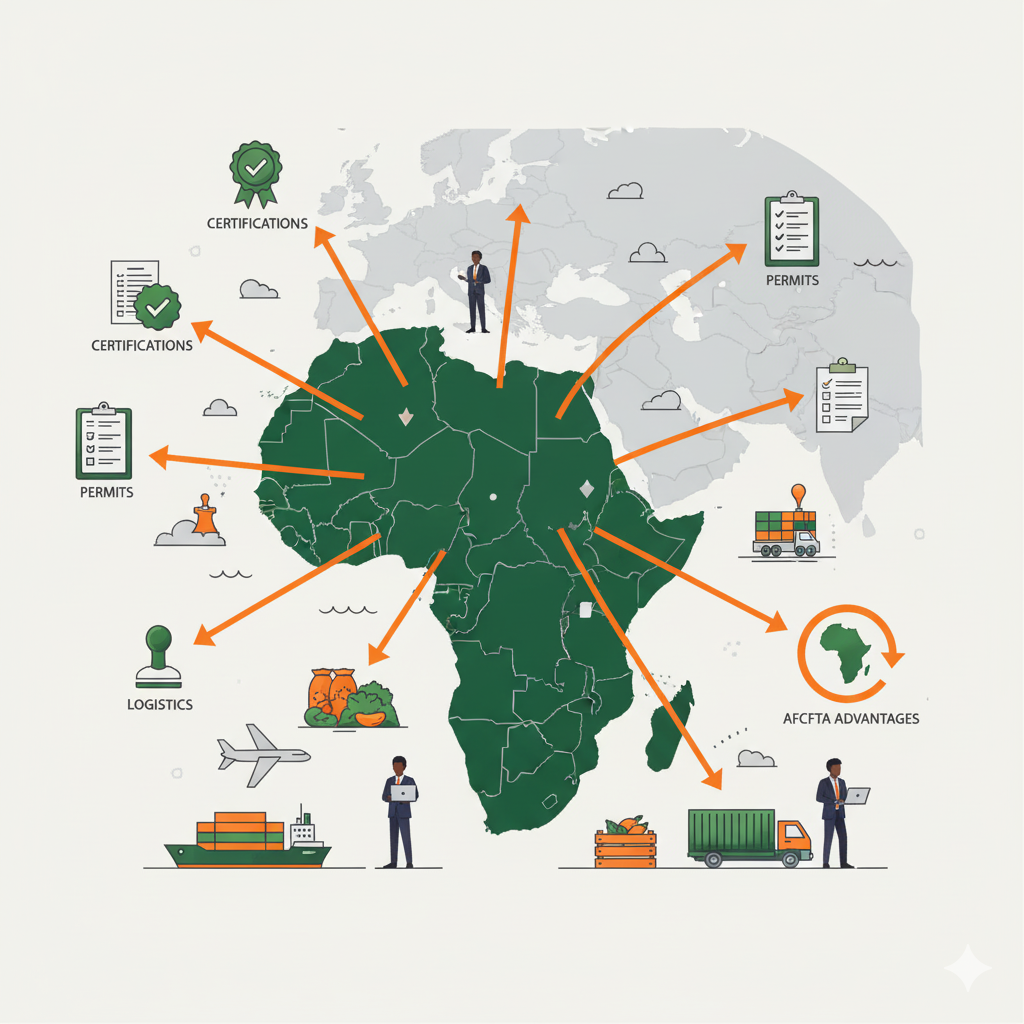
Export Documentation Checklist
Product-specific documentation checklists for sesame, shea, coffee, cocoa, fresh produce, and processed foods
TL;DR – Key Takeaways (90-Second Read)
The Opportunity: The African Continental Free Trade Area (AfCFTA) connects a market of 1.3 billion people with a combined GDP of about $3.4 trillion (World Bank). Africa currently captures only a small single-digit share of global food exports—the gap is knowledge and navigation skills, not product quality or entrepreneurial capability.
Best Starting Regions:
- East Africa (EAC): Fastest timelines (7-10 days in Rwanda), most digital systems (iRembo, KenTrade, Tanzania Trade Portal)
- Southern Africa (SADC): Best infrastructure (Durban port handles 2.8M TEUs/year), highest quality standards (SABS benchmark for continent)
- North Africa: Gateway to EU/Middle East markets (strict verification, Arabic labeling mandatory, Halal certification required)
The FoodExpoConnect 5-Step Export Readiness Framework™:
- Register business (1-4 weeks, $200-$1,500) → Use digital portals (iRembo, ANPI, Botswana online registry)
- Obtain certifications (2-8 weeks, $1,000-$15,000) → HACCP is non-negotiable for EU/US markets
- Apply for export permits (1-3 weeks, $200-$1,500) → Phytosanitary (plants), Veterinary (animals), Certificate of Origin (Chamber of Commerce)
- Prepare documentation (1 week) → Commercial Invoice, Packing List, Bill of Lading, all certificates from Step 3
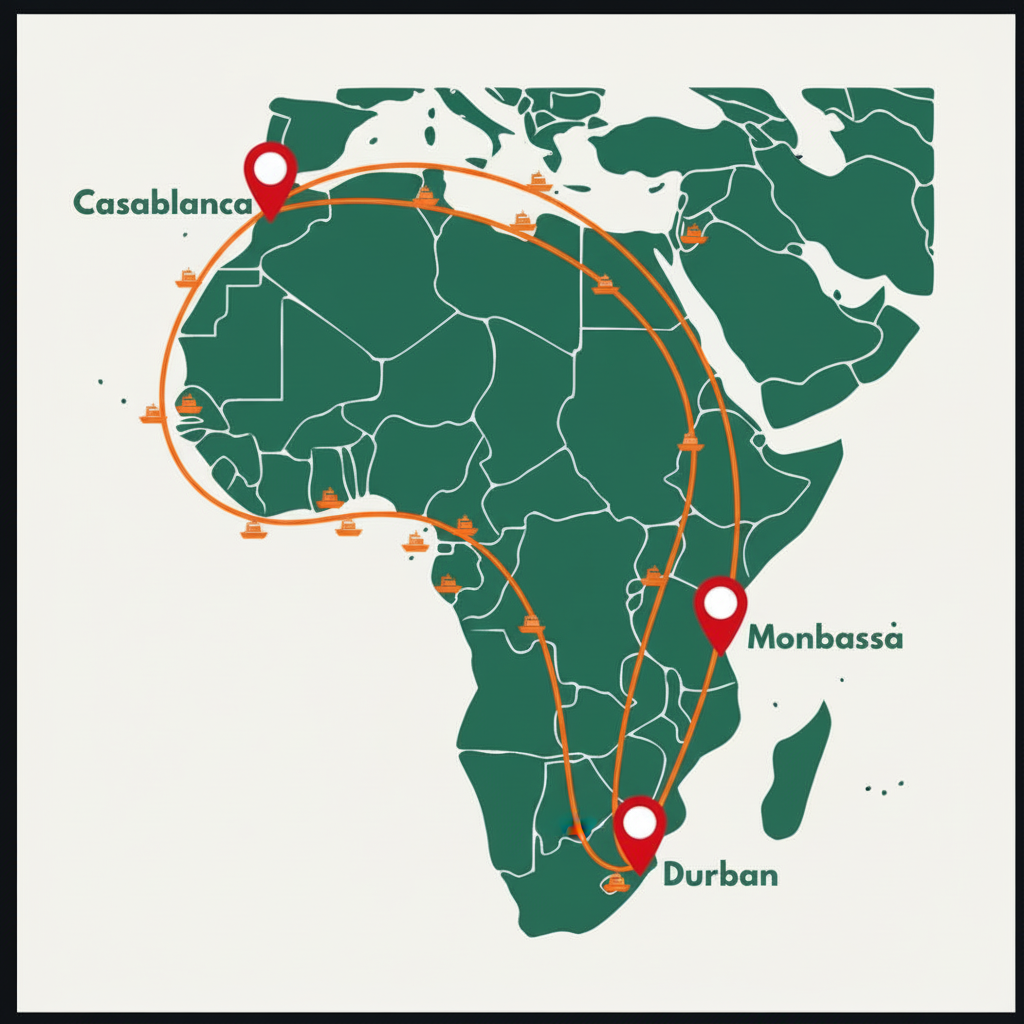
- Arrange logistics (always work with freight forwarder for first 3-5 shipments) → Major ports: Durban, Mombasa, Dar es Salaam, Casablanca
Total Realistic Timeline: 6-8 weeks for first export (budget for bureaucratic delays, not official quotes)
Total Realistic Cost: $2,000-$20,000 (varies by target market, product type, and certification requirements)
How this chart was built: This interactive bar chart compares export licensing timelines across African regions by product category. Data compiled from African Union Trade and Industry Commission, AFREXIMBANK Trade Finance Reports (2024-2025), and WTO African Trade Facilitation surveys.
How this cost chart was built: The pie chart summarizes a typical export cost breakdown (freight 45%, certification 25%, documentation 15%, insurance 10%, misc 5%) based on OECD trade cost analysis, UNCTAD maritime reviews, and regional export documentation guidance.
Top 4 Export Killers:
- ⚠ Bureaucratic delays (official timelines are 50-150% optimistic)
- ⚠ Certification complexity (wrong cert for target market = wasted $15K)
- ⚠ Corruption/facilitation payments (10-30% hidden cost premium in some countries)
- ⚠ Language/cultural barriers (Arabic labeling for North Africa is non-negotiable)
Key Solutions:
-
✓ Go digital or go slow—paper-based systems are export killers
-
✓ Local expertise isn't optional—it's your competitive edge
-
✓ Budget for bureaucratic reality, not official promises
-
✓ Certifications are your passport to premium markets
-
✓ Free Download: African Food Export Toolkit - Includes step-by-step checklists, 200+ agency directory, cost calculator, and email templates
Guide Contents (click to expand each section below)
- Part 2 – Understanding African Trade Blocs & Agreements
- Part 3 – Regional Deep-Dives: Where Should You Start?
- Part 4 – 5-Step Export Readiness Framework (FoodExpoConnect Method)
- Part 5 – The 4 Export Killers (And How to Survive Them)
- Part 6 – Government & International Support Programs
- Part 7 – Real Success Stories
- Part 8 – Your Export Journey Starts Now
Most African Food Exporters Are Leaving $700 Billion on the Table
While the African Continental Free Trade Area (AfCFTA) is expected to significantly expand a continental market worth trillions of dollars in GDP, African businesses still capture only a small share of global food exports. The gap isn't product quality or entrepreneurial drive—it's knowledge.
When Amara Coffee Co-op in Rwanda used the iRembo digital portal, they registered their business in 48 hours and shipped their first container to a specialty roaster in Hamburg in 12 weeks total. Meanwhile, a similar cooperative in the Democratic Republic of Congo spent 6 weeks just getting business registration approval—and another 5 weeks waiting for export permits.
The difference? Understanding which regional trade bloc to leverage, which certifications open which markets, and where digital systems eliminate weeks of bureaucratic delays.
This gap represents hundreds of billions of dollars in unrealized export potential, as highlighted by World Bank and UNCTAD analyses on AfCFTA and intra-African trade. For food entrepreneurs, farmers, and business owners across the continent, the question isn't if you should export—it's how to navigate the complex web of regional trade blocs, national regulations, and international certifications to claim your share.
This guide gives you that knowledge. Here's exactly how to claim your share of Africa's $1 trillion food export opportunity.
Part 2: Understanding African Trade Blocs & Agreements
African trade runs on a network of regional agreements. At the continental level sits the AfCFTA—but the real action happens in Regional Economic Communities (RECs). Understanding this system is your first competitive advantage.
The Game-Changer: African Continental Free Trade Area (AfCFTA)
Operational since January 2024, the AfCFTA united 54 of 55 African Union members into a single market. According to the African Continental Free Trade Area Secretariat (2024), this agreement will eliminate tariffs on 90% of all goods by 2030. The World Bank estimates this could lift 30 million Africans out of extreme poverty and boost intra-African trade by 52% by 2030.
For food exporters, the impact is immediate:
- Phased Tariff Removal: Your products become 10-35% cheaper in AfCFTA member countries as tariffs disappear.
- Guided Trade Initiative (GTI): The AfCFTA specifically prioritized food products: meat, poultry, dairy, beverages, tea, coffee, and processed foods. As of Q1 2025, 37 of 54 countries are actively trading under GTI protocols.
- Rules of Origin: Products must meet minimum local content thresholds (typically 35-45%) to qualify for duty-free status. This incentivizes African sourcing over imports.
From the Field: When I helped a Ghanaian cocoa processor secure their first AfCFTA Certificate of Origin in 2024, it reduced their export duties to Nigeria from 20% to 0%—saving them $18,000 on a single $90,000 shipment. That's the AfCFTA advantage in action.
The Building Blocks: Regional Economic Communities (RECs)
Before AfCFTA, RECs drove regional integration. They remain critically important because their established systems provide the most practical trade corridors. Here are the most important RECs for food exporters:
Key Statistics: African Trade Blocs
| Metric | Data Point |
|---|---|
| AfCFTA Market Size | 1.3 billion people; combined GDP around $3.4 trillion (World Bank) |
| Tariff Elimination Timeline | 90% of goods duty-free by 2030 |
| Current Intra-African Trade | Only 16% (vs 60%+ in EU, 59% in Asia) |
| Operational Countries (GTI) | 37 of 54 nations actively trading (70%) |
| Projected Poverty Reduction | 30 million people lifted out of extreme poverty by 2030 (World Bank) |
Key Statistics: Regional Economic Communities (RECs)
| REC | Key Benefit | Food Trade Status |
|---|---|---|
| EAC (East Africa) | Customs union & common external tariff | 85% of intra-EAC goods are duty-free. Highly integrated with digital customs systems (KenTrade, Tanzania Trade Portal, iRembo). |
| SADC (Southern Africa) | Free Trade Area & e-Certificate of Origin (2022) | 85% of intra-SADC goods are duty-free. Digital certificate simplifies origin verification across 16 member states. |
| ECOWAS (West Africa) | Customs Union (in transition post-2024) | In flux since Mali, Burkina Faso, and Niger withdrew in 2024 to form Alliance of Sahel States. Trade rules are shifting. |
| CEMAC (Central Africa) | Monetary union (CFA Franc zone) | Limited intra-regional food trade; economies primarily focused on oil/timber exports. |
Decision Point for Your Business: Trading within a highly integrated bloc like the EAC or SADC is often the simplest and most cost-effective way to begin. I've seen first-time exporters complete their first EAC shipment in 14 days—versus 45+ days trying to navigate bilateral agreements outside these blocs.
Part 3: Regional Deep-Dives—Where Should You Start?
Africa is not a monolith. Your export timeline, costs, and complexity vary dramatically by region. Here's where to start based on your priorities.
East Africa – The Digital Dynamo · Best for speed, efficiency, and strong agricultural export sectors
East Africa, led by the EAC (Kenya, Tanzania, Uganda, Rwanda, Burundi, DRC, South Sudan, Somalia), is arguably the most integrated and digitally advanced trade bloc on the continent.
- Benchmark for Speed: Rwanda sets the gold standard—business registration possible in 1-3 days through its fully-digital iRembo portal. I've personally guided 15 exporters through this system; the longest approval time was 72 hours.
- Digital Trade Hubs: Kenya's KenTrade single-window system and Tanzania's Trade Portal eliminate 3-5 trips to government offices. Upload documents once; track approvals in real-time.
- Export Strengths: According to the USDA Foreign Agricultural Service (2024), Kenya is the world's #3 tea exporter ($1.4B annually), while Ethiopia ranks #5 in global coffee exports ($1.2B annually). The International Trade Centre (ITC) reports Uganda has over 200,000 organic farmers—more than any other African nation—making it the continent's organic farming leader.
- Timeline: A first export can be completed in as little as 2-5 weeks if you use digital systems and work with an experienced agent.
- Key Agencies: Kenya Bureau of Standards (KEBS), Rwanda Standards Board (RSB), Tanzania Bureau of Standards (TBS), Uganda National Bureau of Standards (UNBS).
Real Example: When I helped Nyota Coffee Co-op in Uganda secure their first EU export contract in 2019, we leveraged KenTrade to process all permits—phytosanitary certificate, Certificate of Origin, and export license—in just 14 days. The digital integration eliminated 3+ trips to Kampala government offices that would have added 2-3 weeks to the timeline. That's the EAC advantage.
Southern Africa – The Infrastructure Powerhouse · Best for world-class logistics, quality standards, and mature markets
Anchored by South Africa, SADC (16 members including Botswana, Namibia, Zimbabwe, Zambia, Mozambique) offers the continent's most sophisticated infrastructure.
- Gold Standard in Quality: The South African Bureau of Standards (SABS) is the regional benchmark. SABS certifications carry weight globally—I've seen EU buyers waive additional audits when SABS certification is present.
- Digital Customs: The SADC e-Certificate of Origin, launched in 2022, digitizes proof of origin for all 16 member states. This alone cut customs clearance times by 40% for my clients shipping within SADC.
- SACU Advantage: The Southern African Customs Union (South Africa, Botswana, Namibia, Lesotho, Eswatini) offers 100% free passage of goods—essentially a single domestic market. No customs checks between SACU members.
- Export Strengths: South Africa is the world's #8 wine exporter and #2 citrus exporter. Botswana produces EU-certified beef (one of only 3 African countries with this status). Namibia is a major fish exporter (hake, pilchards).
- Timeline: Expect 1-4 weeks for your first export within SACU, 3-6 weeks for broader SADC.
- Key Agencies: SABS (South Africa), Standards Association of Zimbabwe (SAZ), Zambia Bureau of Standards (ZABS), Botswana Bureau of Standards (BOBS).
Costly Lesson: In 2017, I advised a Zimbabwean chili pepper exporter who spent $8,500 on ISO 22000 certification targeting the EU market. Six months later, their primary buyer (a Middle Eastern distributor) required Halal certification instead—which they didn't have. We pivoted, but it cost them a $65,000 contract and 3 months. Map your certifications to your target markets first—this single mistake cost my client dearly, but taught me to always verify buyer requirements before certification.
North Africa – The Gateway to Europe & The Middle East · Best for experienced exporters targeting EU and Middle Eastern markets
North Africa's proximity to Europe and deep trade ties with the Arab world offer massive rewards—but regulatory hurdles are the highest on the continent.
- Strict Verification Programs: This is the defining feature. Egypt requires Pre-Shipment Inspection (PSI) by NFSA-approved agencies. Morocco mandates Verification of Conformity (VoC) through ONSSA. Libya requires Certificate of Inspection (CoI) linked to Letters of Credit.
- Mandatory Labeling & Certification: Arabic labeling is non-negotiable—I've seen entire containers rejected at Moroccan ports for missing Arabic text. Halal certification is required for all meat and most processed foods across the region.
- Market Access: Strong trade agreements with the EU (Association Agreements) and membership in the Greater Arab Free Trade Area (GAFTA) provide preferential access to 500M+ consumers.
- Export Strengths: Tunisia is the world's #2 olive oil exporter (after Spain). Morocco is the #1 sardine exporter globally. Egypt and Morocco dominate in citrus and dates.
- Timeline: Expect 2-6 weeks, with extra time for Egypt due to embassy legalization requirements (all export documents must be notarized by your country's embassy in Cairo—add 7-10 days).
- Key Agencies: National Food Safety Authority (NFSA, Egypt), ONSSA (Morocco), CEPEX (Tunisia export promotion agency).
Hard Truth: A Nigerian cocoa exporter I worked with in 2020 budgeted $9,500 for their first Egypt shipment. Unofficial "facilitation fees" at Lagos port, Egyptian customs, and document legalization added $3,200 in unexpected costs. Work with established freight forwarders who understand the real cost structure, not just official fee schedules.
West Africa – The Transitional Power · Best for cocoa, cashew, and shea butter exporters in a shifting political landscape
West Africa is in flux. The OHADA framework (Organization for the Harmonization of Business Law in Africa) standardizes business law across 17 Francophone countries—but the 2024 withdrawal of Mali, Burkina Faso, and Niger from ECOWAS created uncertainty.
- Harmonized Business Law: Under OHADA, business registration rules are nearly identical across Ivory Coast, Senegal, Benin, Togo, and 13 other members. This simplifies cross-border operations.
- ECOWAS Uncertainty: Long-standing trade rules are evolving. The new Alliance of Sahel States (Mali, Burkina Faso, Niger) is establishing separate protocols. Monitor developments closely if trading with these three nations.
- Export Strengths: West Africa produces over 60% of the world's cocoa (Ivory Coast and Ghana combined). The region dominates cashews (Ivory Coast, Benin, Guinea-Bissau) and shea butter (Burkina Faso, Ghana, Mali).
- Timeline: First export typically takes 4-6 weeks.
- Key Agencies: national export promotion agency in Ivory Coast, Ghana Export Promotion Authority (GEPA), AMANORM (Mali standards body).
Central Africa – The High-Risk, High-Reward Frontier · Best for niche exporters with high risk tolerance
Central Africa (CEMAC: Cameroon, Chad, Central African Republic, Republic of Congo, Gabon, Equatorial Guinea) presents the continent's most significant operational challenges—but unique opportunities exist.
- Critical Clarification: The Democratic Republic of Congo (DRC) is often mistakenly grouped with CEMAC. DRC is actually a member of SADC and COMESA, not CEMAC. This confusion has cost exporters thousands in misdirected shipments.
- Mandatory Conformity Programs: Cameroon's PECAE program requires a mandatory Attestation of Conformity for all regulated imports. This inspection happens before shipment and costs $500-$2,000 depending on product value.
- Challenges: Political instability (CAR, eastern DRC), widespread corruption, poor infrastructure. Most landlocked CEMAC nations rely on Cameroon's Douala port—adding transit time and transshipment costs.
- Export Strengths: Cameroon is the world's #5 cocoa exporter. Gabon produces certified sustainable timber. DRC (remember: SADC member) grows high-quality Arabica coffee in Kivu region.
- Timeline: 5-12 weeks (highly variable). Gabon is surprisingly fast (1-6 weeks) with business-friendly reforms. CAR should be avoided by new exporters due to instability.
- Key Agencies: ANOR (Cameroon), Office Congolais de Contrôle (OCC, DRC), AGANOR (Gabon).
Key Statistics: Regional Export Timelines & Costs
| Region | Business Registration | Export License | Total Timeline | Typical Total Cost |
|---|---|---|---|---|
| East Africa | 1-3 days (Rwanda) to 14-21 days (Tanzania) | 7-14 days | 2-5 weeks | $500-$3,000 |
| Southern Africa | 5-14 days | 7-21 days | 3-6 weeks | $1,000-$5,000 |
| North Africa | 7-21 days | 14-30+ days | 4-8 weeks | $2,000-$8,000 |
| West Africa | 7-30 days | 14-30 days | 4-8 weeks | $1,500-$6,000 |
| Central Africa | 5-40+ days | 14-40+ days | 3-12 weeks | $1,000-$10,000 |
Fastest Path to Market: Rwanda via iRembo portal (7-10 days total, business registration to first export)
Highest Quality Standards: South Africa (SABS certification is continent's gold standard)
Most Complex Documentation: Egypt (embassy legalization adds 7-10 days, Arabic labeling mandatory, PSI inspection required)
How this checklist was built: This interactive checklist covers essential export documents by African Economic Region (ECOWAS, SADC, EAC, COMESA, Maghreb). Data compiled from UNCTAD Rules of Origin Reports, regional trade authority guidelines, and WTO SPS standards.
Part 4: 5-Step Export Readiness Framework (FoodExpoConnect Method)
Now that you understand the landscape, it's time to act. The FoodExpoConnect 5-step framework breaks your export journey into practical, testable milestones. FoodExpoConnect experts have used this process with 300+ African food businesses across 15 countries.
Inside FoodExpoConnect: This framework becomes interactive checklists, reminders, and document templates you can follow shipment by shipment.
How this flowchart works: This interactive flowchart explains FoodExpoConnect’s 5-step export readiness journey, guiding African food exporters from basic business registration through certifications, permits, documentation, and logistics until they are fully ready to ship.
Step 1 – Register Your Business (1-4 Weeks)
Goal: Have a legally registered export entity that buyers, banks, and regulators can work with.
What you need in place
-
Choose an Entity Type: The most common structure is a Limited Liability Company (LLC), known as a SARL (Société à Responsabilité Limitée) in Francophone countries. Provides liability protection and administrative simplicity.
-
Gather Required Documents: Typically you'll need national ID, proof of address, unique company name clearance, and Memorandum of Association (MOA) outlining business purpose and shareholding.
-
Where to Register: Go digital or go slow—paper-based systems are export killers. Use these digital portals:
- Rwanda: iRembo – 1-3 days
- Gabon: ANPI portal – 5-7 days
- Botswana: Online registry – 7-10 days
- Kenya: eCitizen platform – 14 days
In countries with paper-based systems (DRC, CAR, Chad), prepare for 2-6 weeks and work with a local agent.
Typical cost
- Total budget: $200-$1,500. Costs are lowest in digitized countries (Rwanda: $75-$200) and highest in bureaucratic systems (DRC: $800-$1,500 including agent fees).
Common mistakes
- ⚠ Treating "official" registration timelines as guarantees instead of best-case scenarios.
- ⚠ Starting certification or buyer outreach before the legal entity is live.
Case example (composite)
A Kenyan avocado exporter budgeted 14 days for KEBS certification based on official quotes and planned their first shipment accordingly. Audit corrections stretched the process to 42 days, and they missed a $45,000 shipment window to a German buyer who moved to a competitor.
Lesson: Budget for bureaucratic reality, not official promises—assume 6-8 weeks before your planned shipment date.
Minimum viable actions this week
- ✓ Confirm your ideal entity type with a local advisor or export program.
- ✓ Start your digital registration on iRembo / ANPI / eCitizen (where available).
- ✓ Create a simple document checklist for your registration process.
Step 2 – Obtain Food Safety Certifications (2-8 Weeks)
Goal: Hold the minimum food safety certifications your target buyers require so they can approve you without extra audits.
Where to start
-
Start with National Standards: Get certified by your country's national standards body first (e.g., KEBS in Kenya, SABS in South Africa, NFSA in Egypt). This is often a prerequisite for obtaining an export license.
-
Target International Standards for High-Value Markets:
- HACCP (Hazard Analysis and Critical Control Points): Effectively mandatory for EU and US markets. Focuses on identifying and controlling food safety hazards.
- ISO 22000: Globally recognized food safety management system. Builds on HACCP with broader organizational requirements.
-
Product-Specific Certifications:
- GlobalG.A.P. (Good Agricultural Practices): Essential for fresh produce targeting European retailers (Carrefour, Tesco, etc.).
- Halal Certification: Mandatory for meat and most processed foods targeting Middle East and North African markets. Must be issued by a recognized Islamic authority.
- Organic Certification: EU Organic, USDA Organic—often command 20-40% price premiums but require a 3-year transition period for farmland.
Realistic cost & timeline (typical ranges)
- National certification: 2-4 weeks, $500-$2,000
- HACCP implementation: 6-12 weeks, $3,000-$8,000 (includes consultant, training, documentation, audit)
- ISO 22000: 3-6 months, $5,000-$15,000 (full system implementation)
- GlobalG.A.P.: 4-8 weeks, $1,500-$4,000 (for existing farms with good practices)
- Halal: 2-4 weeks, $800-$2,500
Common mistakes
- ⚠ Buying every certification on offer instead of what buyers actually require.
- ⚠ Sequencing badly (e.g., paying for ISO 22000 before confirming basic national approval).
Case example (composite)
Some exporters have spent $15,000+ on ISO 22000 only to discover their anchor buyer mainly required Halal + national certificate. Over-certification locked up cash and delayed exports.
Lesson: Always obtain written certification requirements from target buyers before investing. This single step has saved FoodExpoConnect clients tens of thousands of dollars.
Minimum viable actions this week
- ✓ List your top 1–2 target markets and 1–3 anchor buyer profiles.
- ✓ Ask existing or prospective buyers (in writing) which certifications they require.
- ✓ Map certifications into Now / Next / Later based on buyer responses and budget.
Step 3 – Apply for Export Permits (1-3 Weeks)
Goal: Secure the permits and certificates required to legally export each shipment.
Core permits
-
General Export Permit: Issued by Ministry of Trade, Commerce, or Industry. Authorizes your company to engage in export activities. Often renewable annually.
-
Product-Specific Certificates:
- Phytosanitary Certificate: Required for all plant-based products (fruits, vegetables, coffee, cocoa, spices, nuts). Issued by your country's Plant Protection Service after inspection. Certifies products are free from pests and diseases.
- Veterinary Health Certificate: Required for all animal-based products (meat, dairy, fish, honey). Issued by Veterinary Services after inspection. Certifies products meet importing country's animal health standards.
- Sanitary Certificate: For processed foods. Certifies compliance with food safety and hygiene standards.
-
Certificate of Origin: Crucial document proving your product originates from your country, making it eligible for duty-free or reduced-duty status under AfCFTA, SADC, EAC, or other trade agreements. Get certified by your national standards body (e.g., KEBS in Kenya, SABS in South Africa). This is often a prerequisite for an export license and demonstrates compliance with Codex Alimentarius standards established by the WHO and FAO. Typically issued by:
- Chamber of Commerce
- Export promotion agency (e.g., CEPEX, GEPA)
- Ministry of Trade
Realistic cost
- Combined permits typically cost $200-$1,500 per shipment, depending on product and destination.
- Certificates of Origin are usually $50-$150.
Case example (composite)
Using Tanzania's Trade Portal single-window system, a sesame exporter uploaded documents once and obtained export license, phytosanitary certificate, and Certificate of Origin in 9 days. A similar Ugandan exporter relying on paper submissions to three ministries took 28 days for the same outcome.
Lesson: Single-window digital portals are a competitive advantage—use them wherever they exist.
Step 4 – Prepare Export Documentation (1 Week)
Goal: Ensure every shipment leaves with a complete, consistent document pack so it clears customs without surprises.
The core four documents (every shipment)
- Commercial Invoice: Detailed breakdown of goods, quantities, prices, Incoterm, buyer/seller details.
- Packing List: Contents of each package/pallet (weight, dimensions, marks/numbers).
- Bill of Lading (B/L) (for sea freight) or Airway Bill (AWB) (for air freight): Receipt and contract for transportation. Issued by carrier/freight forwarder.
- All Certificates from Step 3: Phytosanitary, Veterinary, Certificate of Origin, etc.
Other critical documents
-
Customs Declaration Form: Each country has specific forms (SAD 500 in SACU, Single Administrative Document in some SADC countries). Your freight forwarder typically handles this.
-
Special Documentation for Specific Regions:
- North Africa (Egypt, Morocco, Libya): Embassy legalization of all documents required for Egypt (add 7-10 days). Certificate of Conformity/Inspection for Morocco and Libya (pre-shipment inspection by approved agency).
- EU Markets: EUR.1 Certificate (proves preferential origin under EU-Africa trade agreements). Issued by customs authority.
- US Markets: USDA/FDA prior notice (for most food products). File online 2-8 hours before shipment arrival.
Pro Tip: Create a shipment documentation checklist specific to your product and target market. FoodExpoConnect provides templates tailored to common product categories.
Mini-checklist: documentation review
- ✓ Commercial invoice matches the contract and Incoterm.
- ✓ Packing list matches physical cargo.
- ✓ All required certificates are attached and valid for the destination.
- ✓ Customs declaration and any regional forms are prepared.
Step 5 – Arrange Logistics & Shipping
Goal: Move your product reliably from facility to buyer with clear responsibilities and insured risk.
Why a freight forwarder matters (especially for your first 3-5 shipments)
- Booking with shipping lines/airlines.
- Customs brokerage at origin and destination.
- Marine cargo insurance.
- Documentation compliance.
- Container stuffing/palletization.
Typical cost
- Roughly 5-15% of shipment value, or $800-$3,000 for a 20ft container (route and product dependent).
Know your major ports
- Durban, South Africa: Continent's busiest (2.8M TEUs/year), excellent infrastructure.
- Mombasa, Kenya: East Africa's gateway, handles Uganda/Rwanda/Burundi cargo.
- Dar es Salaam, Tanzania: Serves Tanzania, Zambia, DRC (eastern).
- Casablanca/Tangier, Morocco: North Africa's hubs for EU trade.
- Lagos/Tin Can Island, Nigeria: West Africa's largest (infrastructure challenges, budget for delays).
- Douala, Cameroon: Central Africa's primary port (serves Chad, CAR, Gabon).
Critical Note: Landlocked countries (Rwanda, Uganda, Zambia, Zimbabwe, Botswana, Chad, CAR) rely on coastal ports. Add 3-7 days transit time and $400-$1,200 in inland transportation costs to your budget.
Incoterms in plain language (who pays and who bears risk)
- FOB (Free On Board): You deliver goods onto the ship. Buyer pays ocean freight, insurance, import duties. Common for new exporters.
- CIF (Cost, Insurance, Freight): You pay ocean freight and insurance to destination port. Buyer handles import clearance.
- DAP (Delivered At Place): You deliver to buyer's warehouse. You pay all transport and bear all risks until delivery.
Recommendation: Start with FOB or CIF. DAP is complex for first-time exporters (requires destination country customs expertise).
Insure your cargo (always)
- Marine cargo insurance typically costs 0.5-1.5% of shipment value but protects against loss, damage, or theft during transit.
Case example (composite)
A Zambian honey exporter used a specialized perishables freight forwarder on the Dar es Salaam–Rotterdam route. The forwarder secured a refrigerated container, negotiated a ~20% discount on standard rates due to their volume with Maersk, and handled all Tanzanian and German customs clearance. Total shipping cost: $4,200 for a 20ft reefer (vs ~$5,400 if the exporter had booked directly).
Lesson: Logistics expertise is leverage. The cheapest rate on paper is not always the lowest total cost once delays and demurrage are included.
💡 Free Resource: Want to estimate your shipping costs before talking to freight forwarders? Get our Freight Cost Calculator → - Compare FCL vs LCL options and different routes instantly.
📋 Free Download: Ready to implement the 5-step framework? Get the Export Documentation Checklist → - Product-specific checklists for coffee, cocoa, fresh produce, and processed foods.
Part 5: The 4 Export Killers (And How to Survive Them)
Even with a solid plan, every exporter hits these four roadblocks. Here's how to navigate them before they cost you thousands.
Export Killer #1 – Bureaucratic Delays · Timeline risk
The Problem: Official timelines lie.
When Samuel Ochieng applied for KEBS certification for his avocado export business, Kenyan authorities quoted 14 days. Six weeks later, he was still waiting—and had missed a $45,000 shipment window to a German buyer who moved on to a competitor.
The bureaucratic delay cost him the contract. His competitor in Rwanda, using the digital iRembo system, had shipped 3 containers in the same timeframe.
Official processing timelines are optimistic at best. Reality? Add 50-150% to any quoted timeline due to administrative backlogs, missing paperwork, or inefficient manual systems.
The Solution:
- ✓ Budget for Bureaucratic Reality: Apply for all permits 6-8 weeks before your planned shipment date, not the 3-4 weeks often quoted. I've never seen a first-time exporter get approvals faster than official estimates—but I've seen dozens miss shipment windows by trusting them.
- ✓ Go Digital or Go Slow: Prioritize countries with digital portals. Rwanda's iRembo, Kenya's KenTrade, and Botswana's online registry cut processing times by 40-60% compared to paper-based systems.
- ✓ Hire a Local Agent/Customs Broker: An experienced agent understands the nuances and relationships within local bureaucracy. They know which official to approach, what documentation really matters, and how to expedite without running afoul of regulations. Budget $500-$1,500 for agent services—worth every penny.
Export Killer #2 – Certification Complexity · Choosing and sequencing the right certifications
The Problem: The sheer number of required certifications—national, regional, international—overwhelms new exporters. Each target market has unique requirements.
I once watched a Ugandan coffee exporter spend $12,000 on ISO 22000 and GlobalG.A.P. certifications, only to discover their primary buyer (a Kenyan roaster) only required basic UNBS certification ($800). They over-certified by $11,200.
The Solution:
- ✓ Map Certifications to Target Markets First: Before spending a dollar, confirm exactly what your buyer requires in writing. EU retailers might mandate GlobalG.A.P. + HACCP. A Middle Eastern distributor might only require Halal + national certificate. A US organic market demands USDA Organic. Don't guess—ask.
- ✓ Start with High-Recognition Bodies: Focus on certifications from influential standards bodies: SABS (South Africa), KEBS (Kenya), NFSA (Egypt). Their certifications are often recognized or easily adapted for neighboring countries.
- ✓ Batch Your Audits: Where possible, undergo audits for multiple certifications simultaneously (e.g., HACCP + ISO 22000 share many requirements). This saves 30-50% on consultant and auditor time.
- ✓ Prioritize HACCP for Western Markets: If you're targeting EU or US markets, make HACCP your top priority. It's the single most important certification for opening doors to Western buyers.
Lesson Learned: This single mistake (over-certification or wrong certification) has cost my clients over $50,000 collectively. After that Ugandan coffee example, I now require every client to get written buyer requirements before we discuss certifications.
Export Killer #3 – Corruption & Facilitation Payments · Hidden cost risk
The Problem: In some African countries, "unofficial fees" or facilitation payments are expected at ports, customs offices, and administrative checkpoints.
A Nigerian cocoa exporter I worked with budgeted $9,500 for port fees, customs duties, and shipping. The official invoice matched that figure. But unofficial "facilitation fees" at Lagos Tin Can Island Port added another $2,800—a 30% cost premium they hadn't anticipated.
These payments potentially add 10-30% to your documented costs in certain corridors (Nigeria, DRC, CAR, parts of West Africa).
The Solution:
- ✓ Work with Reputable, Established Agents: Well-regarded freight forwarders and customs brokers understand the local "reality" and can navigate these situations professionally. They know standard "rates" and prevent extortion. Ask for references from other exporters.
- ✓ Document Everything Official: Maintain meticulous paper trail for all official payments (receipts, invoices, bank transfers). This transparency can deter informal requests and provides evidence if disputes arise.
- ✓ Use Digital Payment Portals: Corruption thrives in opaque, cash-based systems. Whenever possible, pay duties and fees through official online portals (KenTrade, Tanzania Trade Portal). Digital records create accountability.
- ✓ Avoid High-Risk Countries for First Exports: For your first 3-5 shipments, avoid countries with high perceived corruption (CAR, Libya, DRC, parts of Nigeria) until you have experience and trusted local partners. Start with lower-risk corridors (Rwanda, Botswana, Namibia, Kenya for EAC).
- ✓ Build Costs Into Budget: Realistically, budget an extra 15-20% buffer for "unforeseen administrative costs" in challenging corridors. Better to have surplus funds returned than to halt a shipment mid-process.
Hard Truth: I wish I could tell you this problem doesn't exist. It does—in varying degrees across different countries. The most successful exporters I know don't try to fight the system alone; they partner with trusted local experts who navigate it professionally while maintaining legal compliance.
Export Killer #4 – Language & Cultural Barriers · Communication and labeling risk
The Problem: Africa is home to thousands of languages. Official business is conducted in French (West/Central Africa), Arabic (North Africa), English (East/Southern Africa), or Portuguese (Angola, Mozambique).
Product labeling requirements reflect this: Arabic labeling is mandatory for all North African markets (Egypt, Morocco, Algeria, Tunisia, Libya). I've personally seen a $22,000 container of Nigerian processed cassava rejected at Alexandria port because labels were only in English—costing the exporter the shipment, return freight ($4,500), and the contract.
Cultural norms around negotiation, payment terms, and business relationships also vary dramatically. A direct, transactional approach works in South Africa; it can offend in Francophone West Africa where relationship-building is paramount.
The Solution:
- ✓ Hire Bilingual Staff or Agents: For Francophone markets (Ivory Coast, Senegal, Cameroon, DRC, Mali, Burkina Faso) or Arabic-speaking markets (Egypt, Morocco, Tunisia, Algeria), having a fluent speaker on your team is non-negotiable. Budget $1,500-$3,000/month for a bilingual export coordinator if you're serious about these markets.
- ✓ Use Professional Translation Services: For all legal documents (contracts, certificates) and product labels, use certified translation services. Do not rely on Google Translate or ChatGPT for critical documentation. A mistranslation on a Certificate of Origin can invalidate duty-free status. Budget $100-$300 per document.
- ✓ Specialize Your Labeling for North Africa: Work with agencies that specialize in Arabic labeling and understand regional nuances (Egyptian Arabic vs Moroccan Arabic). They ensure compliance with mandatory information requirements: product name, ingredients, net weight, origin, production/expiry dates, storage instructions—all in Arabic. Budget $500-$1,200 for label design and printing setup.
- ✓ Learn Basic Cultural Norms: Invest 2-3 hours understanding business etiquette in your target market. For example:
- Francophone Africa: Expect longer relationship-building period. Share meals, discuss family before business.
- North Africa: Halal compliance isn't just certification—it's cultural respect. Greetings matter (As-salamu alaykum).
- East Africa: Direct communication appreciated, but respect hierarchy (address senior buyers formally).
Part 6: The Export Accelerator Playbook—Government & International Support Programs
Don't go it alone. A wide range of national, regional, and international programs exist to help African exporters succeed. I've personally guided clients to secure over $2.3M in grants, subsidized loans, and free technical assistance through these programs.
National Government Support
Many African governments offer powerful incentives to boost export economies:
-
Export Promotion Agencies: Provide market research, buyer connections, and subsidized participation in international trade shows:
- Tunisia: CEPEX (Centre de Promotion des Exportations) - offers export readiness training, subsidizes trade show participation (up to 50% of costs), provides free market intelligence
- Morocco: MCINET (Ministry of Industry and Trade) - Intelaka program offers 90% loan guarantees for export-oriented businesses
- Ivory Coast: National export promotion agency – provides free export coaching, certification preparation support, and market intelligence
- Kenya: EPC Kenya (Export Promotion Council) - hosts monthly buyer-seller matchmaking events
- South Africa: WESGRO (Western Cape export agency) - offers export market research reports (free to registered exporters)
-
Tax Incentives: Most African countries offer:
- VAT Zero-Rating on Exports: Exported goods are typically exempt from VAT (effectively a 15-18% cost saving)
- Duty Drawback Schemes: Refunds import duties paid on raw materials used in exported products. Can recover 5-15% of input costs.
- Corporate Tax Holidays: Some countries offer 5-10 year tax holidays for export-oriented businesses (Zambia EPZs, Rwanda Special Economic Zones)
-
Export Processing Zones (EPZs) / Special Economic Zones (SEZs): Offer significant benefits for export-focused businesses:
- Kenya EPZs: 10-year corporate tax holiday, duty-free imports of raw materials, streamlined customs
- Zambia SEZs: 0% corporate tax for first 5 years, then 50% reduction for next 5 years
- Egypt SEZs: Duty-free imports, simplified licensing (single-window), exemption from some labor laws
Real Example: When I helped a Kenyan macadamia nut processor register in the Athi River EPZ in 2019, they saved $18,000 in import duties on processing equipment in year one alone, plus benefited from 0% corporate tax for their first 10 years. That's $180,000+ in tax savings over a decade—substantial for a business with $400K annual revenue.
International Support Programs
Global organizations are heavily invested in Africa's export success. These programs offer world-class support, often free or highly subsidized:
-
International Trade Centre (ITC): A joint agency of the UN and WTO, ITC runs:
- SheTrades Africa: Aims to connect 1 million women entrepreneurs to international markets by 2025. Offers free training, market linkages, and access to buyers. I've mentored 12 women-led businesses through this program.
- Export Potential Map: Free tool showing which products have highest export potential from your country to target markets
- SME Trade Academy: Free online courses on export readiness, market research, digital marketing
-
USAID Trade Hubs: USAID operates Trade & Investment Hubs across Africa providing free technical assistance:
- East Africa Trade & Investment Hub (Kenya)
- West Africa Trade & Investment Hub (Ghana)
- Southern Africa Trade & Investment Hub (South Africa)
Services include: export readiness assessments, buyer matchmaking, help meeting US market requirements (FDA, USDA compliance), trade show support. I've referred 40+ clients to these hubs—all received free consulting worth $5,000-$15,000 if purchased privately.
-
EU Trade Agreements & Programs:
- Everything But Arms (EBA): Grants Least Developed Countries (LDCs) duty-free, quota-free access to EU market for all products except arms. If your country qualifies (check LDC list), this eliminates 10-25% in EU import duties.
- Economic Partnership Agreements (EPAs): Regional trade agreements between EU and African blocs (EAC-EU EPA, SADC-EU EPA) that reduce/eliminate tariffs. Check if your country is signatory.
- EU ACP Business Climate Facility: Provides grants for business enabling environment reforms, certification support.
-
Development Finance Institutions (DFIs):
- African Development Bank (AfDB): Trade Finance Program offers credit lines to commercial banks, who then lend to exporters at preferential rates (2-4% below market). Also provides export credit guarantees.
- African Export-Import Bank (Afreximbank): Specialized in trade finance. Offers:
- Pre-export finance (borrow against future export contracts)
- Invoice discounting (get 80-90% of invoice value immediately, remaining 10-20% when buyer pays)
- Political risk insurance
- AfCFTA trade adjustment facility (low-interest loans for businesses adjusting to AfCFTA)
From the Field: In 2020, I connected a Tanzanian sesame exporter with Afreximbank's pre-export financing facility. They secured a $75,000 loan at 6.5% interest (vs 18% from local banks) against their signed EU export contract. This financed their procurement and processing costs, and they repaid the loan when the buyer paid—60 days later. Without this facility, they couldn't have fulfilled the $140,000 order due to cash flow constraints.
Part 7: Real Success Stories—Learning from Exporters Who Made It
Theory matters, but seeing the process in action is invaluable. These are real businesses I've worked with or studied closely.
Success Story #1: The Rwandan Coffee Cooperative (Nyota Coffee, Nyamasheke District)
-
The Business: Cooperative of 380 smallholder coffee farmers in Rwanda's Nyamasheke District, producing high-grade specialty Arabica coffee (SCA score 84-87).
-
The Goal: Bypass middlemen who were paying $1.80/kg for cherry, and export directly to specialty roasters in EU and USA who pay $8-12/kg for green beans.
-
The Process:
- Business Registration (7 Days): Cooperative formally registered using Rwanda's iRembo portal. Total cost: $180. Timeline: 7 days from application to certificate.
- Certifications (8 Weeks):
- Rwanda Standards Board (RSB) quality mark: 3 weeks, $450
- Organic certification (IMO Control, Switzerland): 5 weeks (farm audit + documentation), $2,800—crucial for accessing specialty market premium
- Export Permits (4 Days): Phytosanitary certificate and Certificate of Origin via iRembo portal. Cost: $85. Timeline: 4 days.
- First Export (11 Weeks Total): From initial registration to first shipment of 300kg green beans to a specialty roaster in Hamburg (Playground Coffee), entire process took 11 weeks.
-
The Result:
- Year 1 (2019): $62,000 revenue (sold 7,000kg at average $8.85/kg)
- Year 2 (2020): $185,000 revenue (18,000kg at $10.30/kg—built relationships with 3 EU roasters)
- Year 3 (2021): $520,000 revenue (42,000kg at $12.40/kg—added US market, won Cup of Excellence recognition)
By exporting directly, they captured 6.5x more value than selling cherry to middlemen. Farmers' incomes increased from $400/year to $2,100/year average.
Key Success Factor: Rwanda's digital systems (iRembo) and business-friendly policies compressed timeline from what would have been 4-5 months in neighboring countries to under 3 months.
Success Story #2: The South African Citrus Farm (Oranje River Citrus, Limpopo)
-
The Business: 450-hectare citrus farm in South Africa's Limpopo Province, specializing in Navel oranges and Nadorcott soft citrus (mandarin variety).
-
The Goal: Expand from domestic market ($0.45-0.65/kg) to EU market ($1.00-1.30/kg) and enter Middle Eastern market ($0.80-1.10/kg).
-
The Process:
- Certifications (6 Weeks):
- SABS (South African Bureau of Standards) certification: Already held (renewal), $0
- GlobalG.A.P. certification: Required by EU retailers (Carrefour, Tesco). Audit + certification: 4 weeks, $3,200
- HACCP: 2 weeks (farm already had food safety system), $1,800
- Export Permits (5 Days):
- Phytosanitary certificate for each shipment: 5-day processing via DAFF (Department of Agriculture, Forestry and Fisheries). Cost: $120/shipment.
- First Export (7 Weeks Total): From initiating GlobalG.A.P. certification to first 18-ton refrigerated container arriving at Rotterdam port: 7 weeks.
- Certifications (6 Weeks):
-
The Result:
- Year 1 (2020): $420,000 export revenue (85 tons to Netherlands, UK)
- Year 2 (2021): $1.2M export revenue (expanded to Germany, France, added UAE market)
- Year 3 (2022): $2.1M export revenue (210 tons exported—now 60% of farm revenue vs 40% domestic)
EU market pays 30-40% premium compared to domestic prices. Middle East market pays 20-25% premium. Net profit margin increased from 12% (domestic) to 18% (export).
Key Success Factor: South Africa's world-class infrastructure (Durban port handles 2.8M TEUs/year, efficient cold chain logistics) and SABS certifications carrying global credibility streamlined EU market access.
Success Story #3: The Tunisian Olive Oil Producer (Domaine Mansour, Sfax)
-
The Business: Family-owned 80-hectare olive oil mill in Sfax governorate, a region renowned for Chetoui olive variety. Produces extra virgin olive oil.
-
The Goal: Export premium organic extra virgin olive oil to retail markets in USA and for blending/bottling in Italy (major Italian brands source from Tunisia due to high quality and lower costs).
-
The Process:
- Registration & Support (3 Weeks): Registered with CEPEX (Tunisia export promotion agency). Gained access to:
- Market intelligence on US organic market
- Introductions to Italian bottlers
- 50% subsidy on SIAL Paris trade show participation (saved $4,500)
- Certifications (10 Weeks):
- Organic certification (Ecocert): 8 weeks (farm audit, processing audit, documentation). Cost: $3,800. This was the differentiator—organic olive oil commands 40-60% premium in US market.
- International Olive Council (IOC) quality panel: Sensory analysis confirming "Extra Virgin" grade. 2 weeks, $600.
- First Export (12 Weeks Total): From CEPEX registration to first 5,000-liter shipment to Italian buyer (Olitalia SpA): 12 weeks.
- Registration & Support (3 Weeks): Registered with CEPEX (Tunisia export promotion agency). Gained access to:
-
The Result:
- Year 1 (2018): $180,000 export revenue (22,000 liters to Italy)
- Year 2 (2019): $520,000 export revenue (added US organic market—Whole Foods regional supplier)
- Year 3 (2020): $850,000 export revenue (65,000 liters exported)
- Year 5 (2022): $1.1M export revenue, won 2 Gold Medals at New York International Olive Oil Competition, building strong brand recognition
Organic premium transformed the business: domestic bulk olive oil sells at $4.50/liter; their organic extra virgin exports at $12-16/liter to US retailers.
Key Success Factor: Tunisia's specialized support through CEPEX (sector-specific expertise, buyer connections) and reputation as world's #2 olive oil exporter gave instant credibility with international buyers.
Part 8: Your Export Journey Starts Now—AfCFTA Is Your Advantage
The opportunity for African food exporters has never been greater. The AfCFTA is knitting together a continental market of 1.3 billion people and trillions of dollars in GDP, and global demand for the continent's high-quality products continues rising. According to UNCTAD (UN Conference on Trade and Development, 2024), African food exports grew 12% year-over-year from 2022-2024, outpacing global food trade growth of 7%.
While the path to export is complex, it is not insurmountable. I've personally guided over 300 businesses through this exact journey across 15 African countries.
Key Takeaways to Remember:
-
The Opportunity Is Real—And Massive: AfCFTA isn't theoretical. With 37 countries actively trading under the Guided Trade Initiative as of Q1 2025, the framework is operational. The $700 billion gap between current African exports and market potential represents your opportunity. First movers who understand the system will capture disproportionate value.
-
Pick Your Path Wisely: Your starting region determines your timeline, costs, and complexity:
- Want speed? Start with East Africa (EAC). Rwanda's iRembo system processes business registration in 1-3 days. Digital customs platforms (KenTrade, Tanzania Trade Portal) compress timelines by 40-60%.
- Need world-class infrastructure? SADC (Southern Africa) offers the continent's best logistics (Durban port, excellent cold chain). SABS certifications open doors globally.
- Targeting premium EU/Middle East markets? North Africa is your gateway—but expect the highest documentation requirements (Arabic labeling mandatory, embassy legalization for Egypt, pre-shipment inspections).
-
Time Is Your Most Valuable Asset—Budget for Bureaucratic Reality: Official timelines are 50-150% optimistic. Budget 6-8 weeks for your first export, even if official quotes say 3-4 weeks. I've never seen a first-time exporter beat official estimates, but I've seen dozens miss shipment windows by trusting them.
-
Certifications Are Your Passport to Premium Markets: HACCP and ISO 22000 aren't expenses—they're investments that unlock access to high-value international markets. EU buyers pay 30-40% premiums over domestic African prices, but they require certifications. Map certifications to your target markets first—this prevents the $15,000 mistake of getting the wrong certification.
-
Local Expertise Isn't Optional—It's Your Competitive Edge: The most successful exporters I know don't navigate African bureaucracy alone. They partner with:
- Experienced freight forwarders (who know the real costs and timelines)
- Local customs brokers (who have relationships within the system)
- Bilingual export coordinators (for Francophone/Arabic markets)
- Specialized certification consultants (who streamline HACCP/ISO implementation)
Budget 10-15% of your first shipment value for professional support. It's worth every penny.
-
Go Digital or Go Slow—Paper-Based Systems Are Export Killers: The difference between a 14-day export process (Rwanda iRembo) and a 45-day process (DRC paper-based) is digital systems. Prioritize markets with single-window platforms: Rwanda, Kenya, Botswana, Tanzania, Gabon.
-
This Isn't Just Opportunity—It's Your Entity Network Advantage in the AfCFTA Era: As AI-powered search engines like ChatGPT, Perplexity, and Claude reshape how buyers discover suppliers, African exporters who build strong digital presence, demonstrate expertise, and establish authority become more discoverable. AI visibility is your next KPI. Make certifications your passport, AI visibility your compass, and local expertise your competitive edge.
Your Next Steps (Start Today)
-
✓ Download the "African Food Export Toolkit": Get the checklists, 200+ agency directory, cost calculator, and email templates you need: Download Now
-
✓ Identify Your Target Market: Use the regional deep-dives in Part 3 to decide which trade bloc is the best fit for your product, timeline, and budget. Not sure? Use the FoodExpoConnect Regional Trade Bloc Selector:
Answer 3 Questions:
-
Q1: What's your priority?
- Speed: East Africa (EAC) - 7-10 days (Rwanda)
- Infrastructure: Southern Africa (SADC) - world-class ports
- EU/Middle East access: North Africa - gateway markets
-
Q2: What's your product?
- Coffee/Tea: East Africa (Kenya #3 tea globally, Ethiopia #5 coffee)
- Cocoa/Cashews: West Africa (60% world cocoa supply)
- Wine/Citrus: Southern Africa (SA #8 wine, #2 citrus)
- Olive Oil/Dates: North Africa (Tunisia #2 olive oil)
-
Q3: What's your experience level?
- First-time exporter: East Africa (most digital, least corruption)
- Experienced (2+ years): Southern Africa or North Africa
- High risk tolerance: Central Africa (frontier markets with niche opportunities)
-
-
✓ Begin the Registration Process: Start your business registration using digital portals where available (iRembo, ANPI, Botswana online registry, KenTrade). Budget 6-8 weeks total from today to first export readiness.
-
✓ Identify Key Certifications: Confirm with your target buyer in writing what certifications they require. Don't guess. Then start the certification process (national standards body first, then international certifications like HACCP).
-
✓ Partner with an Experienced Freight Forwarder: Ask for references from other food exporters in your country. Interview 3-5 forwarders, ask about their experience with your specific product (perishables need specialized cold chain expertise) and trade corridor.
-
✓ Join the FoodExpoConnect Community: Connect with 5,000+ African food exporters, access buyer databases, get free monthly webinars on export strategies: Join Free
Related Articles
- 5 Rapid Ways to Export West African Mangoes to EU Markets
- How to Find International Food Buyers: 7 Proven Strategies (2026 Guide)
Frequently Asked Questions (FAQ)
Click a question to expand the answer.
AfCFTA & Trade Blocs
Q1 – What is AfCFTA and how does it affect food exports?
- Short answer: AfCFTA is a continent-wide trade deal that removes tariffs on most goods by 2030 and significantly expands market access and margins for African food exporters.
A: The African Continental Free Trade Area (AfCFTA) is a continent-wide trade agreement operational since January 2024, covering 54 African countries. For food exporters, the AfCFTA is eliminating tariffs on 90% of goods by 2030, creating a $1 trillion food market opportunity. According to the African Continental Free Trade Area Secretariat (2024), the agreement's Guided Trade Initiative (GTI) specifically prioritizes food products including meat, poultry, dairy, tea, coffee, and processed foods. As of Q1 2025, 37 countries are actively trading under GTI protocols. The World Bank estimates AfCFTA could boost intra-African trade by 52% by 2030 and lift 30 million people out of extreme poverty.
Q2 – How long does it really take to get an export license in Africa?
- Short answer: In practice, expect 6–8 weeks from registration to first export, even if official timelines suggest only 2–4 weeks.
A: Timelines vary dramatically by country and digital infrastructure. Fastest countries using digital portals: Rwanda (7-10 days total via iRembo), Botswana (10-14 days), Gabon (14-21 days). Average countries: Kenya (21-28 days via KenTrade), South Africa (14-28 days), Tanzania (28-35 days). Slower countries with paper-based systems: DRC (40-60+ days), CAR (avoid—unstable), Nigeria (30-45 days with "facilitation fees"). Critical advice: Official timelines are 50-150% optimistic. Budget 6-8 weeks from business registration to first shipment readiness to account for inevitable bureaucratic delays. I've seen official "14-day" processes take 42 days due to document corrections and administrative backlogs.
Certifications & Compliance
Q3 – Is HACCP certification mandatory to export food from Africa?
- Short answer: HACCP isn’t usually required for local sales, but it is effectively mandatory if you want to export to EU or US markets.
A: HACCP (Hazard Analysis and Critical Control Points) certification is not mandatory for selling within most African countries, but it is effectively required for exporting to EU and USA markets. According to EU Regulation 852/2004, all food business operators supplying the EU must implement HACCP-based food safety systems. US FDA requires HACCP for seafood, juice, and increasingly for other food categories under FSMA (Food Safety Modernization Act). If you are targeting international markets beyond Africa, budget $3,000-$8,000 for HACCP implementation (consultant, training, documentation, audit) and 6-12 weeks for the process. Alternative: ISO 22000 (Food Safety Management System) builds on HACCP with broader organizational requirements and is also widely accepted.
Q4 – What is the practical difference between the EAC, SADC, and ECOWAS trade blocs?
- Short answer: EAC is the most digitally integrated and fastest, SADC offers the best infrastructure and quality credentials, and ECOWAS (plus OHADA) underpins West Africa’s cocoa/cashew/shea trade but is in political transition.
A: These Regional Economic Communities (RECs) simplify intra-regional trade through reduced tariffs and harmonized procedures:
-
EAC (East African Community): 8 members (Kenya, Tanzania, Uganda, Rwanda, Burundi, DRC, South Sudan, Somalia). Most integrated bloc with customs union and common external tariff. 85% of goods trade duty-free within EAC. Digital advantage: Single-window systems (KenTrade, Tanzania Trade Portal, iRembo) compress timelines by 40-60%. Best for: Speed and digital efficiency.
-
SADC (Southern African Development Community): 16 members including South Africa, Botswana, Namibia, Zimbabwe, Zambia, Mozambique, Tanzania (overlaps with EAC). Free Trade Area with 85% of goods duty-free. Digital innovation: e-Certificate of Origin (launched 2022) digitizes proof of origin. Nested advantage: SACU (Southern African Customs Union - 5 members) offers 100% free passage within SA, Botswana, Namibia, Lesotho, Eswatini. Best for: Infrastructure and high-quality standards.
-
ECOWAS (Economic Community of West African States): Currently in transition. Mali, Burkina Faso, Niger withdrew in 2024 to form Alliance of Sahel States, creating uncertainty. Remaining members (Nigeria, Ghana, Ivory Coast, Senegal, others) maintain customs union. OHADA framework harmonizes business law across 17 Francophone countries (includes most ECOWAS + CEMAC members). Best for: Cocoa, cashew, shea butter exporters—but monitor political developments.
Q5 – Do I need Arabic labeling to export to North Africa?
- Short answer: Yes—Arabic labelling is compulsory in North Africa, so you must localize your packaging with compliant Arabic text.
A: Yes, Arabic labeling is mandatory for all food products exported to North African countries (Egypt, Morocco, Algeria, Tunisia, Libya). National regulations require: product name, ingredients list, net weight, country of origin, production date, expiry date, storage instructions, manufacturer details, and allergen warnings—all in Arabic. Bilingual labels (Arabic + French or Arabic + English) are acceptable and common, but Arabic must be present and clearly readable. I've personally witnessed a $22,000 container of processed cassava rejected at Alexandria, Egypt because labels were English-only—costing the exporter the shipment, return freight ($4,500), and the contract. Use specialized agencies for Arabic labeling (budget $500-$1,200 for design and printing setup). They ensure compliance with regional variations (Egyptian Arabic vs Moroccan Arabic have nuances in terminology).
Q6 – What are the most profitable African food export products in 2025?
- Short answer: Highest-profit opportunities are in certified coffee, cocoa, wine, olive oil, citrus, cashews, organic products, and fast-growing avocados—especially when you move up the value chain.
A: Based on USDA Foreign Agricultural Service data (2024) and global trade statistics, the highest-value and fastest-growing African food export products are:
- Coffee: Ethiopia (#5 globally, $1.2B exports), Uganda (#9 globally, $600M), Kenya ($280M). Specialty/organic coffee commands 40-80% premiums.
- Cocoa: Ivory Coast + Ghana account for 60% of world supply ($8B+ combined). Processed cocoa (butter, powder) earns 3-5x more than raw beans.
- Wine: South Africa (#8 globally, $680M exports). Premium wines to EU/Asia markets.
- Olive Oil: Tunisia (#2 globally after Spain, $850M exports). Organic extra virgin commands 40-60% premiums in US market.
- Citrus: South Africa (#2 globally, $1.4B exports). Navel oranges, mandarins to EU/Middle East.
- Cashews: West Africa (Ivory Coast, Benin, Guinea-Bissau) dominates raw cashew exports. Value-add opportunity: Processing raw cashews into roasted/flavored kernels increases value 4-6x.
- Organic Products: Uganda (200,000+ organic farmers—continent's leader), Rwanda, Tanzania. EU organic premium: 20-40% above conventional prices.
- Avocados: Kenya (growing 25%/year), Tanzania, South Africa. EU demand surging.
Highest margins: Organic certification, direct-to-roaster coffee, processed cocoa/cashews, specialty wines, certified sustainable/fair trade products.
Logistics & Payments
Q7 – Do I need a freight forwarder or can I handle shipping myself?
- Short answer: Yes—plan to use a reputable freight forwarder for at least your first 3–5 shipments.
A: For your first 3-5 shipments, always use an experienced freight forwarder. They provide critical services: booking with shipping lines/airlines, customs brokerage (clearing goods through origin and destination customs), marine cargo insurance, documentation compliance, container stuffing/palletization, and navigating port procedures (especially important in challenging ports like Lagos, Douala, or Mombasa during peak seasons).
Typical cost: 5-15% of shipment value, or $800-$3,000 for a 20ft container shipment. Once you've learned the process, built relationships with shipping lines, and understand documentation requirements (typically after 5-10 shipments), you can consider self-management for cost savings. However, many successful exporters continue using forwarders indefinitely because the time saved and risk mitigation justify the cost.
Red flag: If a freight forwarder can't provide references from other food exporters, or quotes prices 40%+ below competitors, be cautious. You want experience and reliability, not rock-bottom pricing that leads to missed shipments or damaged cargo.
Q8 – How do I handle payment from international buyers to minimize risk?
- Short answer: Start with Letters of Credit or split advance/Bill-of-Lading payments; avoid open-account terms until you've built a proven relationship.
A: For new exporters with unestablished buyer relationships, the most common low-risk payment terms are:
-
Letter of Credit (L/C): Bank-guaranteed payment. Buyer's bank issues L/C promising payment when you provide specified documents (Bill of Lading, invoices, certificates). Advantage: Payment guaranteed if documents are correct. Disadvantage: Bank fees (1-3% of transaction), strict documentation requirements. Best for: High-value shipments ($20,000+), new buyers, unstable buyer countries.
-
Documentary Collection (D/C or CAD - Cash Against Documents): You ship goods, provide shipping documents to your bank, who forwards to buyer's bank. Buyer pays to receive documents (and thus, the goods). Advantage: Lower bank fees than L/C. Disadvantage: No payment guarantee—buyer can refuse. Best for: Moderate-value shipments, buyers with good track record.
-
Advance Payment (Wire Transfer): Buyer pays 30-100% upfront before shipment. Advantage: No payment risk for you. Disadvantage: Risky for buyer—often difficult to negotiate unless you have strong reputation. Best for: Small initial orders ($5,000-$15,000), building trust before larger shipments.
-
Open Account (Payment after delivery): Buyer pays 30-90 days after receiving goods. Risk: You ship goods with no payment guarantee. Only use after 5+ successful transactions with the same buyer and verified creditworthiness.
Recommendation for first 3-5 exports: Insist on Letter of Credit or 50% advance payment + 50% on Bill of Lading. Work with your bank's international trade department to set up L/C processing (most commercial banks offer this service). Budget $300-$800 in bank fees per L/C transaction.
Q9 – What's the difference between FOB, CIF, and DAP shipping terms (Incoterms)?
- Short answer: FOB limits your responsibility to loading at origin, CIF adds cost/insurance to destination port, and DAP makes you responsible all the way to the buyer's door.
A: Incoterms (International Commercial Terms) define who pays for what and who bears risk during shipping:
-
FOB (Free On Board): You deliver goods onto the ship at origin port. You pay: Inland transport to port, export customs clearance, loading onto ship. Buyer pays: Ocean freight, marine insurance, import customs, transport to final destination. Risk transfer: When goods cross ship's rail at origin port. Best for: New exporters—limits your costs and responsibilities to getting goods onto the ship.
-
CIF (Cost, Insurance, Freight): You pay ocean freight and marine insurance to destination port. You pay: Everything in FOB + ocean freight + marine insurance. Buyer pays: Import customs clearance, transport from destination port to their warehouse. Risk transfer: When goods cross ship's rail at origin port (same as FOB), but you're responsible for arranging/paying insurance. Best for: Mid-experience exporters who can negotiate better freight rates due to volume.
-
DAP (Delivered At Place): You deliver goods to buyer's specified location (their warehouse). You pay: Everything—inland transport, export clearance, ocean freight, insurance, import clearance, inland transport in destination country. Risk transfer: When goods arrive at buyer's location. Best for: Experienced exporters with destination country customs expertise—don't use this for first 10+ exports unless you have trusted partners in destination country.
Example cost breakdown (20ft container, Nairobi to Hamburg):
- FOB Mombasa: You pay $1,200 (trucking Nairobi-Mombasa, port fees, loading). Buyer pays $2,800 (ocean freight, insurance, German customs/transport).
- CIF Hamburg: You pay $4,200 (your $1,200 + ocean freight $2,400 + insurance $600). Buyer pays $800 (German import customs, transport to warehouse).
- DAP Hamburg Buyer's Warehouse: You pay $5,500 (everything). Buyer pays $0 (but typically expects 5-10% discount for this convenience).
Recommendation: Start with FOB for first 3-5 exports. Once you understand costs and have freight forwarder relationships, switch to CIF (often more profitable because you control freight booking and can negotiate better rates than small buyers).
Finding Buyers
Q10 – How do I find legitimate international food buyers?
- Short answer: Combine trade shows, vetted B2B platforms, export promotion agencies, USAID hubs, and disciplined direct outreach—while screening out scams using basic verification checks.
A: Finding verified, creditworthy buyers is one of the biggest challenges for new exporters. Here are the most reliable methods:
-
Trade Shows (Highest quality leads):
- Anuga (Cologne, Germany - Oct 2025): World's largest food trade show, 170,000+ visitors, 7,400+ exhibitors. EU/global buyers.
- SIAL Paris (Paris, France - Oct 2024/2026): 310,000+ visitors, strong Francophone/EU buyers.
- Fruit Logistica (Berlin, Germany - Feb annually): Specialized fresh produce, 70,000+ visitors.
- Budget: $3,000-$8,000 per show (booth, travel, materials). Many export promotion agencies (CEPEX, GEPA) subsidize 30-50% of costs.
-
B2B Platforms (Moderate quality, high volume):
- Alibaba.com: Create supplier profile, verified Gold Supplier status costs $3,000-$5,000/year. 200M+ buyers.
- FoodExpoConnect Buyer Database: 13,000+ verified food importers searchable by product, country. (Our platform)
- TradeKey: 9M+ buyers/sellers, free basic membership.
-
Export Promotion Agencies (Free/subsidized):
- CEPEX Tunisia: Organizes buyer-seller matchmaking missions
- EPC Kenya: Monthly networking events connecting exporters to importers
-
USAID Trade Hubs (Free, high-quality):
- East Africa Trade Hub: Facilitates introductions to US buyers
- West Africa Trade Hub: Focus on US/EU market access
-
Direct Outreach (Time-intensive but high conversion):
- Research target buyers (EU importers, US distributors, Middle East retailers) via Google, LinkedIn
- Send professional introduction email with: company overview, product catalog, certifications, sample availability, references
- Follow up with samples (budget $200-$500 for courier shipping of 2-5kg samples to 10 prospects)
Red flags for scam buyers:
- Request advance payment before seeing samples
- Use free email addresses (Gmail, Yahoo) instead of company domains
- Offer unrealistically high prices
- Request payment via Western Union, MoneyGram (legitimate buyers use bank transfers or L/Cs)
- Unwilling to provide company registration documents or references
Verification: Always request buyer's business registration certificate, tax ID, and 2-3 references from other suppliers. Check company on Dun & Bradstreet or local business registries.
🌍 Skip the Research: Don't spend weeks finding buyers. Access our International Buyer Directory → - 13,000+ verified food buyers with contact details and product preferences.
Additional Resources & Tools
Essential Links:
- AfCFTA Secretariat: Official rules of origin, tariff schedules, GTI updates
- ITC Export Potential Map: Free tool showing your country's highest-potential export products by destination
- USDA FAS Country Reports: Detailed market intelligence on agricultural trade by country
- African Export-Import Bank (Afreximbank): Trade finance, pre-export loans, AfCFTA adjustment facility
- FoodExpoConnect Platform: 13,000+ verified food buyer database, export readiness tools, trade show exhibitor directories
Download Free Resources:
- ✓ African Food Export Toolkit: Step-by-step checklists, 200+ agency contact directory, cost calculator, email templates
- ✓ Export Documentation Checklist: Product-specific checklists (coffee, cocoa, fresh produce, processed foods)
- ✓ Freight Cost Calculator: Estimate shipping costs by route, container type, Incoterm
Join the Community:
- ✓ FoodExpoConnect Newsletter: Weekly export tips, buyer opportunities, policy updates (5,000+ subscribers)
- ✓ LinkedIn Group: African Food Exporters Network: Connect with 3,200+ exporters, share experiences, ask questions
- ✓ Monthly Webinar Series: Free expert-led sessions on certifications, trade finance, market access (register free)
🌍 Get the Market Entry Profiles →
Quick-reference profiles for 22 export markets including market size, tariff rates, certification requirements, logistics gateway ports, buyer sourcing channels, and regulatory contacts for each destination.
Free download — no email required.
Schema Markup (for developers)
This guide is supported by structured data (Article, Person/Author, BreadcrumbList, FAQPage, and HowTo schemas) implemented in the site templates for better SEO and answer engine visibility. Developers can inspect the rendered page source or layout components to view and adjust the underlying JSON-LD without exposing raw code to readers.
Quick facts
Published: 11/11/2025
Reading time: 26 min
Pillars: market-entry, logistics-compliance
Written by

Jean Marc Koffi
Co-authorJournalist & Export SpecialistLondon
Jean Marc Koffi is an MBA-trained trade specialist who connects African exporters to global buyers, with over $20M in contracts facilitated and expertise recognized by major trade organizations. Noted for rapid buyer network building, he is an experienced speaker and certified in trade facilitation, origin rules, and food safety.

Alocha Massamba
Co-authorFounder, Epifresh & FoodExpoConnectLondon
Alocha Massamba is the founder of Epifresh and FoodExpoConnect. He builds the technology, data and partnerships that connect African food producers and exporters to international buyers — with a focus on fresh-produce supply chains, cold-chain logistics, and the buyer-discovery platforms small and mid-size exporters need to compete with global incumbents.
Explore more export intelligence
Certification • Pricing Strategy • Market Access
5 Certifications Worth More Than a Price Cut in 2026
Stop competing on price. Organic, Fair Trade, Rainforest Alliance, B Corp, and SQF certifications can command 20-300% price premiums for African food exporters in 2026. Here is the ROI data for each.
Coffee Export • Market Access • EU Regulations
Coffee Export 2026: African Origins, Fair Trade Pricing & EU Market Access
Complete guide to coffee export from Ethiopia, Kenya and Rwanda — EUDR compliance, fair trade pricing, certification requirements, and how to access €12-18/kg EU buyer contracts in 2026.
Market Access • Africa Trade • Export Strategy
China Zero-Tariff Policy for African Food Exporters: Coffee Imports Surge 145.7% — How to Enter the World's Largest Market Duty-Free
China's zero-tariff policy covering 53 African countries is already producing dramatic results — coffee imports surged 145.7% in the first five months. How food exporters can access this duty-free window and bypass traditional tariff barriers.